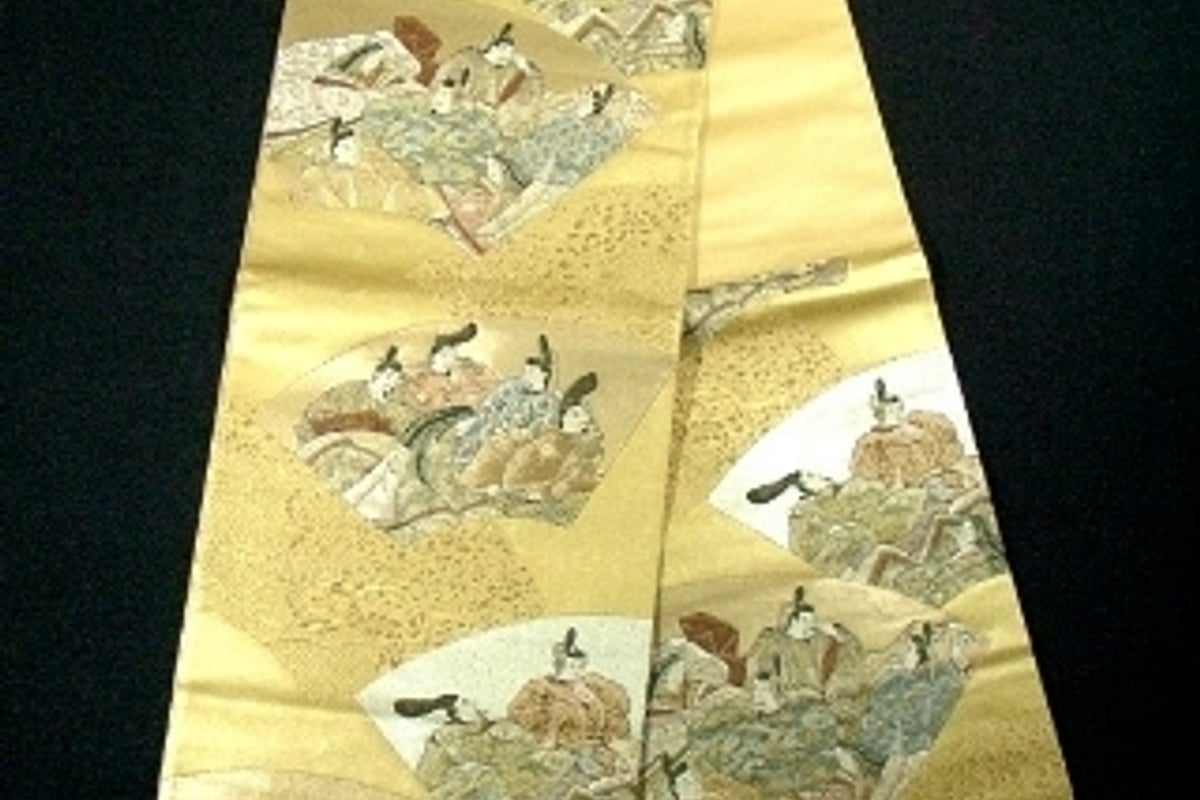
Image: Wikimedia Commons
Nishijin-ori is the general term for high-grade, yarn-dyed silk textiles produced mainly in the Nishijin district of northern Kyoto City. It is a "mon-orimono" patterned weave in which the thread is dyed before being woven into designs, and 12 techniques designated as national Traditional Crafts have been passed down, including tsumekaki-hon-tsuzureori, tateshiki, nukishiki, donsu, shuchin, and shoha. Its origins are said to trace back to weaving techniques brought from the continent around the 5th to 6th centuries, and it developed in the Heian period under the court's Oribe no Tsukasa weaving bureau. It is said to take its name "Nishijin" ("western encampment") from the fact that weavers who had fled during the Onin War later resumed weaving on the site of the Western Army's former encampment. In the Edo period it established a reputation as a luxury textile favored by feudal lords and wealthy merchants, and it continues today to support Japanese kimono culture, mainly through obi sashes. A major characteristic is that many specialized artisans are involved through a division of labor, from design creation to dyeing and weaving, maintaining a system of producing many varieties in small quantities.
Origin
The origins of Nishijin-ori are said to lie in weaving techniques brought over by groups of immigrant artisans around the 5th to 6th centuries. In the Heian period, techniques were refined under the court's Oribe no Tsukasa weaving bureau, which oversaw court textiles, laying the foundation for Kyoto's weaving industry. Artisans fled to various places during the Onin War (1467-1477), but after the war ended, they returned to the site where the Western Army's headquarters had been and resumed the weaving industry, which is said to be why the area came to be called "Nishijin" after that site.
History
In the Edo period, Nishijin-ori gained strong support from wealthy classes such as feudal lords and rich merchants, developing into a byword for luxury silk textiles. From the Meiji era onward, it underwent repeated technical innovation, incorporating Western technology such as the Jacquard loom, producing a diverse range of obi fabrics and textiles. In 1976, 12 techniques — including tsumekaki-hon-tsuzureori, tateshiki, nukishiki, donsu, shuchin, and shoha — received national Traditional Craft designation, and traditional techniques continue to be passed down today, centered on the Nishijin Textile Industry Association.
Features
The greatest characteristic of Nishijin-ori is that it is a "yarn-dyed" patterned weave, in which the thread is dyed before being woven. Its appeal lies in the rich color beauty created by using a wide variety of colored threads and the intricate patterned beauty woven precisely according to a mon-ishozu design chart. Rather than mass-producing a single item, a system of handling many varieties in small quantities is maintained, and high quality is preserved through a division of labor among specialized artisans for each process, including design, pattern-card making, dyeing, and weaving.
Techniques
Tsumekaki-hon-tsuzureori
A technique in which the weaver files their own fingernails into saw-like edges and uses them to gather the weft thread strand by strand to weave out a pattern. It requires great labor and skill, and is considered an especially advanced technique even among Nishijin-ori methods.
Mon-ishozu (pattern design)
The process of translating a design into a chart resembling graph paper, filling in each square to specify the textile's structure. For a single maru-obi sash, the chart can run to about 15 meters in length, and it serves as the blueprint for weaving.
Materials Used
Production Process
- 1
Design and pattern chart
A design representing the finished image is created and rendered into a mon-ishozu chart showing the textile's structure.
- 2
Thread dyeing
The thread is dyed in advance according to the design (yarn-dyeing).
- 3
Warping
The number and length of warp threads set on the loom are arranged.
- 4
Weaving
The loom is operated according to the mon-ishozu chart, passing the weft thread through to weave out the pattern.
| Main Production Areas |
|
|---|
Artisans & Workshops
細尾(HOSOO)
A Nishijin-ori weaving house founded in 1688. In addition to traditional obi fabric production, it is also known for new ventures leveraging Nishijin-ori techniques, such as collaborations in interior design and with luxury brands.
Official site →How to Buy
- 西陣織会館
- A facility offering exhibits of Nishijin-ori materials, live demonstrations, and product sales. Visitors can watch kimono shows and purchase obi fabric accessories.Where to buy →PR
Hands-on Experiences
西陣織会館 手織り体験
京都市上京区西堀川通元誓願寺上る竪門前町414
Reservation required, takes about 40 minutes, experience fee from around 2,200 yen (participants make small items such as coasters).
View details →