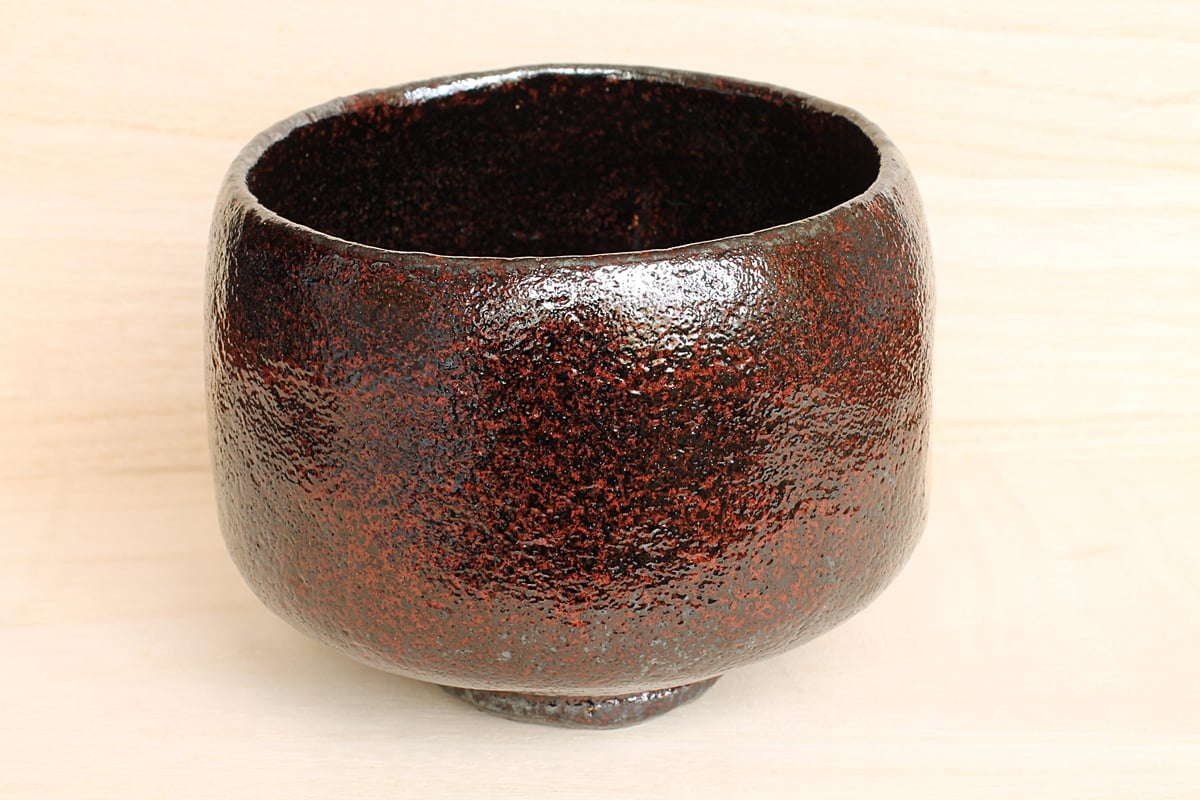
Image: Wikimedia Commons
Raku-yaki is a ceramic art originating from the hand-formed tea bowls devised in the Momoyama period by Chojiro, the first-generation head of the Raku family, embodying the wabi-cha philosophy of Sen no Rikyu, and it has been passed down in Kyoto for over 450 years. Its characteristic technique is shaping each bowl one at a time by hand and spatula alone, without a potter's wheel, then firing it at a low temperature; the unadorned, generous forms and the soft texture that seems to cradle the palm have long been loved by tea practitioners. The technical roots are said to lie in Chinese sancai (three-color) ware of the Ming dynasty, believed to have been transmitted by Ameya, an immigrant craftsman said to be Chojiro's father. The Raku family has passed the craft down from father to a single chosen heir from the first-generation Chojiro to the current sixteenth generation, with each generation's head developing a distinctively individual style — a feature not seen in other ceramic traditions. Today, alongside the mainline Raku-yaki of the Raku family, several other kilns in Kyoto also produce aka-raku and kuro-raku tea bowls modeled on this tradition.
Origin
Raku-yaki is said to have been started in the Momoyama period (late 16th century) by Chojiro, the first-generation head of the Raku family. As a tea bowl befitting the "wabi-cha" ideal of Sen no Rikyu, a new type of bowl was created, shaped using only hand and spatula without a potter's wheel. Its technical roots are said to lie in Chinese sancai ware of the Ming dynasty, believed to have been transmitted by Ameya, an immigrant craftsman said to be Chojiro's father.
History
Production of Raku tea bowls is estimated to have begun around the Tensho era (around 1579), and since then the Raku family has continued for over 450 years, passed down from father to a single chosen heir from the first-generation Chojiro to the current sixteenth generation. Each successive head has pursued their own distinctive style, and the 14th-generation head, Kichizaemon, opened the Raku Museum in 1978, making works and related materials from each generation available to the public.
Features
The greatest characteristic is the "tezukune" hand-forming technique, in which each bowl is carefully shaped using only hand and spatula without a potter's wheel; firing at a low temperature produces a soft, warm texture. The unadorned, simple forms, seen as embodying the spirit of wabi-cha, are highly valued by tea practitioners. Alongside the original "Raku-yaki" centered on works by the Raku family head, aka-raku and kuro-raku tea bowls made by kilns modeled on this tradition are also widely enjoyed.
Techniques
Tezukune hand-forming
A technique of shaping clay using only hand and spatula, without a potter's wheel. It produces warm forms in which each bowl has its own distinct character.
Firing
A technique of firing one bowl at a time in the kiln. The firing method differs by color: aka-raku is fired at a relatively low temperature, while kuro-raku is fired at high temperature and then rapidly cooled.
Materials Used
Artisans & Workshops
樂家
The head family of Raku-yaki, continuing from the first-generation Chojiro to the sixteenth generation, passed down from father to a single chosen heir. Works and related materials from each generation are displayed at the adjoining Raku Museum.
Official site →楽入窯(吉村楽入)
One of the Kyo-yaki / Kiyomizu-yaki kilns, specializing in Raku-yaki including kuro-raku and aka-raku tea bowls, and handling everything from tea utensils to tableware.
Official site →How to Buy
- 宇野商店
- A tea-utensil shop founded in 1900, located in Gion, Higashiyama Ward, Kyoto City. It displays and sells tea utensils and art crafts centered on Raku tea bowls.Where to buy →PR
Hands-on Experiences
樂美術館
京都市上京区油小路通一条下る
Displays Raku tea bowls and tea-ceremony art crafts by successive generations of the Raku family. Open 10:00-16:30 (last entry 16:00), admission from around 900 yen for general visitors depending on the exhibition, closed Mondays (open if a public holiday).
View details →