Image: Wikimedia Commons
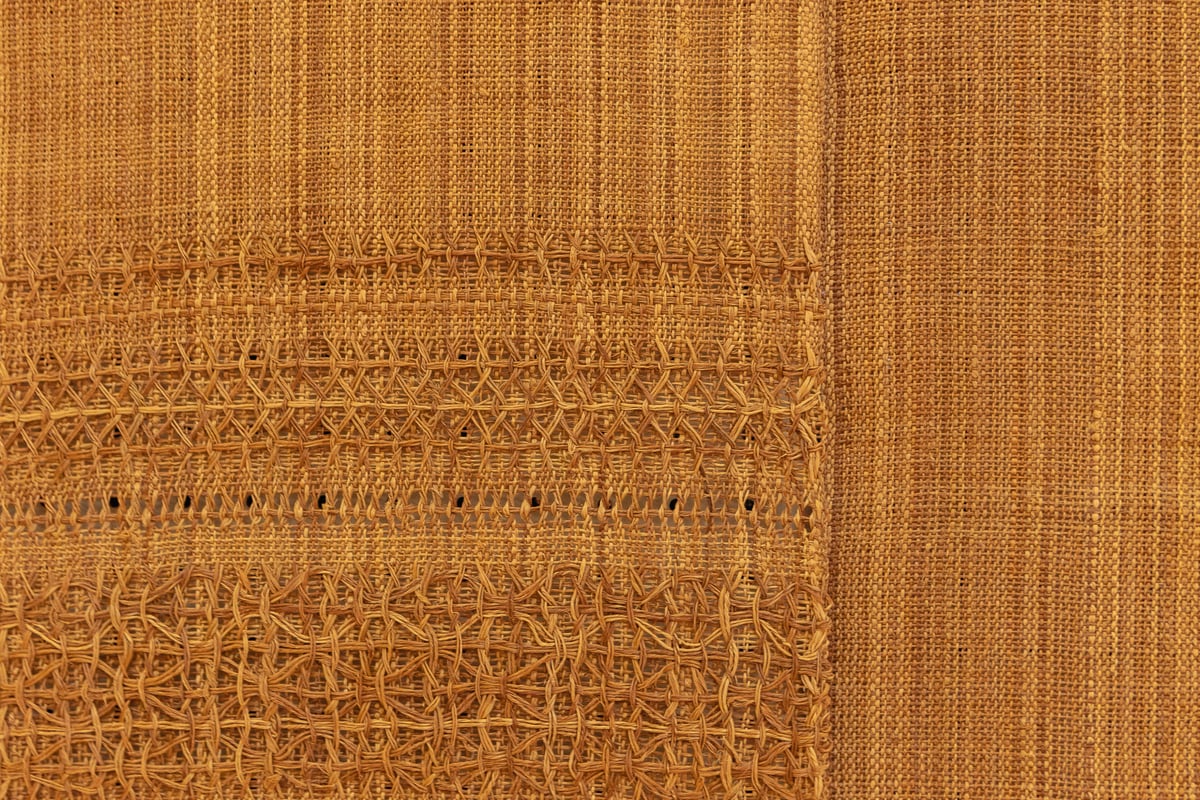
Uetsu Shinafu is a cloth handed down in the Sekigawa district of Tsuruoka City, Yamagata Prefecture, and the Yamakumada and Kaminari districts of Murakami City, Niigata Prefecture, made by spinning thread from the bark fibers of trees such as the Japanese linden and the giant-leaved linden and weaving it into cloth. As a textile made from tree bark, it is considered the oldest of its kind in Japan, and as one of the 'primitive cloths' said to date back to the Jomon period, it is counted among Japan's three great ancient cloths, alongside Okinawa's bashofu (banana-fiber cloth) and Shizuoka's kuzufu (kudzu-fiber cloth). Every step, from thread-making to weaving, is done entirely by hand, and the cloth takes about a year to complete through roughly 22 processes. It is durable and water-resistant, and grows more supple in texture the more it is used. It was once used for work clothes, rice sacks, and fishing nets, but today it lives on in the form of hats, bags, obi sashes, and other items. In 2005, the shina cloth of the three production areas spanning Yamagata and Niigata was designated a Traditional Craft Designated by the Minister of Economy, Trade and Industry under the name 'Uetsu Shinafu.'
Origin
The history of textiles using the fibers of the shina tree is long, and it is said the technique was already in use during the Jomon period. In mountain settlements such as the Sekigawa district of Tsuruoka City, Yamagata Prefecture, and the Yamakumada and Kaminari districts of Murakami City, Niigata Prefecture, the technique of extracting fiber from the bark of the Japanese linden and giant-leaved linden, spinning it into thread, and weaving it into cloth has been passed down since ancient times. It was once prized as a practical cloth supporting daily life in mountain villages, used for work clothes, rice sacks, fishing nets, and cloth for straining sake.
History
Shina cloth was once woven in mountain villages across the region as a durable, everyday cloth indispensable to daily life, used for work clothes, rice sacks, fishing nets, and straining cloth. The technique handed down in the three districts of Sekigawa, Yamakumada, and Kaminari is valued as one of Japan's three great ancient cloths. In 2005, it was designated a national Traditional Craft under the name 'Uetsu Shinafu,' recognizing it as a textile of a production area spanning Yamagata and Niigata prefectures.
Features
The defining characteristic of Uetsu Shinafu is that every step is done entirely by hand, from peeling the bark of trees such as the Japanese linden to extract the fiber, to spinning it into thread and weaving it into cloth. The process involves around 22 steps and takes about a year to complete. The finished cloth has a rustic, coarse texture, is durable and water-resistant, and becomes more supple in texture the more it is used. Today it has also taken the form of products such as hats, bags, and obi sashes, drawing attention nationwide.
Materials Used
Production Process
- 1
Peeling the bark
The bark of trees such as the Japanese linden, cut in the mountains, is peeled off.
- 2
Fermenting and refining
The bark is boiled and fermented, and the inner bast fiber is extracted.
- 3
Spinning the thread
The extracted fiber is split into fine strands and twisted together by hand into a single thread.
- 4
Weaving
The spun shina thread is set on a loom and woven into cloth.
| Main Production Areas |
|
|---|
How to Buy
- 関川しな織センター
- Displays and sells shina cloth bolts, hats, bags, and other products. Visitors can also watch the weaving and processing work up close.Where to buy →PR
Hands-on Experiences
関川しな織センター
山形県鶴岡市関川字関川222
In addition to displaying and selling shina weaving products and offering a look at the production process, the center also runs a coaster-making experience (1,100 yen per coaster, about 20 minutes, reservation required).
View details →さんぽく生業の里
新潟県村上市山熊田325
A facility set up by volunteers from the Yamakumada settlement and the Sanpoku district as a base for making use of local resources centered on shina weaving. Visitors can watch shina weaving and try it themselves (from about 1,300 yen per person). Hands-on activities and meals require a group of 5 or more and a reservation at least 3 days in advance.
View details →