 Image: Wikimedia Commons
Yamagata Prefecture
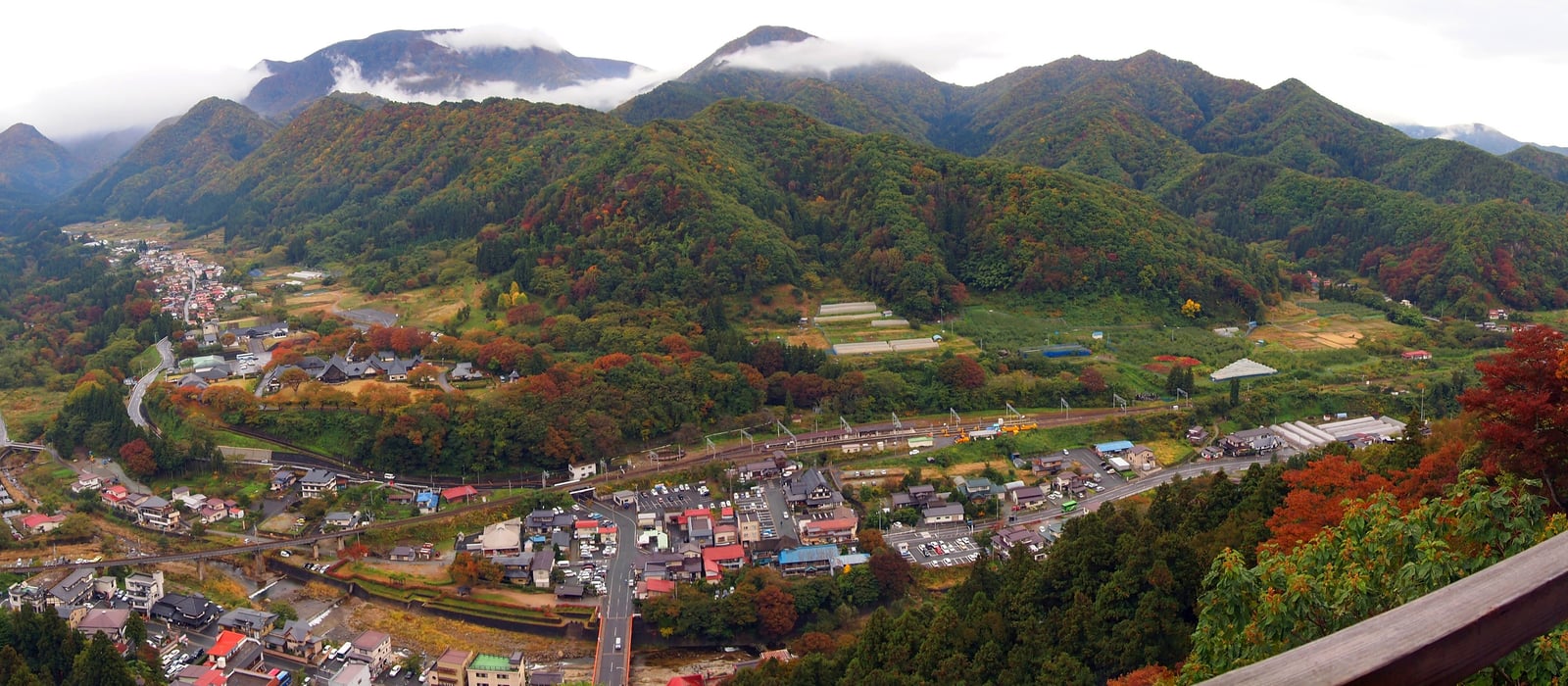
Cradled by the Three Mountains of Dewa, the Zao mountain range, and the Mogami River, Yamagata Prefecture is home to a rich variety of craftsmanship and food culture shaped by the distinct climates of its four regions: Murayama, Mogami, Oitama, and Shonai. The prefecture boasts five Traditional Crafts Designated by the Minister of Economy, Trade and Industry, including Tendo Shogi Goma, which accounts for about 95% of Japan's shogi piece production nationwide, Oitama Tsumugi, which traces its roots to Uesugi Yozan's industrial promotion policies, and Yamagata Imono, cast metalwork with roughly 900 years of history. Sakata, a former Kitamae-bune trading ship port, is also home to distinctive crafts such as Funadansu sea chests and Shonai Sashiko embroidery. In food, Yamagata carries on regionally distinctive local dishes such as Imoni, beloved as the star of the autumn 'Imoni-kai' gatherings, Yonezawa Beef, one of Japan's Three Great Wagyu Brands, and Tama Konnyaku served on skewers. In summer, the Yamagata Hanagasa Festival draws visitors from within and beyond the prefecture.
Yamagata's Traditional Crafts

Oitama Tsumugi
Oitama Tsumugi
Oitama Tsumugi is the collective name for tsumugi silk textiles woven in the Oitama region of southern Yamagata Prefecture (Yonezawa City, Nagai City, and Shirataka Town in Nishiokitama District). It traces its origins to Uesugi Yozan, lord of the Yonezawa domain, who encouraged the weaving industry as part of a policy to promote local industry and rebuild the domain's finances. From this beginning, three production areas -- Yonezawa Tsumugi, Nagai Tsumugi, and Shirataka Tsumugi -- each developed their own distinctive techniques. Yonezawa Tsumugi is known for the beauty of its dyeing with safflower (benibana) and other plant dyes; Nagai Tsumugi for the intricate patterns of its weft ikat and combined warp-and-weft ikat weaves; and Shirataka Tsumugi for the delicate small ikat patterns created by 'itajime-gasuri' (board-clamp ikat dyeing), a technique passed down only among weavers in Shirataka Town nationwide. In 1976 (Showa 51), the tsumugi of these three production areas were jointly designated a Traditional Craft Designated by the Minister of Economy, Trade and Industry under the unified name 'Oitama Tsumugi.' Its rustic, warm texture and the handcrafted beauty of its ikat patterns continue to attract many kimono enthusiasts.
Yamagata Imono (Yamagata Cast Metalwork)
Yamagata Imono
Yamagata Imono is a metal-casting craft centered on Yamagata City with a history of roughly 900 years. It is said to have begun in the late Heian period, during the Kohei era (mid-11th century), when foundry craftsmen who had accompanied Minamoto no Yoriyoshi's military campaign discovered that the sand and soil along the Mamigasaki River were well suited to mold-making, and settled in the area. In the Edo period, when Mogami Yoshiaki laid out the castle town, he established a foundry workers' quarter (present-day Dōmachi) where he gathered craftsmen together, laying the foundation for the area as a production center. In contrast to the heavy, decorative style of Nanbu ironware, Yamagata Imono is characterized by a simple beauty that makes the most of its thin-walled, delicate cast surface, and is used to make everything from everyday items such as tea-ceremony kettles, iron kettles (tetsubin), and vases to temple bells and stone lanterns. In 1975 (Showa 50), it was designated a Traditional Craft Designated by the Minister of Economy, Trade and Industry. In recent years, in addition to iron kettles and wind chimes, makers have also been developing new products such as interior goods suited to modern life.
Tendo Shogi Goma (Tendo Shogi Pieces)
Tendo Shogi Goma
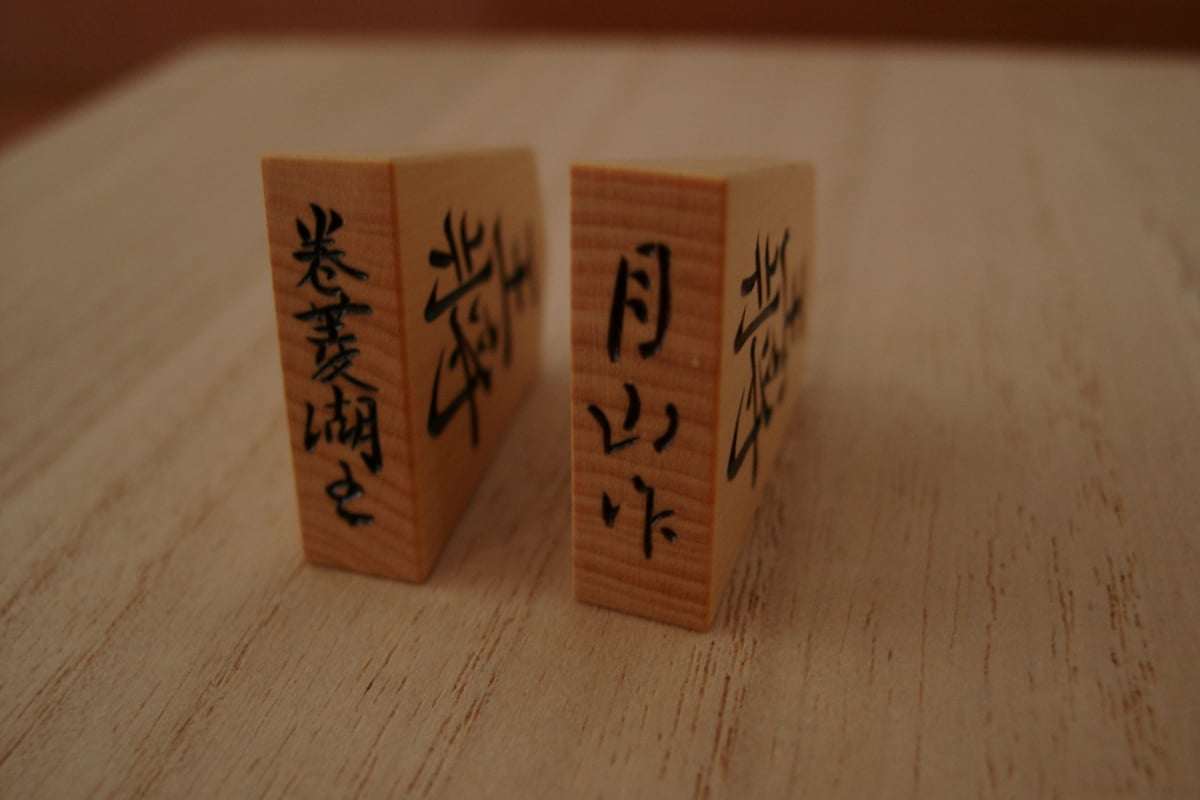
Tendo Shogi Goma are shogi (Japanese chess) pieces made mainly in Tendo City, Yamagata Prefecture, said to account for roughly 95% of national production. Their origins trace back to the late Edo period, when the financially struggling Tendo Oda domain encouraged lower-ranking samurai to make shogi pieces as a side occupation. The domain learned techniques from piece-makers in Osaka by way of the Yonezawa domain, and by the end of the Edo period the foundations of 'kaki-goma' (written pieces), made using cursive script, had been established. From the Meiji era onward, a division-of-labor system took shape and the area developed into a mass-production center, coming to boast the nation's largest output by the early Showa era. The raw material is boxwood (tsuge) from Mikurajima Island in the Izu Islands, sometimes called 'a jewel among woods,' and the pieces come in four types: kaki-goma (written), hori-goma (carved), horiume-goma (carved and lacquer-filled), and moriage-goma (raised-lacquer). Among these, moriage-goma, in which the characters are raised in lacquer, are considered the finest grade and are used even in shogi title matches. In 1996, the craft was designated a Traditional Craft Designated by the Minister of Economy, Trade and Industry.
Uetsu Shinafu (bark-fiber cloth)
Uetsu Shinafu
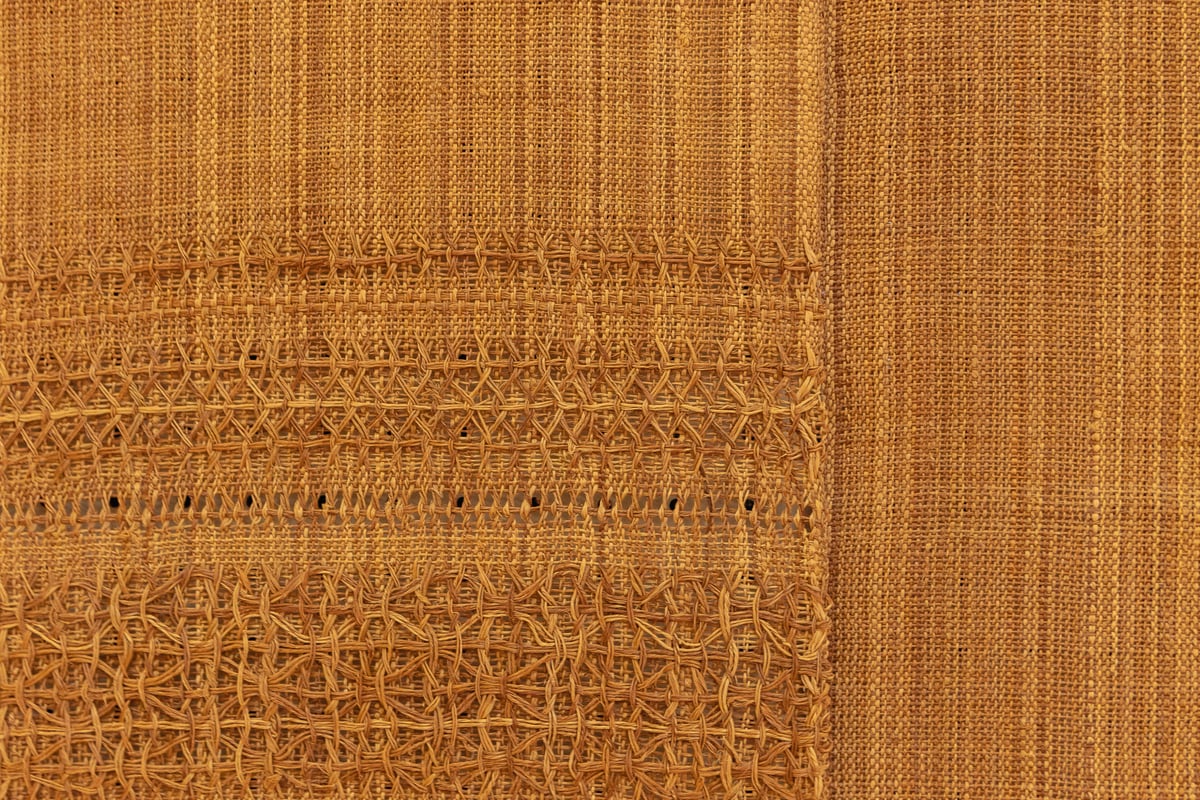
Uetsu Shinafu is a cloth handed down in the Sekigawa district of Tsuruoka City, Yamagata Prefecture, and the Yamakumada and Kaminari districts of Murakami City, Niigata Prefecture, made by spinning thread from the bark fibers of trees such as the Japanese linden and the giant-leaved linden and weaving it into cloth. As a textile made from tree bark, it is considered the oldest of its kind in Japan, and as one of the 'primitive cloths' said to date back to the Jomon period, it is counted among Japan's three great ancient cloths, alongside Okinawa's bashofu (banana-fiber cloth) and Shizuoka's kuzufu (kudzu-fiber cloth). Every step, from thread-making to weaving, is done entirely by hand, and the cloth takes about a year to complete through roughly 22 processes. It is durable and water-resistant, and grows more supple in texture the more it is used. It was once used for work clothes, rice sacks, and fishing nets, but today it lives on in the form of hats, bags, obi sashes, and other items. In 2005, the shina cloth of the three production areas spanning Yamagata and Niigata was designated a Traditional Craft Designated by the Minister of Economy, Trade and Industry under the name 'Uetsu Shinafu.'
Yamagata Butsudan (Buddhist altar)
Yamagata Butsudan
Yamagata Butsudan is a Buddhist altar made through a division of labor centered on Yamagata City, in which seven specialized crafts - woodworking, palace-shrine work, carving, lacquering, maki-e (gold lacquer decoration), metal fittings, and gold-leaf application - are each handled by their own specialist artisans. Its origin is said to date to the Kyoho era (around 1724-1736), when Hoshino Kichibei, who had studied the art of carving in Asakusa, Edo, returned to Yamagata and began making ranma (transom panels) and Buddhist ritual implements. His successor, the second-generation Kichibei Hirotaka, gathered local artisans and put altar-making on a full-scale footing, and the arrival of superior techniques and culture from the Kansai region via shipping on the Mogami River also helped spur the development of the production area. Around 1895, a production system divided among seven specialized trades was established, and the craft has continued to develop as Japan's northernmost Buddhist altar-producing region, being designated a Traditional Craft Designated by the Minister of Economy, Trade and Industry in 1980. It is characterized by sturdy wood joinery using zelkova and other woods, deep and intricate carving, and understated black metal fittings and inlaid-gold fittings.
Hirashimizu-yaki (Hirashimizu ware)
Hirashimizu-yaki
Hirashimizu-yaki is pottery and porcelain fired in the village of Hirashimizu, on the southern foot of Mt. Chitose in the southeast of Yamagata City. Because its raw material is pottery stone rich in iron taken from Mt. Chitose, it is also known as 'Chitose-yaki.' Its founder is said to be the potter Ono Tojihei, who came from Hitachi Province during the Bunka era (1804-1818) of the late Edo period. In the following Bunsei era, a potter from the Soma domain opened a kiln here and brought the techniques of Soma-yaki, helping the area grow into a major pottery-producing community. At its peak in the mid-Meiji era, more than 30 kilns lined the village, but today only a handful remain, including Seiryu-gama and Shichiemon-gama. It is a rare production area where clay suitable for both pottery and porcelain can be found, and each kiln has its own distinctive glazes and techniques. Distinctive pieces are produced here, including 'Nashi-seiji,' with its blue-white speckles created by iron sulfide in the raw clay of Mt. Chitose, and 'Zansetsu,' featuring black speckles floating on a pure white glaze.
Miyama Washi
Miyama Washi
Miyama Washi is handmade paper passed down in the Miyama district of Shirataka Town, Yamagata Prefecture, made from locally grown kozo (paper mulberry). Its origins are said to date back around 400 years, and it was long known for its high quality, even being used as official paper for the Uesugi domain in the capital city of Kyoto; it has been handed down for generations as a household industry in a mountain village that endures long, harsh winters. During the Edo period, Yonezawa domain lord Uesugi Yozan encouraged the cultivation of kozo as part of his fiscal reform policies, and many villagers took up papermaking as an off-season occupation. The paper has a distinctive, warm texture and is used for letter paper, torn-paper collage art, washi dolls, and even as a material for wedding dresses. It was designated an Intangible Cultural Property of Yamagata Prefecture in 1978, and the Miyama Washi Promotion and Research Center now serves as a base for passing on the technique and offering papermaking experiences.
Yamagata Uchihamono (forged blades)
Yamagata Uchihamono
Yamagata Uchihamono refers to forged bladed tools whose blacksmithing techniques have been passed down mainly in Yamagata City. Its origins are said to trace back to 1356, during the Nanboku-cho period, when Shiba Kaneyori, the founding ancestor of the Mogami clan, brought blacksmiths with him when he entered Yamagata; they formed a blacksmithing settlement and made weapons and farming tools. During the Edo period, Yamagata domain lord Mogami Yoshiaki established a blacksmiths' district in the castle town and gave preferential treatment to smiths, and the craft was refined under the patronage of successive lords. In the late Edo period, the district produced the renowned swordsmith Shoji Naotane, and from the Meiji era onward, as demand for swords declined, the focus shifted to blades rooted in daily life, such as kitchen knives, sickles, scissors, and hoes. The technique known as 'jiyu-tanren' (freehand forging), in which soft iron and hard steel are joined by fire-forging and carefully hammered together, is still practiced today, and the resulting blades are prized for combining sharpness with toughness.
Shonai Sashiko
Shonai Sashiko
Shonai Sashiko is a traditional sashiko craft passed down in the Shonai region, centered on Sakata City, and is counted as one of Japan's Three Great Sashiko traditions, alongside Aomori Prefecture's Kogin-zashi and Nanbu Hishizashi. The Shonai region's economy centered on rice farming, which was not suited to growing cotton, so producing clothing locally had its limits. It is said to have begun in the mid-Edo period, when used clothing and cloth brought in from Kyoto and Osaka through the trade of Kitamae-bune (trading ships) were layered together and stitched, regardless of the fabric's grain, to make sturdy work clothes. Fine stitches of white cotton thread were sewn into indigo-dyed cotton cloth to improve warmth and durability, while also carrying the meaning of warding off evil. There are around 40 basic stitch patterns, such as 'kome-zashi' (rice stitch), 'uroko-zashi' (scale stitch), and 'hishi-zashi' (diamond stitch), and the geometric designs are notable for expressing wishes such as bountiful harvests, big catches of fish, and family health. In 1983 (Showa 58), enthusiasts formed the 'Hirata Sashiko no Kai' to pass on the techniques.
Sakata Funadansu
Sakata Funadansu
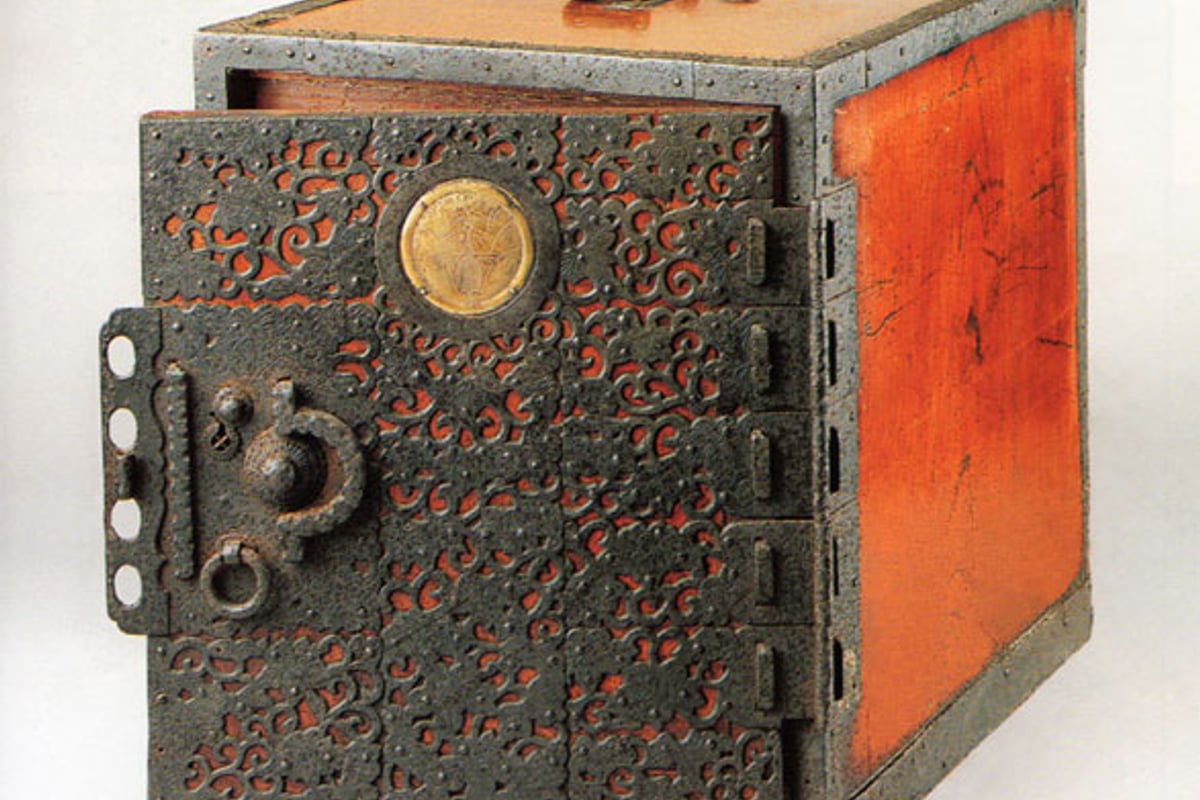
Sakata Funadansu are sturdy chests that sailors on Kitamae-bune (trading ships) had made to store valuables aboard ship, from the Edo period through the Taisho era. Sakata is counted as one of the three great production centers for funadansu (ship chests), alongside Ogi in Sado and Mikuni in Fukui Prefecture. Under a form of shipping business known as 'kaizumi,' in which ships bought and sold goods along the Sea of Japan coast, a distinctive style of funadansu-making developed in Sakata, one of the trade's port towns. The chests have a double-layer structure, using sturdy zelkova wood and highly decorative iron fittings on the outside, and paulownia wood on the inside, which swells in high humidity to keep water out. They were built small so they could be carried out quickly in the event of fire or shipwreck, and different styles were made for different uses, such as kakesuzuri (hanging writing boxes), chobako (ledger boxes), and hanbitsu (half-size chests). Master craftsmen such as Saito Josai appeared during the Edo period, but today there is a shortage of artisans skilled in decorative metal fittings and lacquering, making the transmission of the craft a challenge.
Yamagata's Local Food
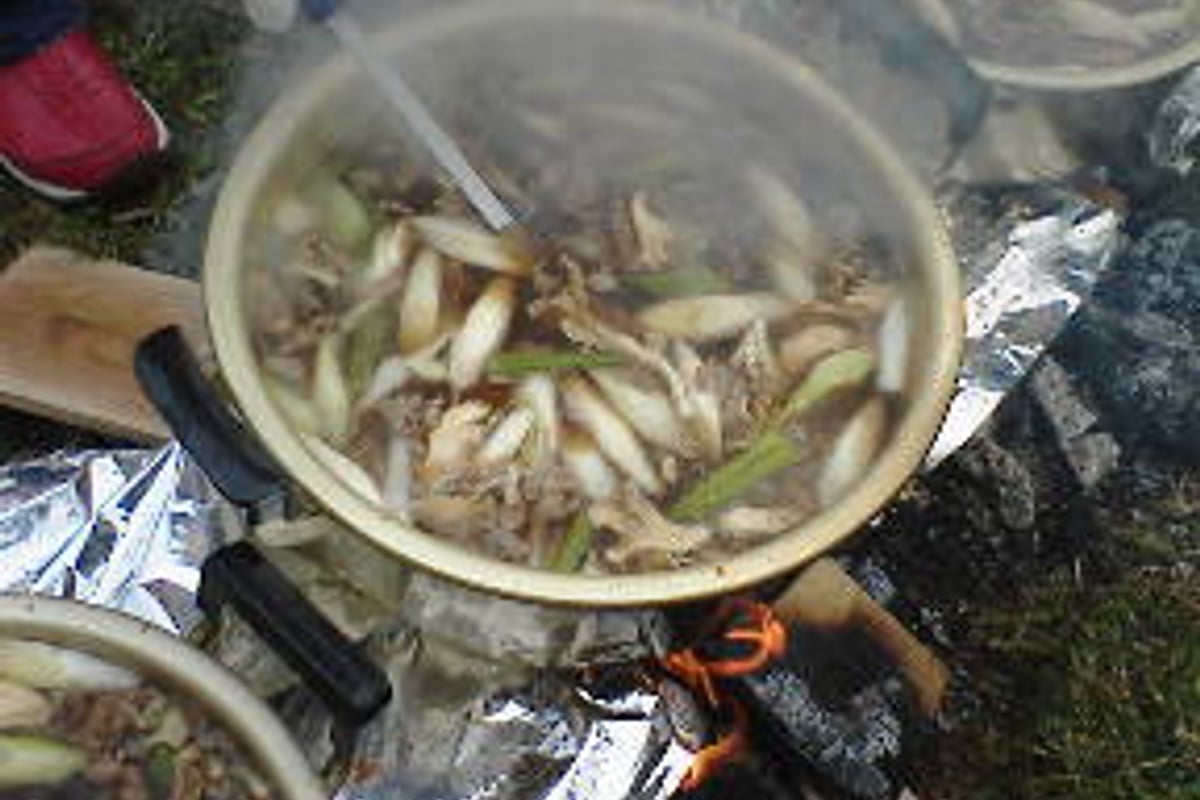
Imoni (Taro Hot Pot)
Imoni
Imoni is a hot pot dish centered on taro grown in Yamagata Prefecture, and every autumn, groups of friends and family gather on riverbanks with pots and firewood for 'Imoni-kai' (communal Imoni-cooking gatherings), a beloved seasonal tradition across the prefecture. Its origins are said to trace back to the Edo-period river trade on the Mogami River, when boatmen around Nakayama Town — an area known for taro production — simmered dried cod from their cargo together with local taro. Seasonings and ingredients vary widely by region: in the inland Murayama region, a sweet-savory beef-and-soy-sauce style is standard, while the Shonai region uses pork and miso, adding mushrooms and deep-fried tofu for a hearty broth. The Mogami region adds wild mountain vegetables and mushrooms, and the Oitama region adds cotton tofu with a hidden touch of miso — each region offering its own distinctive take on the same dish. Every September, the 'Japan's Best Imoni-kai Festival' is held on the banks of the Mamigasaki River in Yamagata City, where about 30,000 servings are prepared in a giant pot 6 meters in diameter.
Dongara-jiru (Winter Cod Miso Soup)
Dongara-jiru (Kandara-jiru)
Dongara-jiru is a winter specialty of the Shonai region in Yamagata Prefecture — a hearty miso-based hot pot made from Pacific cod that gather along the coast to spawn, known locally as 'kandara' (winter cod). Almost the entire fish is used, not just the flesh but also the organs, milt, skin, and bones. The word 'dongara' refers to fish bones and offal, and the name is said to derive from using the flesh and bones without waste. The dish is said to have originated as a fisherman's meal that Shonai fishermen ate on board their boats or on the beach to ward off the cold, and its defining feature is a rich, deep flavor created by dissolving the fatty cod liver into the broth. Winter cod weighing 4 kg or more, caught during the 'kan' (coldest) season from early January to early February, is considered the most delicious, and during this period Tsuruoka City and Sakata City hold 'Kandara Matsuri' (winter cod festivals) where dongara-jiru is served from large pots. Traditionally, green onion is not added, and the authentic way to finish the dish is by topping it with rock nori.
Nattojiru (Natto Soup)
Nattojiru
Nattojiru is a winter dish passed down mainly in the inland areas of Yamagata Prefecture — a soup in which natto (fermented soybeans), ground in a mortar until the beans are no longer visible, is stirred into a hearty miso soup to give it a thick, silky texture. In snowy Yamagata, it was customary to make homemade natto as a preserved winter food, and the dish is said to have originated as a way to use natto whose stickiness had weakened. For inland residents who had few opportunities to eat animal protein, it was a dish that supplemented protein through soybean-based natto and tofu. It has long been cherished as a nutritionally excellent dish, since adding imogara (dried taro stem), a preserved food, along with mushrooms, wild mountain vegetables, and konnyaku also provides vitamins and dietary fiber. The timing of when it is eaten varies by region: it is customary to eat it around the Nanakusa festival on January 7 in the Murayama region, at New Year's in the Mogami region, and on Daikoku-sama's Otoshiya (a year-end-eve tradition, in December) in the Shonai region. Because it takes considerable effort to prepare, fewer households make it from scratch today, but it is still passed down at inns, restaurants, and school lunches.
Omizuke (Chopped Vegetable Pickle)
Omizuke
Omizuke is a pickle made mainly in Yonezawa City, Yamagata Prefecture. It is an everyday side dish made by finely chopping Yamagata seiritsu greens (Yamagata mustard greens) — the prefecture's signature leafy green — together with vegetables such as daikon radish and carrot, and salt-pickling them. Yamagata seiritsu greens are a variety brought from Chongqing, China in 1904; full-scale cultivation in Yamagata Prefecture began in 1908 and spread across the entire prefecture from the Taisho into the Showa era. Several theories exist about the origin of the name, but the most widely accepted one involves a merchant from Omi. While the thick stalks of pickled Yamagata greens were prized, the leaf tips tended to be left over, and this merchant is said to have chopped up the leftover tips to make a pickle called 'Omi-zuke,' which is said to have become 'Omizuke.' Another theory holds that the name comes from 'momi-zuke' (kneaded pickle), referring to the way the chopped vegetables are kneaded before pickling. Eaten even in the season before pickled greens come into store, Omizuke is a local flavor born from the wisdom of using up precious winter vegetables without waste, and it continues to be made in homes and pickle shops today.
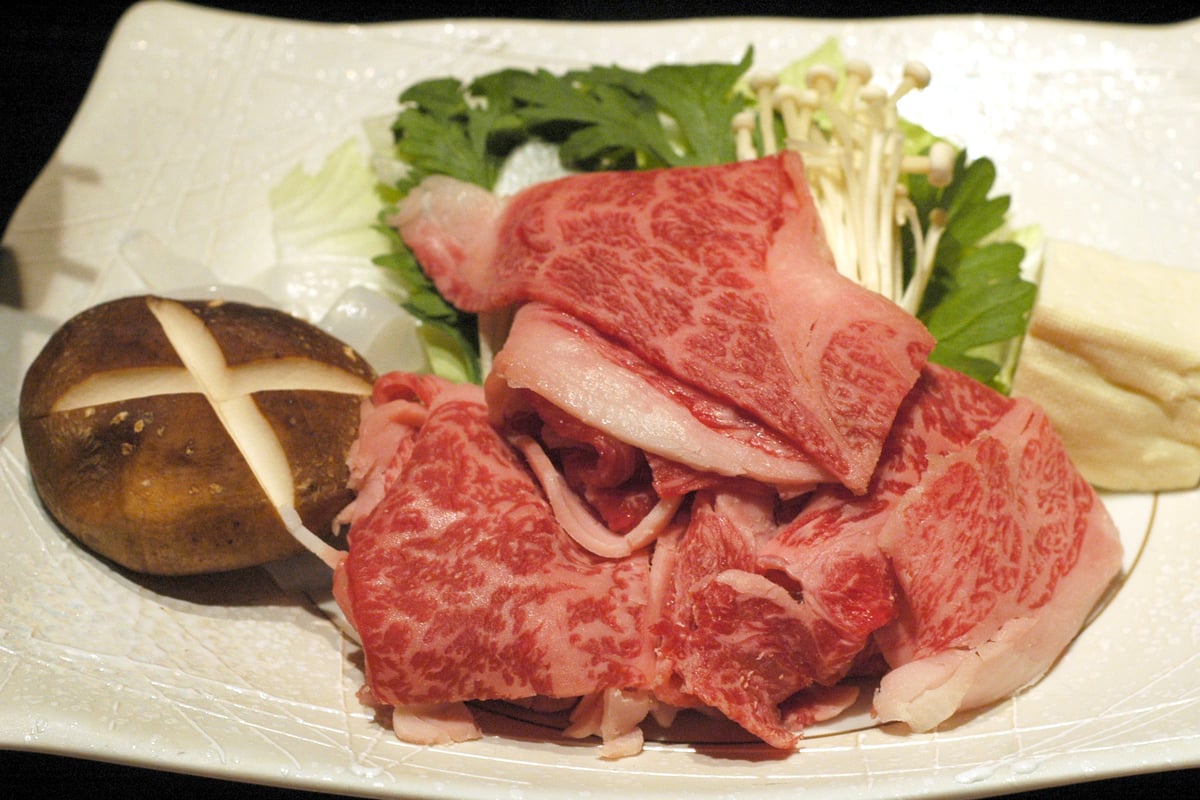
Yonezawa Beef
Yonezawa Beef
Yonezawa Beef is a branded beef of Japanese Black cattle (Kuroge Washu) raised in the Oitama region of Yamagata Prefecture. It is ranked alongside Matsusaka beef and Kobe beef as one of Japan's Three Great Wagyu Brands, and is known as the only one of the three found in eastern Japan. Its history is said to begin in 1871 (Meiji 4), when Charles Henry Dallas, an Englishman invited to Yonezawa as a teacher at the domain school Kojokan, ate local beef out of nostalgia for his homeland. When Dallas completed his term in 1875, he brought one head of Yonezawa cattle back with him to the foreign settlement in Yokohama and served it to his acquaintances, whose favorable reaction made the beef's flavor a topic of conversation. Winning acclaim in Yokohama, a major beef-consuming city at the time, led Dallas to broker a connection between Yonezawa livestock dealers and Yokohama wholesalers, and the beef began to be sold under the name 'Yonezawa Beef.' This marked the start of its reputation spreading nationwide by a route different from that of Matsusaka beef and Kobe beef. Today, the Yonezawa Beef Brand Promotion Council certifies as 'Yonezawa Beef' only meat from nulliparous female Japanese Black cattle that are raised in the Oitama region, shipped at 33 months of age or older, and graded 3 or higher for meat quality, among other standards.
Koi no Umani (Simmered Carp)
Koi no Umani
Koi no Umani is a local dish from the Oitama region of inland Yamagata Prefecture, centered on Yonezawa City, in which carp is sliced into rounds and simmered until sweet and savory in soy sauce, sugar, and sake. In the inland Oitama region, far from the sea and short on seafood, freshwater carp has long served as a valuable source of protein. It is said that the foundation of this food culture, which continues today, was laid in the late Edo period when Uesugi Yozan, the 9th lord of the Yonezawa Domain, encouraged carp farming. After the Russo-Japanese War, sugar became easier to obtain, and the sweet-savory seasoning used today is said to have taken hold from that time. The carp is simmered until even the bones turn soft, and aside from the gallbladder, virtually the whole fish, from head to tail, can be eaten. It is an essential dish for celebratory occasions such as New Year, Obon, and weddings, prized as a lucky food because the Japanese word for carp, 'koi,' echoes the word 'koi,' meaning 'come.' Even today, 'Yonezawa Koi' carp raised around Yonezawa City is protected as a regional brand alongside Yonezawa beef and Tateyama apples.
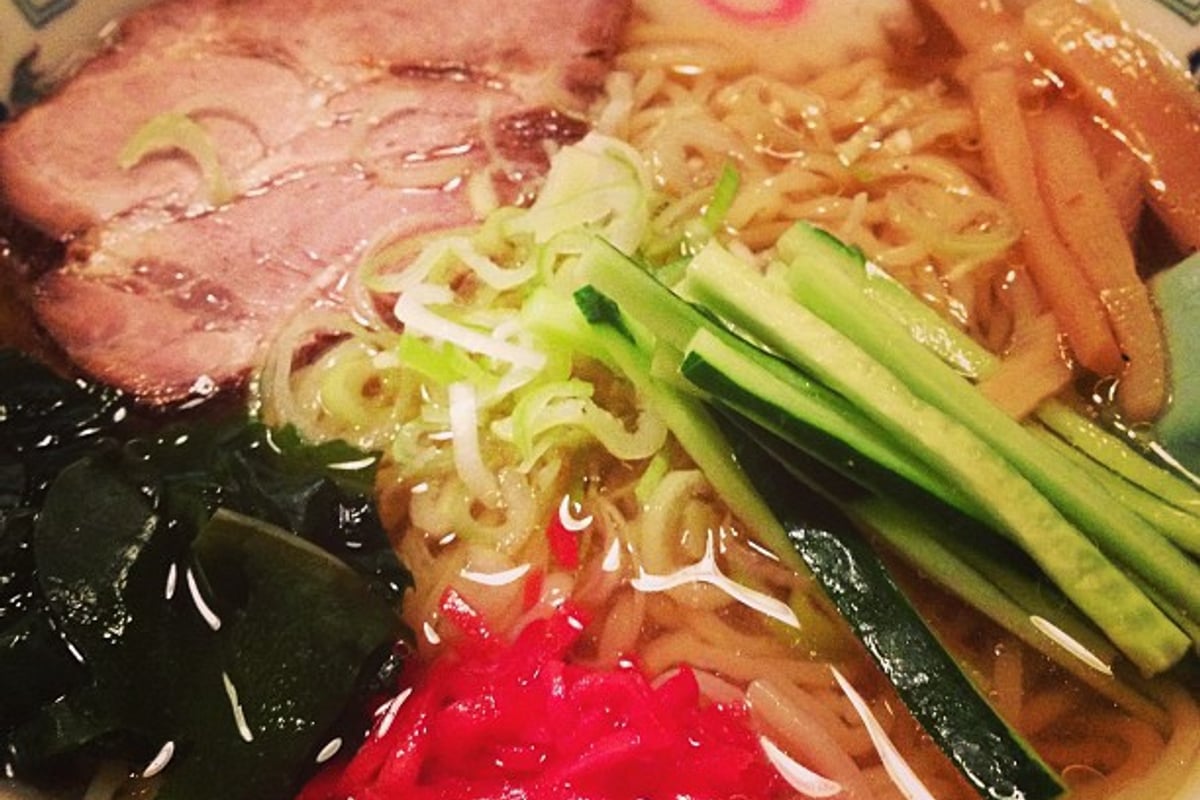
Yamagata Hiyashi Ramen (Cold Ramen)
Yamagata Hiyashi Ramen (Cold Ramen)
Yamagata Hiyashi Ramen, said to have originated in Yamagata City, is Chinese-style noodles served in a chilled soup with cooled Chinese-style noodles. Around 1952, a regular customer at 'Sakaeya Honten,' a Chinese noodle shop in Yamagata City, reportedly asked, 'If cold soba exists, why can't there be cold Chinese noodles?' The dish is said to have originated when the shop's first-generation owner, Abe Senshiro, devised it through trial and error in response. The dish pairs a soup chilled with floating ice and other methods with springy, medium-thick noodles and toppings, and has become a beloved summer staple both within and beyond the prefecture. Today, in addition to Sakaeya Honten, many ramen shops in and around Yamagata City serve their own versions of cold ramen, and it is known as one of Yamagata's representative local dishes.
Kujira Mochi
Kujira Mochi
Kujira Mochi is a local confection from Shinjo City and the Mogami region, made by mixing non-glutinous or glutinous rice flour with sugar, walnuts, and other ingredients, pouring the mixture into a mold, and steaming it into a flat, elongated rice cake. Despite its name, which literally means 'whale mochi,' it contains no whale meat at all. Several theories exist about the origin of the name, including that it comes from 'hisashiku mochi ga yoi' ('keeps well for a long time'), rendered as 'kujira' (久持良); that the large size once made from a sho (about 1.8 liters) of rice was likened to a whale; and that its appearance resembles salted whale meat. It is said to have originated in the Edo period during the time of Tozawa Masatsune, the 3rd lord of the Shinjo Domain, when it was used as military provisions, and it has been passed down in households alongside the custom of offering it as a Hina confection for the old-calendar Peach Festival (April 3). Today it is a signature Shinjo souvenir made and sold by confectionery shops in Shinjo City.
Sasamaki (bamboo-leaf wrapped mochi rice)
Sasamaki
Sasamaki is a local dish of Yamagata Prefecture in which glutinous rice soaked in water is wrapped in sasa (bamboo-grass) leaves into a triangular or bale shape, tied with a cord such as rush grass, and boiled in hot water — it corresponds to what other prefectures call 'chimaki.' It has traditionally been made in each household for the Boys' Festival (Tango no Sekku, the fifth day of the fifth lunar month) to pray for children's healthy growth. Sasa leaves are said to have antiseptic and antibacterial properties and have long been valued as a wrapping material for preserved and portable food. The way it is wrapped varies by region: it is shaped into a cone in the Mogami region and into a fist shape in the Oitama region, while the southern part of Tsuruoka City has its own distinctive method of boiling it in lye water (aku-mizu). To eat it, the sasa leaves are untied and the rice cake is topped with roasted soybean flour (kinako) and black sugar syrup (or sugar).
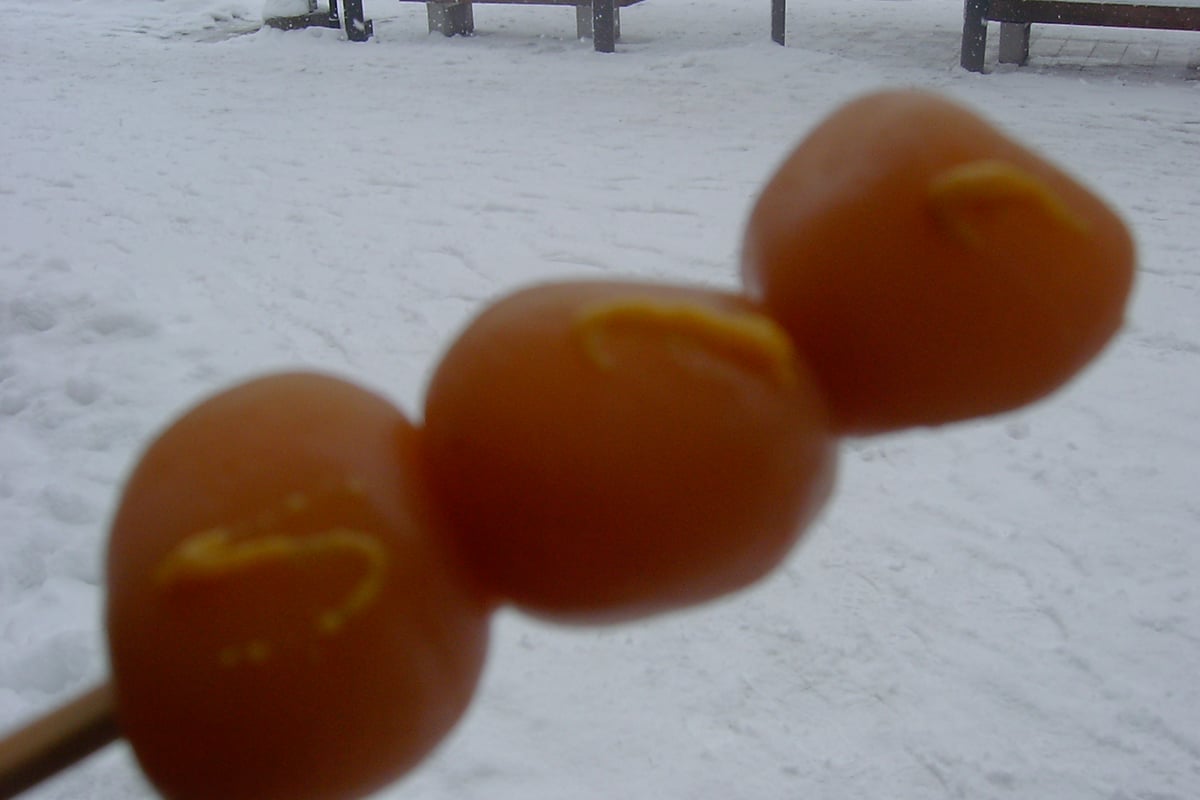
Tama Konnyaku (skewered konjac balls)
Tama Konnyaku
Tama konnyaku is a local specialty said to be a soul food for the people of Yamagata Prefecture: konjac rolled into balls about 3 cm in diameter, skewered, and simmered slowly in a soy-sauce-based broth. It is said to have originated when Jikaku Daishi, who founded Yamadera (Risshaku-ji Temple) in the Heian period, used konjac he had brought back from China in the temple's shojin (Buddhist vegetarian) cuisine; the practice later spread to nearby residents and took root throughout the prefecture. Flat konjac and shirataki (thread-like) konjac are found all over Japan, but the style of skewering it into balls and eating it while walking — 'tama konnyaku' — is a food culture unique to Yamagata. It is a beloved street-food staple at festivals, tourist spots, and cherry-blossom-viewing stalls, and it is typically eaten with a dab of hot mustard (neri-garashi).
Model Course
A Course of Shogi Pieces, Cast Metalwork, and Imoni in Tendo and Yamagata City
Enjoy a hands-on session writing characters on shogi pieces at a specialty shop for Tendo Shogi Goma, which accounts for about 95% of Japan's shogi piece production, then visit a workshop for Yamagata Imono, cast metalwork with roughly 900 years of history, before comparing the different regional styles of Imoni — such as those from Murayama and Shonai — at a local restaurant in Yamagata City. A day course exploring the craftsmanship and flavors of the Murayama region.
A Course to Savor Tsumugi Weaving and Yonezawa Beef in Yonezawa
Visit a weaving workshop for Oitama Tsumugi, which traces its roots to Uesugi Yozan's industrial promotion policies, then savor Yonezawa Beef, counted among Japan's Three Great Wagyu Brands, at a long-established sukiyaki restaurant — a course exploring the tradition and gourmet food of the Oitama region.
A Course Exploring Kitamae-bune Heritage Craftsmanship and Winter Flavors in Sakata and Tsuruoka
In Sakata, which flourished as a Kitamae-bune trading ship port, experience the craftsmanship of Shonai Sashiko, fine stitching on indigo-dyed cotton, and Sakata Funadansu, sea chests that once protected valuables aboard ship, then warm up with Dongara-jiru, a winter local hot pot made using a whole codfish — a course exploring the history and food of the Shonai region.
Events
Yamagata Hanagasa Festival
Every year, August 5-7 (the 64th festival in 2026) / Main streets of central Yamagata City (Tooka-machi, Hon-machi, Nanoka-machi Odori to Bunshokan)
View details →Japan's No.1 Imoni-kai Festival
Every year in September (the day before Respect for the Aged Day; September 20 in 2026) / Riverbed of the Mabiyagasaki River, Yamagata City (near Sougetsu Bridge)
View details →