Image: Wikimedia Commons
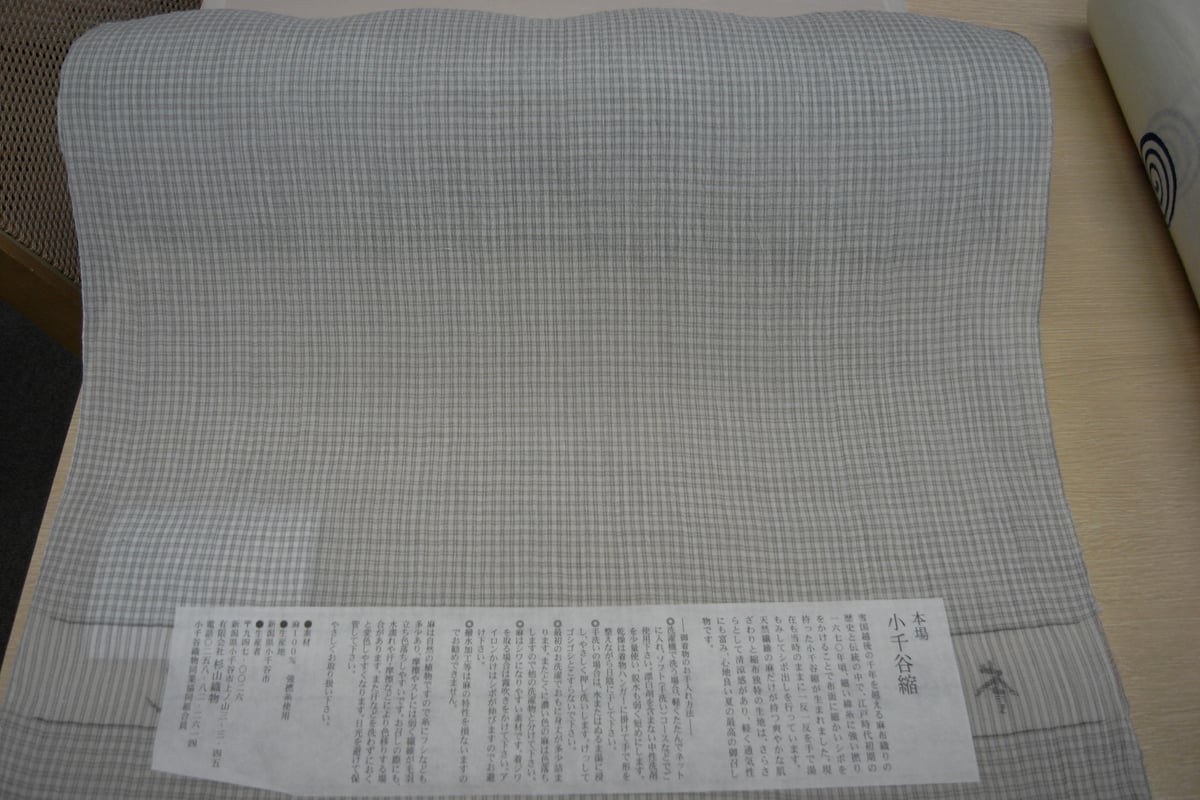
Ojiya Chijimi is a bast-fiber textile made from ramie (choma), woven mainly in Ojiya City, Niigata Prefecture. Choma is a plant also known as ramie, and its fibers are long, with firmness and body. The weft is given a hard twist before weaving, and the cloth is finished with yumomi (kneading in hot water), which brings out fine wrinkles on the surface of the fabric called shibo (fine crinkles). Thanks to this shibo, the cloth does not cling to the skin, and it has long been cherished as a summer kimono fabric with excellent breathability and moisture absorption. It is said to have begun in the early Edo period, when Hori Jiro Masatoshi (Akashi Jiro), who is said to have come from Akashi in Harima Province (Banshu), made improvements to the bast-fiber cloth of Echigo. On clear days from February to March, the woven bolts of cloth are spread out on snowfields for snow bleaching (yuki-zarashi), a seasonal sight in Ojiya. It was designated an Important Intangible Cultural Property in 1955 and a Traditional Craft Designated by the Minister of Economy, Trade and Industry in 1975. In 2009, it was inscribed on the UNESCO Intangible Cultural Heritage list together with Echigo Jofu.
Origin
Cloth made from ramie has been woven around Ojiya since ancient times. In the early Edo period, Hori Jiro Masatoshi (Akashi Jiro), a masterless samurai (ronin) said to have come from Akashi in Harima Province, succeeded in improving Echigo's bast-fiber cloth by applying the techniques of Akashi Chijimi, a silk textile. It is said that the technique of giving the weft a hard twist to bring out shibo was introduced, and that the methods of thread-making and cloth bleaching were also improved. The ramie crepe born in this way was at first called 'Echigo Chijimi,' and it spread throughout the Uonuma area.
History
Records show that by the mid-17th century a chijimi market was being held in Ojiya, drawing merchants from Edo, Kyoto, Osaka, and other places. Production was so active that the Hokuetsu-shi, written in 1800, states there was not a single house in which the sound of the loom could not be heard. In 1955 it was designated an Important Intangible Cultural Property as 'Echigo Chijimi,' and in 1960 the designated name was changed to 'Ojiya Chijimi and Echigo Jofu.' It was designated a Traditional Craft in 1975 and inscribed on the UNESCO Intangible Cultural Heritage list in 2009.
Features
Its greatest characteristic is the shibo created by the hard-twisted weft and yumomi. Because the cloth does not stick to the skin, it stays light and crisp to wear even in sweaty seasons. Five requirements are set for Ojiya Chijimi as an Important Intangible Cultural Property: using hand-spliced ramie thread; making the kasuri (ikat) by hand-binding (te-kubiri); weaving on an izaribata backstrap loom; bringing out the shibo by yumomi and foot-treading; and finishing the cloth with snow bleaching. It is such a labor-intensive textile that it is said 'the hands move as many as 900 times to weave a single shaku.'
Techniques
Shibo-tori (yumomi and foot-treading)
A finishing process in which cloth woven with a hard-twisted weft is soaked in hot water and kneaded by hand or trodden underfoot to bring out fine shibo on its surface. It is the key to the cool feel against the skin that is unique to Ojiya Chijimi.
Snow bleaching (yuki-zarashi)
From February to March, on clear days when the snow surface is frozen and the air is crisp and clean, bolts of cloth are spread out on the snow. It is explained that the cloth is bleached by the action of ozone generated by ultraviolet rays reflected off the snow surface.
Hand-binding (te-kubiri) and the izaribata backstrap loom
Te-kubiri is a technique of binding the parts of the thread that will form the kasuri pattern to resist the dye, so that the thread is dyed in separate colors. The izaribata is a hand loom on which the weaver adjusts the tension of the warp with the waist. These two are also included among the requirements for designation as an Important Intangible Cultural Property.
Materials Used
Production Process
- 1
Thread-making
Thread is made from ramie fiber, and the weft is given a hard twist.
- 2
Making the kasuri thread
The thread is bound according to the design and dyed to make kasuri thread.
- 3
Weaving
The cloth is woven while aligning the kasuri of the warp and weft.
- 4
Yumomi
The woven cloth is kneaded in hot water to bring out the shibo.
- 5
Snow bleaching
The bolts are spread out on the snow and bleached to finish the cloth.
| Main Production Areas |
|
|---|
Artisans & Workshops
西脇商店
A manufacturer and wholesaler of textiles from the Echigo production area, with its shop in Honcho, Ojiya City. A long-established business that marked its 240th anniversary in 2013, it handles authentic (honsei) Ojiya Chijimi and Echigo Jofu made in accordance with the requirements for the Important Intangible Cultural Property.
Official site →How to Buy
- 小千谷織物工房(小千谷市総合産業会館サンプラザ)
- The workshop of the Ojiya Textile Cooperative on the first floor of Sun Plaza, where textiles such as Ojiya Chijimi and Ojiya Tsumugi are displayed and sold. On some days, visitors can watch weaving demonstrations on a takabata (high loom). Admission is free.Where to buy →PR
- IONOストア(水田株式会社)
- An Ojiya Chijimi shop in Asahimachi, Ojiya City. It sells products while introducing the history and materials of Ojiya Chijimi and techniques such as yumomi and snow bleaching. Open from 10:00 to 17:00.Where to buy →PR
Hands-on Experiences
体験工房 織之座
新潟県小千谷市城内1-8-25(小千谷市総合産業会館サンプラザ1階)
Reservation required. Coaster weaving on a tabletop hand loom costs from around 1,200 yen (from about 20 minutes), and kasuri weaving from around 1,800 yen. Reception is from 10:00 to 16:00; closed on Wednesdays.
View details →FAQ
Q. What is the difference between Ojiya Chijimi and Echigo Jofu?
A. Both are bast-fiber textiles made from ramie. They were designated together as a single Important Intangible Cultural Property, and both were inscribed on the UNESCO Intangible Cultural Heritage list in 2009. Ojiya Chijimi has shibo brought out by a hard-twisted weft and yumomi, while Echigo Jofu is a plain weave without shibo.
Q. When can I see snow bleaching?
A. It is usually carried out from around February to March, on days when all the conditions are met: clear weather, a frozen snow surface, clean air, and no dirt on the snow. The sight of colorful bolts of cloth lined up on a pure-white snowfield is beautiful, and many people visit to photograph it.