Image: Wikimedia Commons
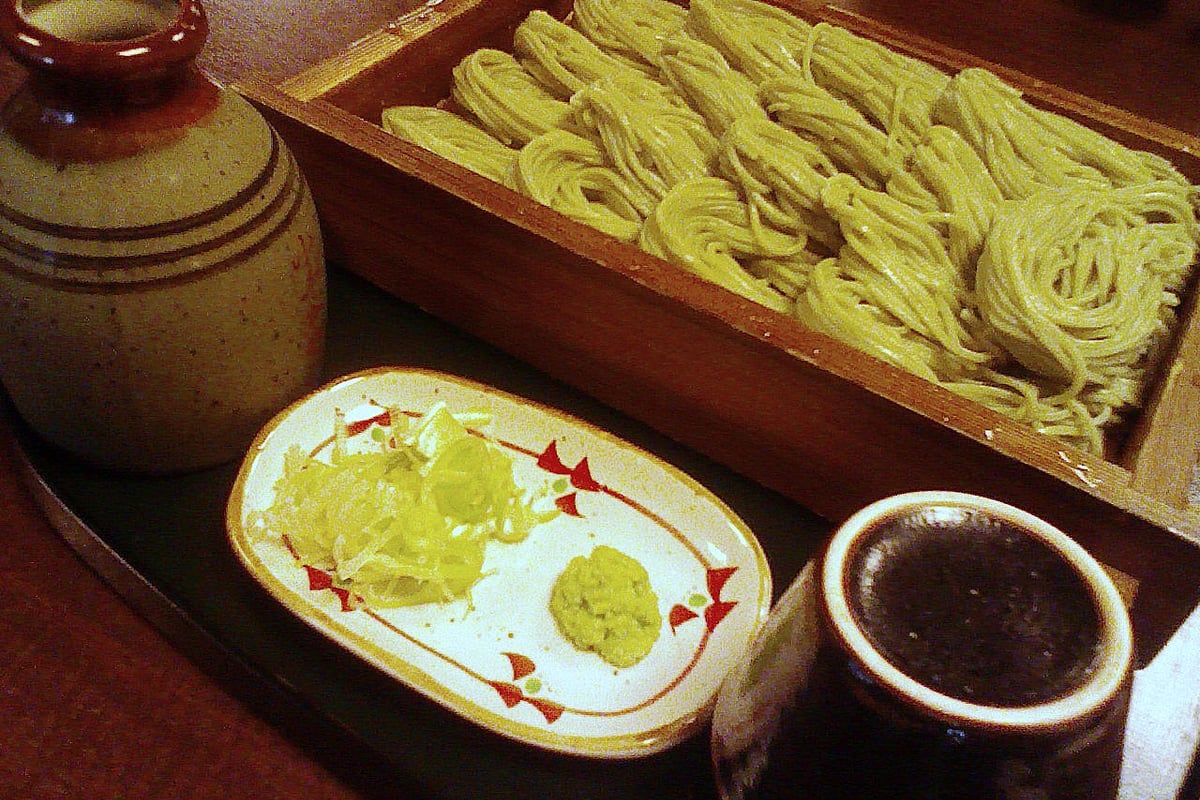
Hegi Soba is a local dish of Niigata Prefecture in which soba noodles made with funori seaweed as a binder are arranged in bite-sized portions on a hegi (square wooden tray). It is said to have originated in the Uonuma region, and Ojiya City and Tokamachi City in particular are known as soba towns. Funori was originally used to size (starch) the threads of textiles such as Ojiya Chijimi. Repurposing this seaweed, familiar in a textile-producing area, for soba making gave rise to this distinctive noodle. Soba bound with funori is prized for its smooth, slippery texture going down the throat and its firm, springy bite. The way the boiled noodles are gathered into bite-sized coils and lined up is called tefuri (bite-sized coiled portions), and its visual beauty is part of the appeal. Serving it with karashi mustard rather than wasabi as a condiment is another custom unique to this area. At specialty restaurants, it can be ordered by the number of people, from a single serving to portions for several, so a group can share soba served on a large hegi. Today it is eaten not only in the Uonuma region but throughout Niigata Prefecture.
Origin
Hegi Soba has its roots in the soba-kiri (cut soba noodles) of the Uonuma region, which began in the Edo period. At first, wheat was hard to obtain, so the leaves of yamagobo (a wild plant) and jinenjo (Japanese wild yam) were used as binders. According to Ojiya City, funori, which was used to size the threads of Ojiya Chijimi, is said to have been adopted as a binder for soba in the late Edo period. It is a noodle born from an idea only possible in a textile town that prospered with chijimi (crepe), a hemp fabric.
History
In the modern era, Hegi Soba was refined as the signature fare of specialty restaurants. Kojimaya Sohonten (小嶋屋総本店) in Tokamachi City was founded in 1922 (Taisho 11), and states that its first-generation owner, Jutaro (重太郎), devised Hegi Soba inspired by local textiles. Wataya (わたや) in Ojiya City is a long-established restaurant founded in 1921 (Taisho 10). Today, a Tokamachi City association has registered 'Tokamachi Hegi Soba' as a trademark, and an Ojiya City industry group has registered 'Ojiya Meibutsu Hegi Soba' (Ojiya's famous Hegi Soba), protecting it as a regional specialty.
Features
Soba bound with funori is characterized by its smooth, slippery texture and springy firmness. As the boiled noodles are lifted out of the water, they are pinched off one bite at a time and shaped with a shaking motion of the hand before being arranged on the hegi. This style of serving is tefuri, and one theory holds that it derives from textile work motions such as kaseguri (reeling thread into skeins). The standard condiments are chopped green onion and karashi mustard, said to be a legacy of a region where wasabi could not be harvested.
Main Ingredients
Food Culture
Funori has long been used to size the threads of textiles, and Hegi Soba is a dish born from the union of Uonuma's textile industry and its food culture. In Tokamachi and Ojiya, each soba restaurant has its own character in noodle making, dipping sauce, and condiments, and visiting several restaurants to compare them is considered one of the ways to enjoy it.
Famous Shops
小嶋屋総本店 本店
新潟県十日町市中屋敷758-1
A long-established Tokamachi restaurant founded in 1922 (Taisho 11), which continues to insist on stone-milling its own flour and on binding with funori. Hegi Soba starts at around 1,045 yen (tax included) per serving, and it can also be ordered on a large hegi for 2 to 4 people.
View details →わたや 本店
新潟県小千谷市本町2-3-34
A long-established Ojiya restaurant founded in 1921 (Taisho 10). As part of its history, it relates that in 1970 the then Crown Prince ate Wataya's Hegi Soba at Naeba Ski Resort. Hegi Soba starts at around 990 yen per serving.
View details →そば処 須坂屋
新潟県小千谷市大字小粟田1721-1
An Ojiya restaurant serving homemade hand-made soba bound with funori, notable for its spacious 120-seat interior. The soba is rolled into bite-sized portions and arranged on a hegi, with Hegi Soba starting at around 1,800 yen for two servings. Hanamaki Hegi Soba is also available.
View details →| Fresh Hegi Soba (Kojimaya Sohonten online shop) | The official online shop of Kojimaya Sohonten sells fresh Hegi Soba so the restaurant's flavor can be enjoyed at home. You can boil it yourself and savor the smooth, slippery texture that comes from funori binding.Where to buy →PR |
|---|
FAQ
Q. What does 'hegi' in Hegi Soba mean?
A. It refers to a square wooden tray made from hegi-ita (split wooden boards). The word is said to derive from 'hagu' (to peel or split), which changed to 'hegu' in local speech. Because bite-sized portions of soba are arranged on this tray, the dish is called Hegi Soba.
Q. Why is it eaten with karashi mustard instead of wasabi?
A. Because wasabi could not be harvested in this region in the past, chopped green onion or asatsuki (chives) and karashi mustard are said to have been used as condiments. Serving it with karashi is still common today, and the Ministry of Agriculture, Forestry and Fisheries also introduces the custom of eating it with karashi.