Image: Wikimedia Commons
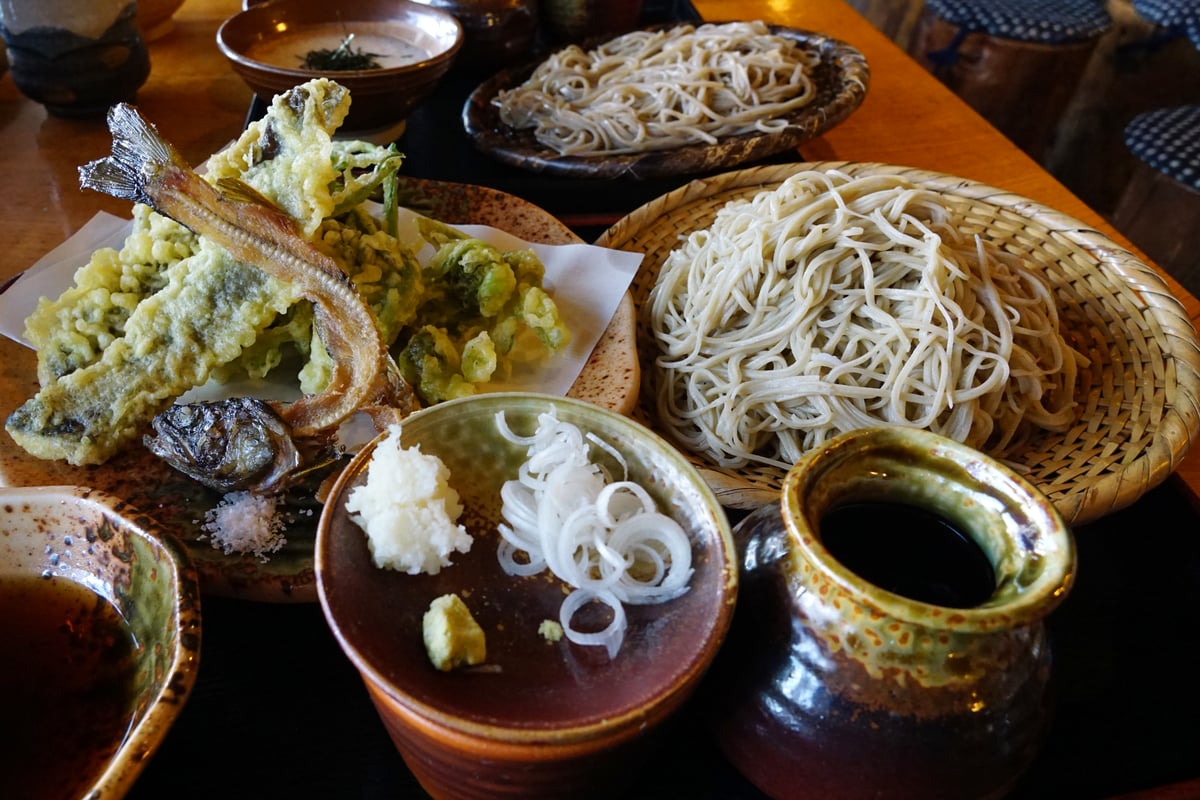
Shinshu Soba is Nagano Prefecture's signature noodle dish, made from buckwheat grown in various parts of the prefecture. The cool highland climate, where temperatures drop at night, is well suited to growing buckwheat, and Nagano Prefecture is one of Japan's leading buckwheat producers, ranking second in the nation with 3,960 tons in 2020 (Reiwa 2). Buckwheat, which bears fruit even in mountain areas where rice and wheat grow poorly, has long been a crop that supported people's livelihoods. Shinshu is also said to be the birthplace of 'soba-kiri' (buckwheat cut into noodles), and the oldest record of it, dated 1574 (Tensho 2), survives at Joshoji Temple in Okuwa Village, Kiso District. There is also a theory that it originated at Motoyama-juku (present-day Shiojiri City) on the Nakasendo highway, but there are other theories as well, such as one placing its origin in Koshu (Yamanashi Prefecture). Within the prefecture, soba with distinct local character has been handed down from place to place, such as Togakushi soba and the soba of the Kaida Kogen highlands. During the autumn harvest season, soba festivals are held throughout the prefecture, where visitors can enjoy freshly harvested shin-soba (new-crop soba).
Origin
In Nagano Prefecture, buckwheat has been grown as a crop suited to cold highland areas where rice and wheat are difficult to grow because of the cool climate and limited land. Legends also remain in various places that ascetic monks, including En no Ozuno, who is regarded as the founder of Shugendo, passed on buckwheat seeds they carried as provisions to villagers. Buckwheat is said to have originally been eaten in forms such as 'sobagaki,' made by kneading buckwheat flour with hot water. In Togakushi as well, buckwheat is said to have been used as food for ascetic monks since the Heian period.
History
Old documents at Joshoji Temple in Okuwa Village, Kiso District, record that 'soba-kiri' was served in 1574 (Tensho 2) to the craftsmen who repaired the main hall. This is regarded as the oldest record of soba-kiri. The 1645 work 'Kefukigusa' lists soba-kiri as a specialty of Shinano Province. The 'Honcho Monzen' (also known as 'Fuzoku Monzen') of 1706 (Hoei 3) states that soba-kiri came from Motoyama-juku and spread to provinces across the country. In Togakushi, the technique of making buckwheat into noodles was introduced in the Edo period, and soba became a dish for welcoming pilgrims at the shukubo (temple lodging).
Features
Buckwheat from Nagano Prefecture grows in highlands with large differences between day and night temperatures, and it is said to yield fragrant, high-quality buckwheat. Buckwheat harvested in foggy places such as the Togakushi Kogen highlands is also called 'kirishita soba' (soba grown under the fog). Togakushi is known for 'bocchi-mori,' in which boiled soba is gathered into bite-sized bundles and arranged on a bamboo zaru tray. In the Kaida Kogen highlands of Kiso, some shops use the native variety 'Kaida Wase.' The Nagano Prefecture Shinshu Soba Cooperative certifies dried noodles containing 40 percent or more buckwheat flour as 'Shinshu Soba.'
Main Ingredients
Food Culture
From October to November, the buckwheat harvest season, 'soba festivals' are held in various parts of the prefecture. In the prefecture there are also facilities where everything from cultivation to milling and soba making is handled within a single area, as well as facilities that offer soba-making experiences. Nagano Prefecture has also developed its own original variety, 'Shinshu Hisui Soba.'
How It Differs from Home Cooking
At specialty shops, it is common to see shops that mill locally grown whole buckwheat (genso) in-house and make the noodles fresh that day. The ratio of buckwheat flour to binder differs from shop to shop, and shops make different styles such as juwari soba (100 percent buckwheat) and nihachi soba (8 parts buckwheat to 2 parts wheat). There are also differences in presentation and ingredients unique to each area, such as Togakushi's bocchi-mori and Kiso's native variety.
Famous Shops
うずら家
長野県長野市戸隠3229
One of Togakushi's representative soba shops, located near the Chusha (Middle Shrine) of Togakushi Shrine. It uses buckwheat flour milled in the depths of winter and stored frozen, bringing out a flavor close to that of new-crop soba all year round. The condiments include wasabi, locally grown karami daikon (pungent radish), and local green onions.
そば切り発祥の地 本山そばの里
長野県塩尻市宗賀本山4404-1
A handmade soba shop in Motoyama-juku, said to be the birthplace of soba-kiri. It is run by an enterprise cooperative that carries on the techniques and flavor of Motoyama soba, and local farmers make soba every day with locally grown buckwheat flour. Mori soba (chilled soba on a tray) starts from about 970 yen.
そば処 信州霧しな
長野県木曽郡木曽町開田高原末川1898-1
A soba shop in the Kaida Kogen highlands at an elevation of about 1,100 m. It serves soba made from whole buckwheat of the local native variety 'Kaida Wase.' In winter, visitors can also enjoy the local dish Toji Soba (Soba Dipped in Hot Pot Broth), in which soba is dipped in hot pot broth before eating.
| 戸隠そば博物館 とんくるりん (Togakushi Soba Museum) | A facility that introduces the history and tools of Togakushi soba; admission is about 200 yen. Soba-making experiences are also available, starting from about 4,500 yen for two servings. It is closed for the winter from late November to early April, so check the timing of your visit. |
|---|
FAQ
Q. Are there rules for dried noodles sold under the name 'Shinshu Soba'?
A. The Nagano Prefecture Shinshu Soba Cooperative certifies dried soba containing 40 percent or more buckwheat flour as 'Shinshu Soba' and has registered it as a trademark. This can serve as a guide when choosing dried noodles as a souvenir.
Q. What is 'bocchi-mori' in Togakushi soba?
A. It is a style of presentation unique to Togakushi, in which boiled soba is divided into bundles of about one mouthful each and arranged in a circle on a bamboo zaru tray. It is usually served in five portions, and one theory holds that they represent five temples and shrines of Togakushi. The trays are local Togakushi Bamboo Craft, made by hand.
Q. Did soba-kiri really originate in Shinshu?
A. The oldest record, dated 1574, survives at Joshoji Temple, and the 'Honcho Monzen' states that it originated at Motoyama-juku. On the other hand, there are also Edo-period documents stating that it began in Koshu (Yamanashi Prefecture), and there are various theories about its birthplace.