Image: Wikimedia Commons
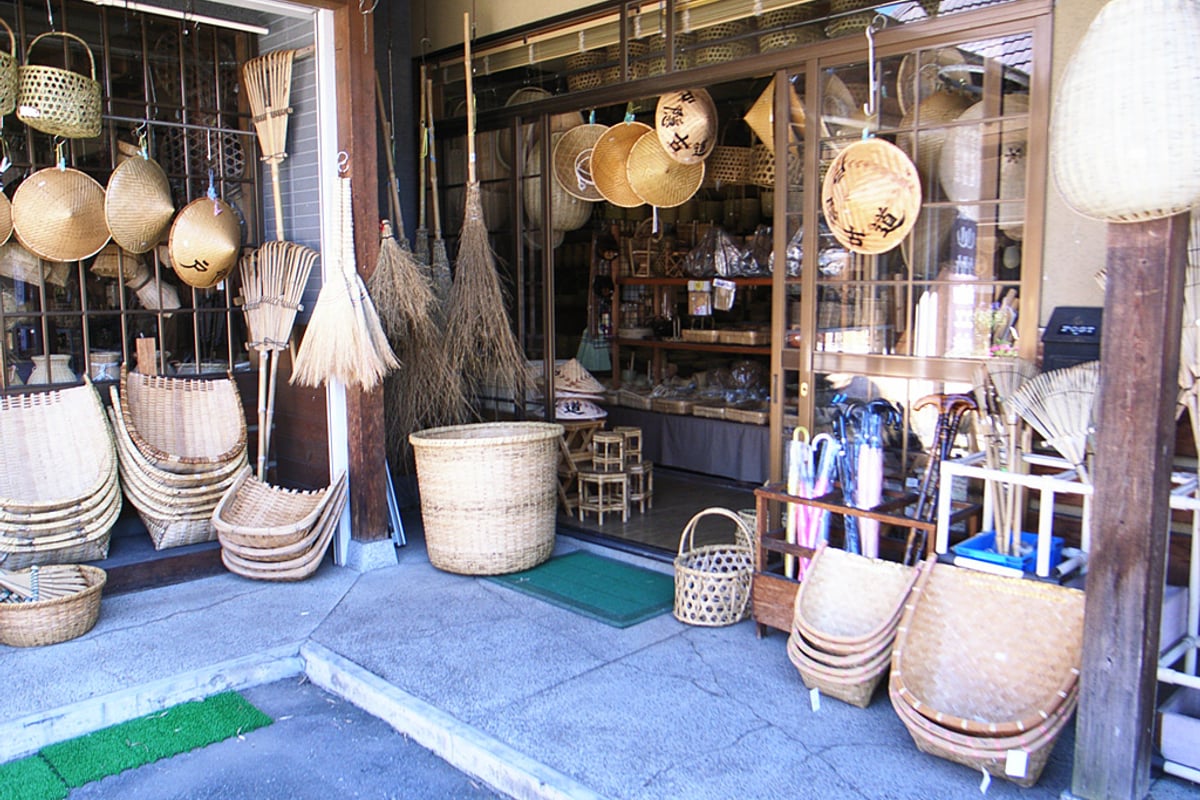
Togakushi Bamboo Craft is bamboo craft made in Togakushi, Nagano City. The material is chishima-zasa (a dwarf bamboo) that grows wild in the mountains of Togakushi; because its base is bent, it is locally called 'nemagari-dake' (literally 'bent-root bamboo'). Though thin, this bamboo is hard and supple, strong enough to bend without breaking even under heavy winter snow. In Togakushi, which lies at a high altitude and is unsuited to rice growing, it is said that in the Edo period people were permitted to pay their annual tax (nengu) in bamboo instead of rice. From the Meiji period onward, demand rose for large baskets used in sericulture, and eventually everyday tools such as zaru (draining baskets) and kago (baskets) came to be made. The representative product is the soba zaru, used to serve Togakushi soba. A distinctive feature is that a single craftsperson handles every step, from cutting the bamboo in the mountains and making bamboo strips (takehigo) to weaving. In 1983, together with the bamboo crafts of Yamanouchi Town and Ina City, it became a Traditional Craft Designated by the Governor of Nagano Prefecture under the name 'Shinshu Takezaiku' (Shinshu Bamboo Craft). In front of Togakushi Shrine, bamboo craft shops and facilities offering hands-on experiences are dotted around.
Origin
Bamboo is said to have been harvested in Togakushi since at least the beginning of the Edo period. Covered in snow in winter and cold throughout the year, Togakushi was not suited to rice growing. For this reason, it is said that when paying the annual tax to the Tokugawa shogunate, people were allowed to pay in bamboo instead of rice. People in the Edo period used this bamboo to make tools for farm work, such as baskets for sifting grain.
History
When sericulture flourished in the Meiji period, many large baskets for raising silkworms were made in Togakushi, and demand rose. Later, everyday bamboo crafts unique to Togakushi, such as zaru, baskets and vessels, came to be made, and they have also been used as vessels for Togakushi soba. In 1983 it became a Traditional Craft Designated by the Governor of Nagano Prefecture as 'Shinshu Takezaiku.' In recent years the number of people carrying on the craft has declined, and passing on the skills has become a challenge.
Features
Chishima-zasa grows to more than 2 m tall, but it is a thin bamboo whose diameter rarely exceeds 3 cm. It has a characteristic luster and smoothness, and the more it is used, the more it turns an amber color. Bamboo of different ages is used for different parts, such as the rim and handle of a zaru, and a soba zaru is woven from three kinds of bamboo that differ in thickness and diameter. In addition to its durability, the beauty of the geometric patterns drawn by the weave is also highly regarded.
Techniques
Integrated Production
A single craftsperson handles every step, from gathering the bamboo to processing the bamboo strips, weaving and finishing. Being able to prepare good material is considered the basic prerequisite for becoming a full-fledged craftsperson, and the quality of the material is said to greatly affect the beauty of the work.
Takehigo (Making Bamboo Strips)
Bamboo cut from autumn to winter is split lengthwise into four, and the strong outer layer is cut away to make bamboo strips. Sometimes the bamboo is left to rest for several years so that its color deepens naturally, or it is smoked to give it a dark brown finish.
Soba Zaru (Soba Draining Basket)
The zaru used to serve Togakushi soba drains water well, bringing out the deliciousness of the soba. Weaving hard nemagari-dake flat requires skilled technique, and it is said that even a veteran craftsperson can make only about two a day.
Materials Used
Production Process
- 1
Gathering Bamboo
From autumn to winter, nemagari-dake growing wild in the mountains is cut.
- 2
Splitting Bamboo
The bamboo is split lengthwise into four, and the strong outer layer is cut away.
- 3
Making Strips
The bamboo strips are prepared with uniform thickness and width to suit the part to be woven.
- 4
Weaving
The bamboo strips are woven into the shape of a zaru or basket.
- 5
Rimming and Finishing
The rim and handles are attached, and the shape is adjusted to finish the piece.
| Main Production Areas |
|
|---|
Artisans & Workshops
井上竹細工店
A shop that has run a bamboo craft business for generations in front of the Chusha (Middle Shrine) of Togakushi Shrine. In addition to traditional items such as soba zaru and bowl baskets, it is also developing items such as bamboo coffee drippers, which can be made with little material and are easy for younger generations to pick up.
Official site →中社竹細工生産組合
A production-area organization of Togakushi bamboo craftspeople, which Nagano Prefecture lists as the production-area cooperative for 'Shinshu Takezaiku.' It has its contact address at the same location as the Togakushi Takezaiku Center (戸隠竹細工センター), and works on the production and passing on of nemagari-dake bamboo crafts.
How to Buy
- 井上竹細工店
- A bamboo craft shop at 3416 Togakushi Chusha, Nagano City, whose products can also be purchased from its web shop. A small soba zaru costs about 9,500 yen and a large deep zaru about 14,000 yen. Because they are handmade, quantities are limited and items are often out of stock.Where to buy →PR
- 戸隠竹細工センター
- A facility near the entrance to the approach to the Okusha (Inner Shrine) of Togakushi Shrine, offering a wide variety of Togakushi bamboo crafts such as soba zaru and baskets. Visitors can also watch the bamboo craft process. It is open from late April to mid-November, with no closing days during that period.Where to buy →PR
Hands-on Experiences
戸隠竹細工センター
長野県長野市戸隠3694(奥社入口)
You can try weaving pre-split bamboo to make a wall hanging. According to the prefecture's guide to hands-on workshops, the fee is about 1,800 yen, sessions are offered from May to October for sixth-grade elementary school students and older, and groups of up to about 40 people can be accommodated.
View details →戸隠竹細工工房 文の郷
長野県長野市戸隠3307
A bamboo craft workshop about a 5-minute walk from the Chusha of Togakushi Shrine. You can try making small items with nemagari-dake, such as single-flower vases and photo frames. Experiences require advance reservations.
View details →FAQ
Q. What is the connection between Togakushi Bamboo Craft and Togakushi soba?
A. Togakushi soba is typically served on a zaru woven from nemagari-dake. It drains water perfectly, bringing out the texture and flavor of the soba. The vessels used at soba restaurants in Togakushi are also made with these bamboo craft techniques, and soba and bamboo craft have become two traditions that support life in the town in front of the shrine.
Q. How can I make bamboo crafts last a long time?
A. When washing, wash gently along the weave and dry thoroughly in the shade. If used with care, they can be used for decades, and over the years their color deepens and turns a glossy amber. They are also tools handed down from parents to children and grandchildren.