Image: Wikimedia Commons
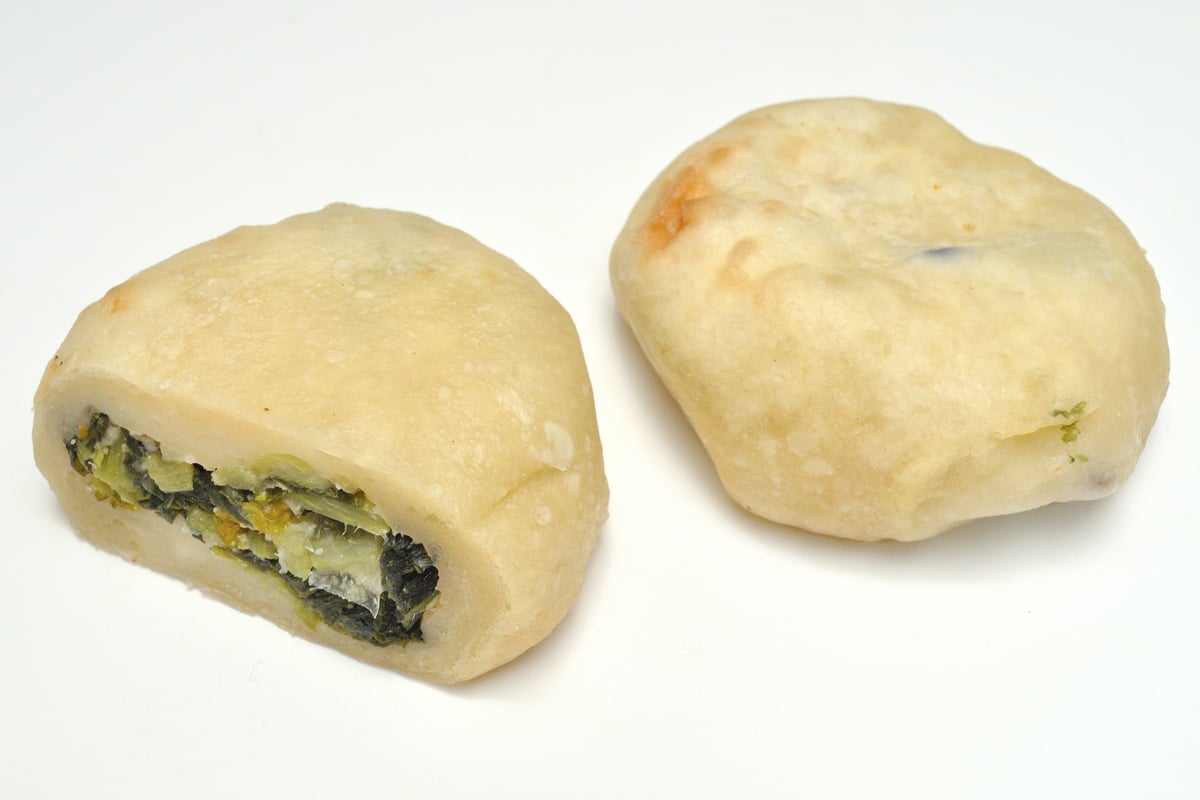
Oyaki is a local dish of Nagano Prefecture in which vegetables, mountain vegetables, mushrooms, anko (sweet bean paste), and other fillings are wrapped in a dough made from wheat flour or buckwheat flour and then grilled or steamed. It is said to have originated in the Nishiyama area spreading west of Nagano City (Ogawa Village, the former Nakajo Village, the former Shinshushinmachi, and elsewhere). In the cool mountain areas unsuited to rice farming, wheat and buckwheat took the place of rice, and oyaki has supported people's diets. Fillings such as Nozawana-zuke (Pickled Nozawana Greens), eggplant, kiriboshi daikon (dried shredded radish), and kabocha squash are used, seasoned with miso or soy sauce. In the past, 'haiyaki oyaki,' steam-baked by burying them in the ashes of the irori (sunken hearth), was the mainstream. Today the methods vary by area and shop, including grilling, steaming, grilling and then steaming, and frying and then grilling. It is a representative flour-based dish of Shinshu that serves both as a staple food and as a snack.
Origin
Oyaki is said to have originated in the Nishiyama area of Kamiminochi District. At a Jomon-period site in Ogawa Village, traces of kneaded and baked flour from minor grains have been found. In this area, where growing rice in the mountains was difficult, wheat and buckwheat were used in place of the staple food. Oyaki, in which familiar vegetables and other fillings are wrapped in a dough of kneaded flour, has been handed down in each household as a substitute for rice, mainly in winter.
History
In the Nishiyama area, the mainstream was 'haiyaki oyaki,' in which the surface was grilled in an unglazed flat pan called a horoku (焙烙) and then steam-baked by burying it in the hot ashes of the irori. Later, methods such as steaming, grilling, and grilling and then steaming spread. In the Zenkojidaira basin, oyaki steamed in a steamer is said to be common. In the rice-growing Azumidaira basin, a dough of cooked rice mixed with wheat flour was used to wrap a filling of brown sugar and miso, and this has been called 'yakimochi.'
Features
For the dough, wheat flour or buckwheat flour is kneaded and rolled out thin, then the filling is wrapped inside and the dumpling is shaped into a round. The fillings change with the seasons, and eggplant, mushrooms, kabocha, kiriboshi daikon, Nozawana-zuke, and other ingredients are seasoned with miso or soy sauce. For sweet versions, adzuki bean paste and kabocha paste are also used. Grilled oyaki are fragrant, while steamed ones are moist and soft, so the texture changes greatly depending on how they are made.
Main Ingredients
Food Culture
Oyaki has been made at home as an everyday meal and as a snack. In the Hokushin region it is regarded as an important ritual food for Obon, and there was also a custom of offering it at the Buddhist altar. It goes by various names depending on the area, such as 'yakimochi,' 'anbin,' and 'chanako.'
How It Differs from Home Cooking
At home, oyaki are made with each household's own fillings and methods, and the flavor differs even within the same area. At specialty shops, each shop shows its own ingenuity, such as the traditional method of grilling over an irori or a unique method of frying the oyaki in oil and then baking them in a kiln oven. Many shops also offer seasonal fillings, and frozen oyaki can be taken home as souvenirs.
Famous Shops
小川の庄 縄文おやき村
長野県上水内郡小川村高府6937
A facility opened in 1986 (Showa 61) by converting a farmhouse, where oyaki are grilled over the irori in a building modeled on a pit dwelling. Oyaki-making experiences start from about 1,200 yen and require a reservation. Oyaki by mail order start from about 540 yen for a pack of two.
View details →いろは堂 鬼無里本店
長野県長野市鬼無里1687-1
An oyaki shop said to have been founded in 1925 (Taisho 14), with its main store in Kinasa, a mountain area of Nagano City. Its distinctive method of frying the dough in oil and then baking it in a high-temperature kiln oven gives the oyaki a crisp, fragrant outside and a chewy inside.
やきもち家
長野県長野市中条日下野5286-1
An inn and eatery with a thatched roof in the former Nakajo Village in the Nishiyama area. The building is an early-Meiji folk house relocated here in 1989 (Heisei 1), and visitors can enjoy traditional 'haiyaki oyaki' grilled over the irori. Oyaki-making experiences start from about 1,500 yen.
| OYAKI FARM BY IROHADO | A shop with an attached factory run by Irohado in Shinonoi, Nagano City, offering seven standard varieties of oyaki as well as seasonal limited-edition ones. In addition to factory tours and a cafe, oyaki-making experiences are available by reservation, starting from about 1,900 yen. |
|---|
FAQ
Q. Are oyaki grilled or steamed?
A. It depends on the area and the shop. In the past, the surface was grilled first and then the oyaki were steam-baked in the ashes of the irori. Today there are oyaki grilled on an iron griddle, steamed in a steamer, grilled and then steamed, and fried and then grilled, among others. In the Zenkojidaira basin, steamed oyaki are said to be common.
Q. What are the classic fillings for oyaki?
A. Classic fillings include stir-fried and seasoned Nozawana-zuke, eggplant seasoned with miso, kiriboshi daikon, kabocha, and adzuki bean paste. There are also oyaki made with seasonal vegetables, such as garlic chives in spring.