Image: Wikimedia Commons
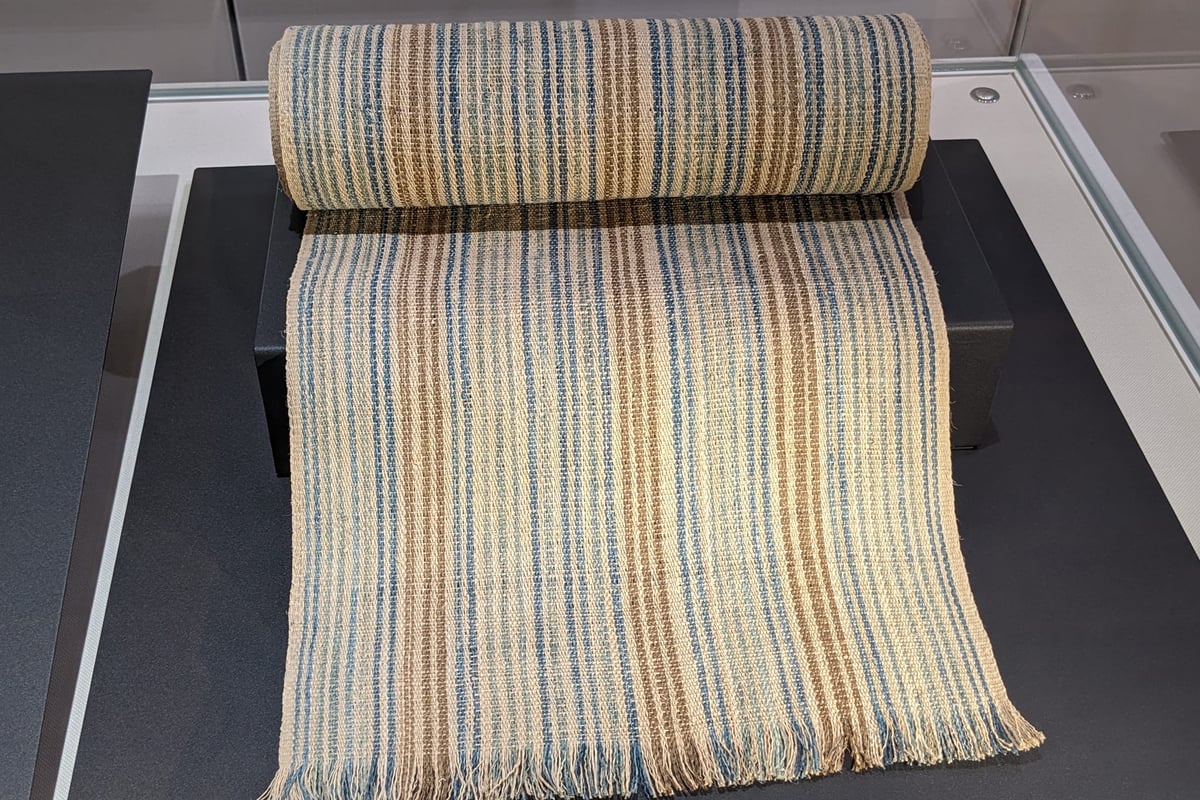
Nibutani Attus is a bark-cloth textile of the Ainu people, handed down in the Nibutani district of Biratori Town, Saru District, Hokkaido. The inner bark of trees such as Ohyo elm and Japanese linden, grown in the Saru River basin, is stripped, boiled, and dried, then torn into thin strips to make thread, which is twisted before being woven on a loom. Making the thread alone is said to account for as much as 80% of the entire process, an extremely labor-intensive task that requires a long time and much effort from the harvesting of the bark to the completion of a bolt of cloth. It is characterized by striped patterns created by the natural coloring of the bark, and is said to be water-resistant, highly breathable, and remarkably strong for a natural fiber. It was once widely used for Ainu clothing, and techniques passed down for more than 100 years continue to be carried on today. On March 8, 2013, together with Nibutani Ita, it became the first Traditional Craft Product designated by the Minister of Economy, Trade and Industry (METI) in Hokkaido.
Origin
Attus is said to mean in the Ainu language 'a bolt of cloth woven from thread made from the inner bark of the Ohyo elm,' and it is a textile made from the bark of Ohyo elm and Japanese linden trees growing wild in the Saru River basin. The process of boiling the inner bark to soften it and tearing the fibers into thin strips to make thread has been handed down since ancient times, and the resulting cloth has been used in daily life for Ainu clothing and sashes. It is such a labor-intensive technique that thread-making is said to account for the majority of the process, and it has been passed down across generations centered on the Nibutani district.
History
Even after the Meiji era, the technique of weaving continued to be passed down, mainly among the women of Nibutani, and the cloth was used not only as an everyday item but also as a trade good. Its durability, unique to a natural material, and its beautiful striped patterns were highly valued, and as the technique was refined over many years, it was designated, together with Nibutani Ita, as the first Traditional Craft Product designated by the Minister of Economy, Trade and Industry (METI) in Hokkaido on March 8, 2013. Today, the Hokkaido Fisheries and Forestry Department and other bodies are also working to cultivate and secure Ohyo elm as a raw material, and the technique is being passed down at facilities such as the Biratori Town Ainu Culture Information Center and the Biratori Town Nibutani Ainu Culture Museum.
Features
The greatest characteristic of Nibutani Attus lies in the process of hand-making thread from the inner bark of Ohyo elm and Japanese linden, twisting it, and then weaving it into cloth. The natural gradation of color in the bark appears as striped patterns, creating a rustic, warm texture. It is said to be water-resistant, highly breathable, and remarkably strong for a natural fiber, and is valued as a textile that combines practicality with beauty.
Techniques
Thread-making (Bark Stripping, Boiling, Drying)
The bark of trees such as Ohyo elm is harvested, and the inner bark is boiled in a kettle and dried before being torn into strips of a consistent thickness to make thread. It is said to account for 80% of the entire process and is an essential task.
Weaving
The twisted bark thread is set on a loom and woven, over a long period of time, into a bolt of cloth. The striped pattern unique to the natural material is a distinguishing feature.
Materials Used
Production Process
- 1
Bark Harvesting
The bark of Ohyo elm and Japanese linden trees growing wild in the forests of the Saru River basin is carefully stripped and harvested in early summer, when the sap begins to flow.
- 2
Boiling and Drying the Inner Bark
The harvested bark is slowly boiled in a kettle to soften it, after which the outer bark is removed to leave only the inner bark, which is then dried in the sun.
- 3
Thread-making
The dried inner bark is torn into strips of a consistent thickness, and each strip is twisted by hand, one at a time, to make thread. This is an important task that accounts for the majority of the entire process.
- 4
Weaving
The completed bark thread is set on a loom and woven over a long period of time into a bolt of cloth, revealing the natural striped pattern.
| Main Production Areas |
|
|---|
Artisans & Workshops
二風谷民芸組合
A cooperative of local artisans based at the Nibutani Kogeikan (Nibutani Craft Hall). It carries on traditional techniques such as Attus weaving and embroidery, and holds exhibitions, direct sales of craft items, and hands-on learning experiences.
Official site →How to Buy
- NIBUTANI AINU CRAFT オンラインショップ
- The official online shop of an Ainu craft brand run by artisans of Biratori Town, where visitors can purchase Nibutani Attus fabric and products.Where to buy →PR
- 平取町アイヌ文化情報センター(二風谷工芸館)
- A facility that exhibits and sells traditional craft items made by local artisans, including Nibutani Attus and Nibutani Ita. Its selection, unique to the production area, is a major attraction.Where to buy →PR
Hands-on Experiences
二風谷工芸館(平取町アイヌ文化情報センター)
北海道沙流郡平取町字二風谷61-6
Reservation required. A wood-carving/embroidery coaster-making experience costs from around 1,300 yen. Advance telephone inquiry is required.
View details →平取町立二風谷アイヌ文化博物館
北海道沙流郡平取町二風谷55
Admission is around 400 yen for adults and around 150 yen for elementary and junior high school students. Visitors can view exhibits explaining Attus weaving techniques and tools.
View details →FAQ
Q. What kind of clothing was Attus used for?
A. Bolts of cloth woven from bark thread were tailored into everyday and ceremonial clothing for the Ainu people, and were also used for accessories such as sashes. Their durability made them valuable for everyday use as well.