Image: Wikimedia Commons
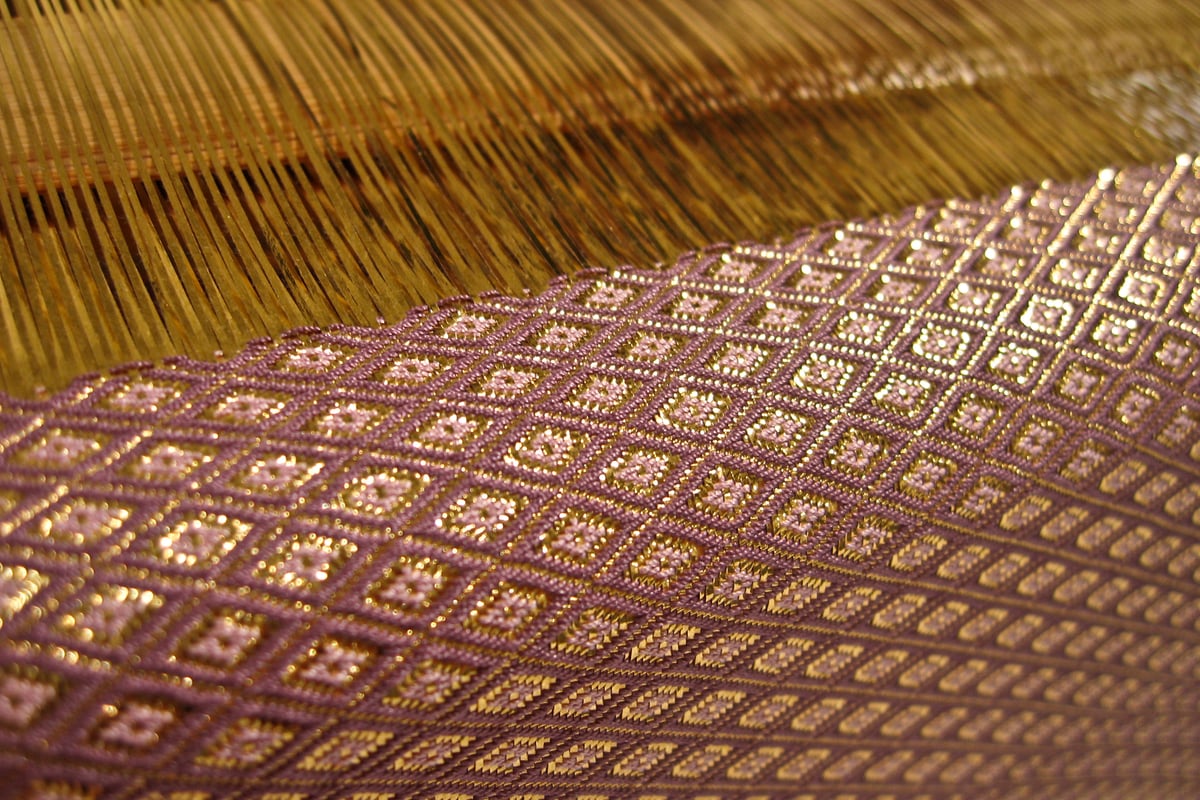
Saga-nishiki is a hand-woven silk textile in which the warp is made of 'foil thread'—gold and silver leaf glued onto washi paper with lacquer and cut into fine strips—while the weft is silk thread. It is said to originate in the Bunsei era (1818-1830) of the late Edo period, when Lady Kashiwaoka, wife of the 9th lord of the Kashima-Nabeshima family of Hizen Kashima Domain, was inspired by the beauty of the ajiro lattice pattern on the ceiling above her sickbed. Lady Yanagioka, wife of the 11th lord, and Kuzuko, wife of the 13th lord, developed it further as a pastime craft woven with paper and cotton threads, and it was later refined into a luxury textile using gold and silver foil thread together with silk. For a long time it was known by names such as 'okumimono,' 'kumi-nishiki,' and 'Kashima-nishiki,' but after it was exhibited to great acclaim at the 1910 Japan-British Exhibition in London, it came to be known uniformly as 'Saga-nishiki,' a name that identifies its place of origin. Its defining feature is the shimmer of gold and silver woven into intricate geometric patterns, used for obi sashes and small accessories.
Origin
The origins of Saga-nishiki trace back to the Bunsei era (1818-1830) of the late Edo period. It is said to have begun when Lady Kashiwaoka, wife of the 9th lord of the Kashima-Nabeshima family of Hizen Kashima Domain, was captivated by the beauty of the ajiro lattice pattern on her sickroom ceiling while confined to bed with illness, and wondered whether the pattern could be woven into everyday use. Her attendants first braided twisted paper cords (kanzeyori) into an ajiro pattern and fashioned them into items such as inro cases, which was the first attempt.
History
Its full development began when Lady Yanagioka, wife of the 11th lord, and Kuzuko, wife of the 13th lord, wove it as a pastime using a warp of cut paper and a weft of cotton thread. It was later refined into a more brilliant textile at the suggestion of the domain lord Nabeshima Naoyoshi, who proposed replacing the warp with gold and silver foil thread and the weft with silk. After it was exhibited at the 1910 Japan-British Exhibition in London, the textile—previously known by names such as 'okumimono' and 'Kashima-nishiki'—came to be known uniformly as 'Saga-nishiki' and gained wide recognition.
Features
Its defining feature is the use of 'foil thread'—gold and silver leaf glued to handmade washi paper with lacquer and cut into fine strips—as the warp, with silk thread as the weft. Rather than a loom, the warp is stretched across a small stand called an ayadake-dai, and the weft is woven in by hand with a special needle called an abari. It is such meticulous work that even a skilled artisan may take several hours to weave just one centimeter. The geometric patterns created by the gleam of gold and silver are used for obi sashes, obi cords, and bags.
Techniques
Making foil thread
Gold and silver leaf is glued to handmade washi paper with lacquer and cut into fine strips to create the foil thread used for the warp. The thickness of the foil and the fineness of the cut determine the sheen of the finished piece.
Hand weaving
The foil-thread warp is stretched across a small weaving stand called an ayadake-dai, and the silk weft is woven in one thread at a time using a special needle called an abari. Even a skilled artisan may take several hours to weave just one centimeter.
Materials Used
| Main Production Areas |
|
|---|
Artisans & Workshops
古賀フミ
Born in Saga City. She learned the techniques of Saga-nishiki from her great-grandmother and mother, and in 1994 was recognized as a Living National Treasure (holder of an Important Intangible Cultural Property). She also received the Medal with Purple Ribbon in 1988 (she died in 2015).
How to Buy
- 佐賀錦振興協議会
- A preservation group based at Kyū-Fukudake (the former Fukuda residence), part of the Saga City Museum of History and Folklore. It serves as the contact point for exhibitions and sales of hand-woven Saga-nishiki, as well as workshops.Where to buy →PR
Hands-on Experiences
旧福田家(佐賀市歴史民俗館)
佐賀県佐賀市松原4丁目3番15号
Hand-weaving experiences require advance reservation (contact the Saga-nishiki Promotion Council at TEL 0952-22-4477).
View details →祐徳博物館(鹿島錦保存会)
佐賀県鹿島市古枝乙1855(祐徳稲荷神社境内)
Admission is 300 yen for adults. The museum displays works of Kashima-nishiki and serves as the contact point for the Kashima-nishiki Preservation Society.
View details →