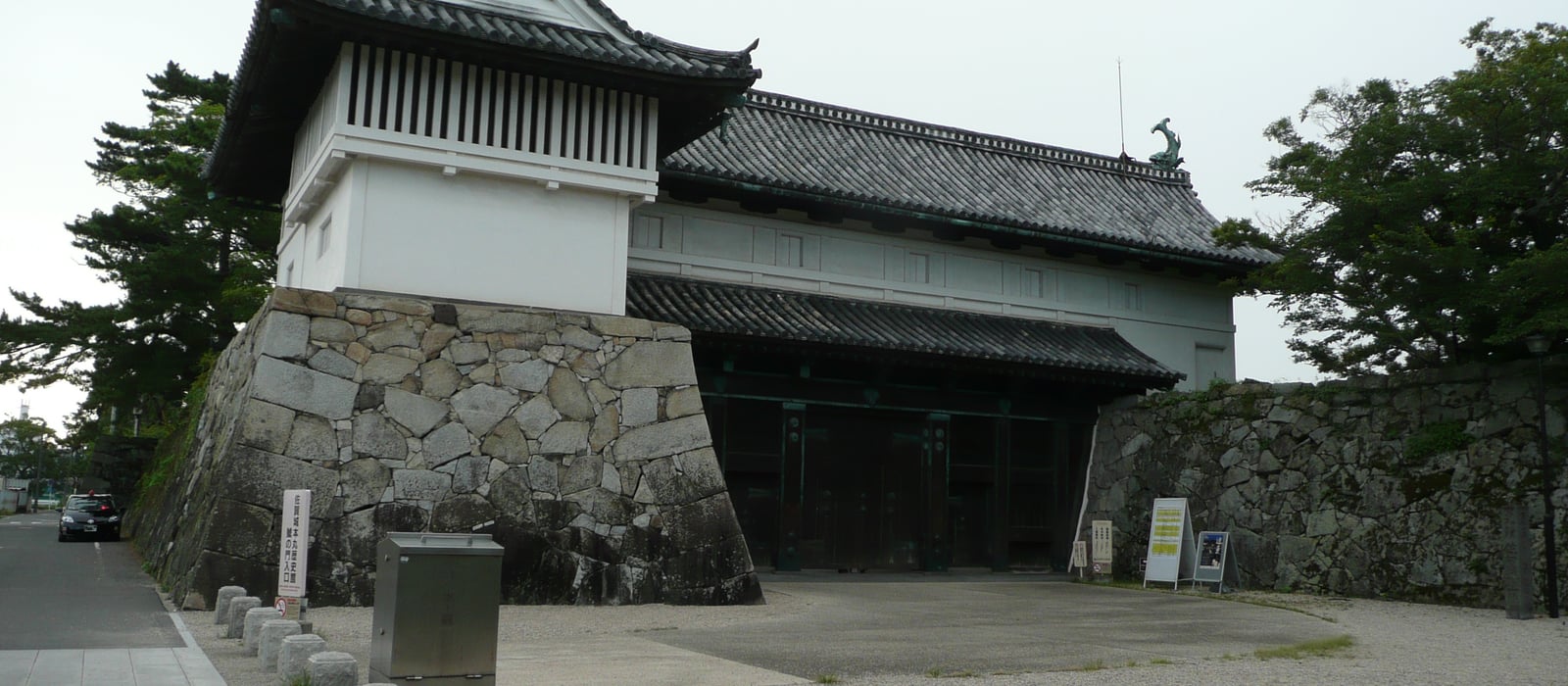
 Image: Wikimedia Commons
Saga Prefecture
Home to Arita-yaki, Imari-yaki, and Karatsu-yaki — three of Japan's most celebrated porcelain and pottery traditions — Saga is known worldwide as 'the land of ceramics.' Arita, where Japan's first porcelain was fired in 1616, sits alongside Ōkawachiyama, the 'hidden kiln village' that once produced wares exclusively for the shogunate, and the Karatsu kilns beloved by tea masters. Delicate handcrafts nurtured under the protection of the Saga Domain, such as Saga-nishiki brocade, Nabeshima Dantsu carpets, and Hizen Biidoro glass, are still practiced today. Alongside a distinctive food culture shaped by the vast tidal flats of the Ariake Sea — home to mudskippers, warasubo fish, and ganzuke — the prefecture also boasts nationally famous specialties such as Saga beef, Yobuko squid, and Ogi yōkan. The sugar culture that traveled the Nagasaki Kaidō through Ogi and Kashima, together with the culinary diversity nurtured by the Ariake Sea and the Genkai Sea, adds further richness to the region's food traditions.
Saga's Traditional Crafts
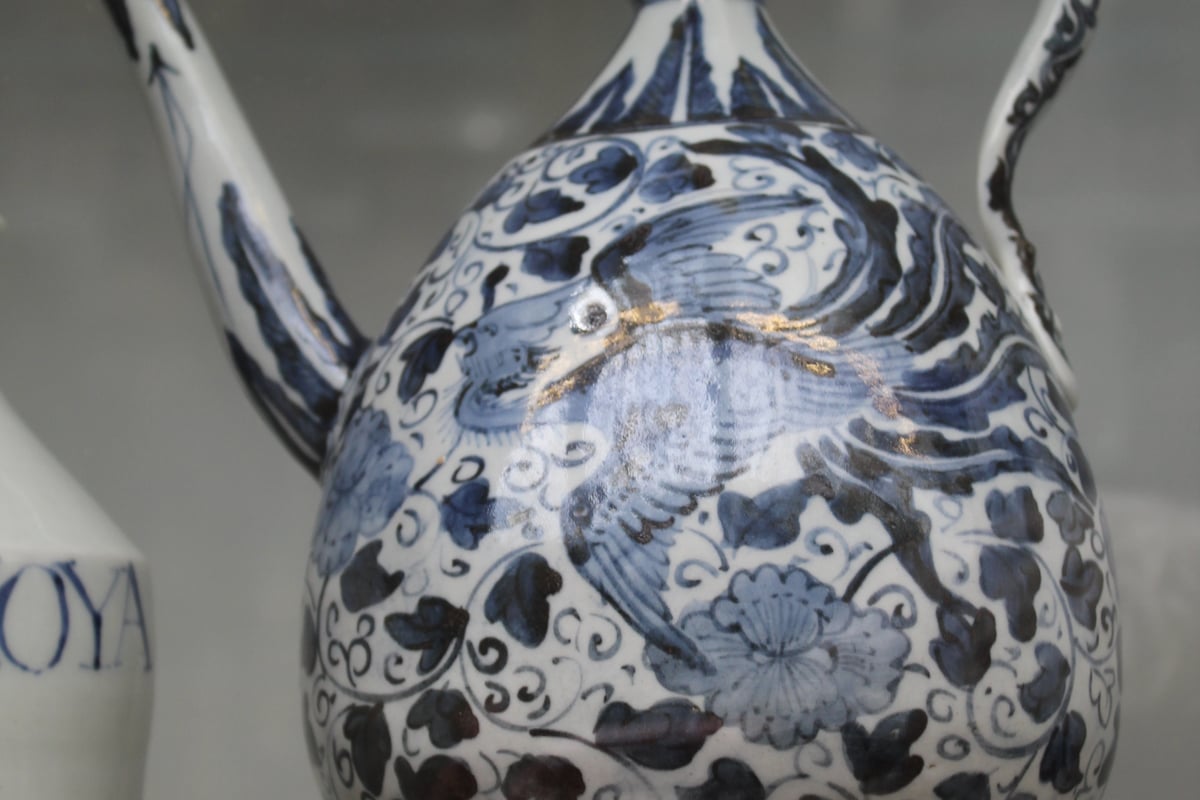
Arita ware
Arita-yaki
Arita ware is porcelain produced mainly in Arita, Saga Prefecture, known as the birthplace of porcelain in Japan. Around 1616, the Korean potter Yi Sam-pyeong (Ri Sanpei), who had been brought to Hizen during Toyotomi Hideyoshi's invasions of Korea, discovered high-quality porcelain stone at Izumiyama in eastern Arita and fired Japan's first white porcelain at the Tenguya kiln. During the Edo period, styles evolved from indigo-blue Early Imari ware to the red-accented Kakiemon style of the 1640s, the Nabeshima style reserved exclusively for tribute pieces made at the domain kiln, and lavish gilded Kinrande ware. Because it was shipped out through Imari Port, it was exported in large quantities to Europe via the Dutch East India Company under the name 'IMARI,' influencing Western ceramic culture. Designated a METI-designated Traditional Craft Product in 1977, the town of Arita still thrives around its porcelain industry today, centered on Tozan Shrine and the Arita Ceramics Fair.
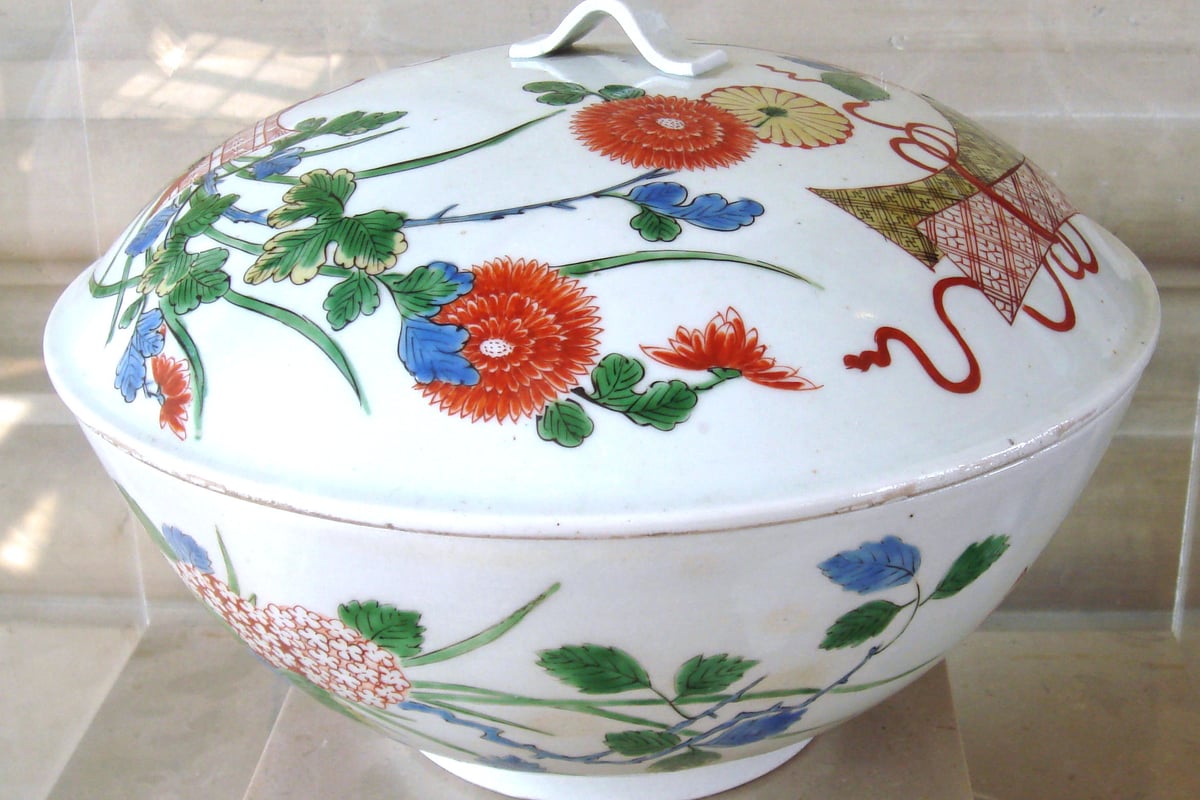
Imari ware
Imari-yaki
Imari ware takes its name from Imari Port, from which porcelain fired in the Arita area was shipped to markets across Japan and overseas. Old Arita ware exported abroad during the Edo period came to be known as 'Old Imari,' while today the name Imari ware more often refers specifically to porcelain fired in Ōkawachiyama, Imari City. In 1675, the Nabeshima clan of Saga Domain relocated its domain kiln from Arita to Ōkawachiyama, which developed as a 'village of secret kilns' producing tribute and gift wares for the shogunate and feudal lords. Set in a mountain valley, the area had checkpoints to prevent technical secrets from leaking out, and potters are said to have spent their entire lives there. General sales began after the Meiji era, and the ware was even exhibited at the 1873 Vienna World's Fair. Known for its meticulous blue-and-white designs and elegant overglaze enamel work, around 30 kilns in the area continue to preserve the tradition today.
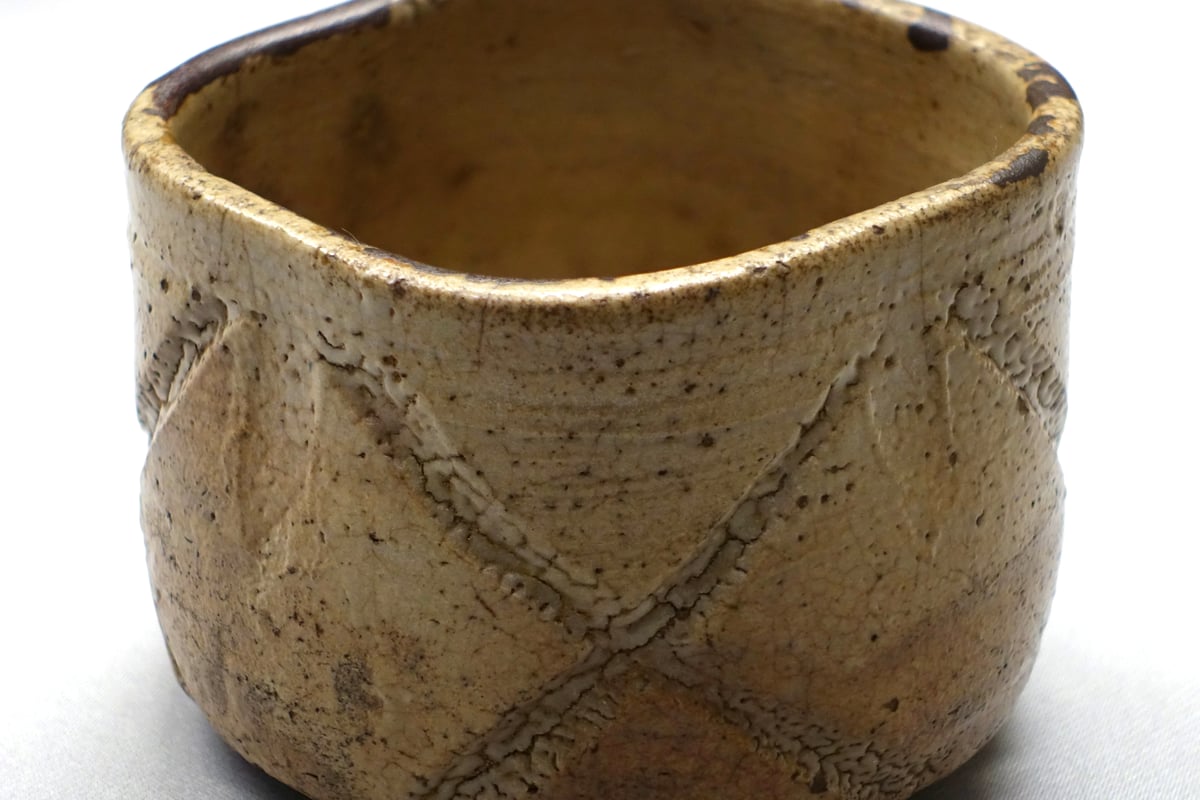
Karatsu ware
Karatsu-yaki
Karatsu ware is stoneware fired mainly around Karatsu City, Saga Prefecture, spanning from western Saga to northern Nagasaki Prefecture. Among tea practitioners it has long been prized alongside Raku ware and Hagi ware as one of the finest tea ceramics, summed up in the saying 'first Raku, second Hagi, third Karatsu.' Its origins are thought to date to the 1580s, when a kiln was opened under the patronage of the Hata clan, lords of Kishidake Castle. Korean potters brought back to Japan during Toyotomi Hideyoshi's invasions of Korea (the Bunroku-Keichō campaigns) introduced new techniques such as the kick wheel, multi-chambered climbing kilns, and hand-beaten forming (tataki-zukuri), dramatically advancing production. Distributed widely across western Japan via Karatsu Port, Karatsu ware was once so representative of the region that pottery in general came to be called 'karatsu-mono.' Production declined somewhat after the Meiji era, but was revived through the 12th-generation Nakazato Tarōemon (Muan), who restored Old Karatsu techniques, and the craft was designated a METI-designated Traditional Craft Product in 1988.
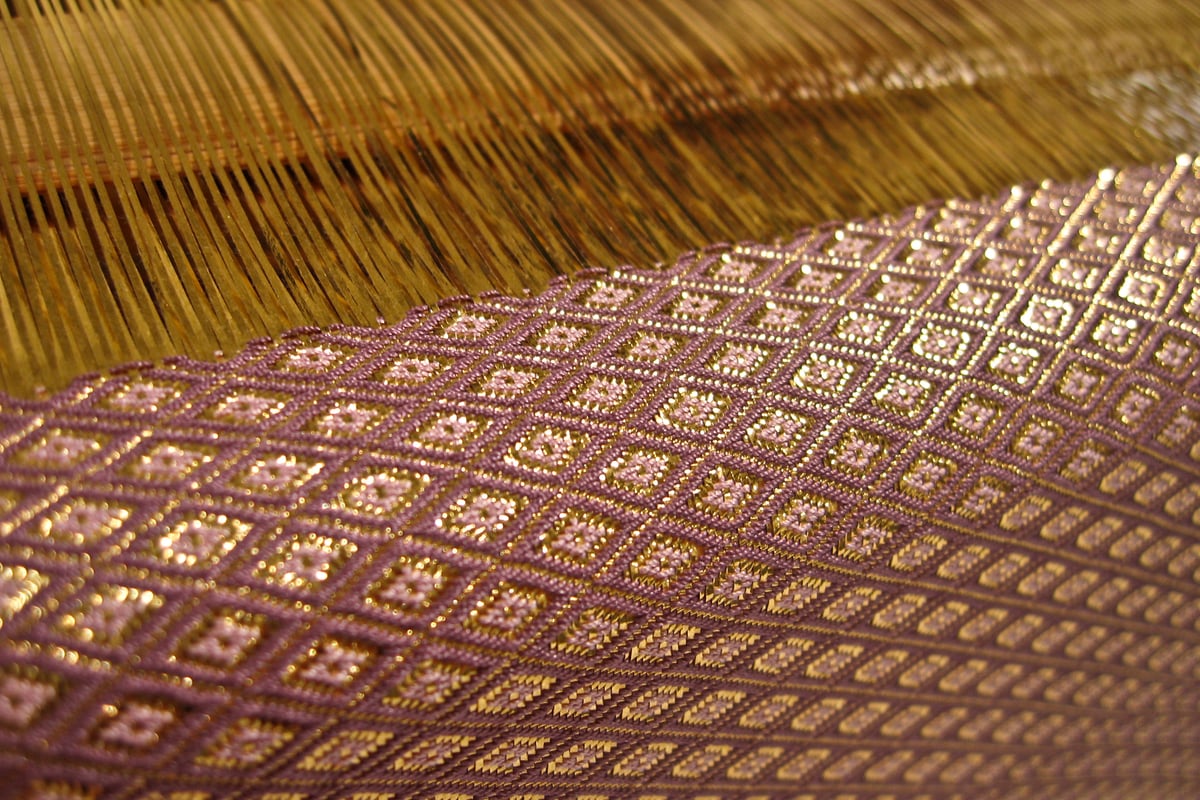
Saga-nishiki (Saga brocade)
Saga-nishiki
Saga-nishiki is a hand-woven silk textile in which the warp is made of 'foil thread'—gold and silver leaf glued onto washi paper with lacquer and cut into fine strips—while the weft is silk thread. It is said to originate in the Bunsei era (1818-1830) of the late Edo period, when Lady Kashiwaoka, wife of the 9th lord of the Kashima-Nabeshima family of Hizen Kashima Domain, was inspired by the beauty of the ajiro lattice pattern on the ceiling above her sickbed. Lady Yanagioka, wife of the 11th lord, and Kuzuko, wife of the 13th lord, developed it further as a pastime craft woven with paper and cotton threads, and it was later refined into a luxury textile using gold and silver foil thread together with silk. For a long time it was known by names such as 'okumimono,' 'kumi-nishiki,' and 'Kashima-nishiki,' but after it was exhibited to great acclaim at the 1910 Japan-British Exhibition in London, it came to be known uniformly as 'Saga-nishiki,' a name that identifies its place of origin. Its defining feature is the shimmer of gold and silver woven into intricate geometric patterns, used for obi sashes and small accessories.

Nabeshima Dantsu (Nabeshima carpet)
Nabeshima Dantsu
Nabeshima Dantsu is Japan's oldest cotton dantsu (hand-woven rug), originating in Ōgimachi village, Kase district, on the outskirts of the Saga castle town. It is said to have begun during the Genroku era of the Edo period (1688-1704), when a farmer named Koga Seiemon learned the art of dantsu weaving from a Chinese craftsman in Nagasaki and wove the first pieces as 'Ōgimachi mosen.' Although the technique is believed to have traveled from Central Asia through Turkey and China before reaching Japan, Nabeshima Dantsu differs from overseas dantsu, which typically use wool, in that it uses high-quality cotton—such as that produced in Shiroishi, Saga Prefecture—for both the warp and the weft. When Nabeshima Tsunashige, the third lord of Saga Domain, took a liking to its reputation, he granted the weaver a stipend of rice and placed it under the domain's protection, making it an official product of the domain; sale to the general public was forbidden for a long time as a result. General sale began in the Meiji era, and it was even exhibited at the 1873 Vienna World's Fair. Today it is still handed down as a precious craft, woven piece by piece with care by artisans using hand looms that remain unchanged for centuries.
Nao Tesuki Washi
Nao Tesuki Washi
Nao Tesuki Washi is a handmade washi paper that has been passed down for more than 300 years in the Nao district of Yamato, Saga City. It began in 1690 (Genroku 3), in the mid-Edo period, when Notomi Yusuke, the village headman of Nao, learned papermaking techniques in Mizoguchi village, Chikugo Province (present-day Yame City, Fukuoka Prefecture), and brought them back home. In the mountainous Nao area, where farmland was scarce, this technique spread as a valuable side occupation for farming households, and by its peak in the early Showa era, nearly 100 households were engaged in papermaking, making it a major production center. Its greatest characteristic is the use of kaji (a mulberry species native to and cultivated in the district) instead of the more common kozo as raw material; because its fibers are long and intertwine closely, the resulting paper is thin yet durable, and it has long been valued for lantern paper, bangasa umbrellas, rain capes, and shoji paper. However, the number of practitioners has continued to decline due to mechanization and changing lifestyles, and today only the Taniguchi family's workshop, 'Nao Tesuki Washi,' carries on the technique. The seventh-generation head, Taniguchi Gen, keeps the workshop running, working on new washi products that make use of tradition while forging new directions.
Hizen Biidoro
Hizen Biidoro
Hizen Biidoro is a traditional free-blown glass craft passed down in Saga City. Its roots trace back to 1852 (Kaei 5), in the closing years of the Edo period, when Nabeshima Naomasa, the 10th lord of Saga Domain, established the Seirenkata (a research institute equivalent to a modern institute of chemistry and physics) on the banks of the Tafuse River. Glassmaking was studied there for producing chemical containers needed for cannon manufacturing and medicine development, and the technique was nurtured under the domain's protection. Soejima Genichiro, who had worked at the Seirenkata since childhood, became independent and founded Soejima Glass Manufacturing in 1903 (Meiji 36), carrying the technique forward, and the company has continued making handmade glass ever since, for more than 120 years. Most products are shaped using the 'chubuki' (free-blowing) technique, which relies solely on breath rather than a mold, and among its techniques, 'Jappan-buki,' which uses two blowpipes at once, is known as a rare, advanced technique found almost nowhere else in the world. Today it is designated an Important Intangible Cultural Property of Saga City, and Soejima Glass Manufacturing preserves the tradition as its sole maker.
Morodomi Furniture
Morodomi Kagu
Morodomi Furniture is the collective name for furniture made in Morodomi, Saga City, and it developed thanks to its location facing the furniture-producing city of Okawa, Fukuoka Prefecture, across the Chikugo River. Morodomi had long been home to woodworking centered on sashimono joinery, but when the former Japan National Railways Saga Line opened in 1935, exchange with Okawa's 400-year-old furniture-producing area became active, bringing new woodworking techniques to Morodomi. Ties deepened further when the Morodomi and Okawa bridges were built over the Chikugo River in 1955, and when the bridges were opened toll-free in 1966, furniture manufacturers from Okawa moved in at an accelerated pace, and the area grew into one of Kyushu's leading furniture-producing regions. In 1980, the annual shipment value of furniture exceeded 10 billion yen, making it Kyushu's second-largest furniture-producing area. It handles a wide range of items, from traditional Japanese furniture such as paulownia chests and low tables to modern chairs and sofas, and in 2022 'Morodomi Kagu' was registered as a regional collective trademark. As a furniture-producing area combining high woodworking skill with strong design, it is now also focusing on exports overseas.
Nishikawanobori Takezaiku
Nishikawanobori Takezaiku
Nishikawanobori Takezaiku is a bamboo craft passed down in Nishikawanobori, Takeo City, Saga Prefecture, in which artisans hand-weave everyday items such as baskets, colanders, and lunch boxes from madake and hachiku bamboo. It is said to have begun in the early Meiji era as a side occupation for farming households, and developed into a local industry as the Nishikawanobori Village Bamboo Craft Association was established in 1909; from the early 20th century through the postwar years it grew into a major bamboo-craft production area with more than 500 artisans. However, from the 1950s onward, as synthetic resin products spread into furniture and farm tools, demand gradually declined, and today the craft is carried on by only a handful of workshops, foremost among them Kuriyama Shoten. Every step, from splitting the bamboo and shaping its width to weaving with its natural spring, is done entirely by hand, and unique techniques such as the chrysanthemum-base weave used for rice-washing colanders have been passed down. Designated a Saga Prefecture Traditional Local Product, in recent years the craft has also produced items suited to modern life, such as lunch boxes and lampshades, drawing renewed attention from younger generations from an SDGs perspective.
Yumino Ningyo
Yumino Ningyo
Yumino Ningyo are clay folk dolls made in the Yumino area of Nishikawanobori, Takeo City, Saga Prefecture. Their origin is said to date to 1882, when Kamejiro Harada, who had trained under the Hakata-doll craftsman Kiyoshige Fujiwara, grew unsatisfied with the Hakata-doll style and set out on a training journey around Kyushu. While stopping at Mount Yoshida in Yumino, he encountered the dark grey clay found there, which sparked his creative drive and led him to start doll-making in the area. The dolls initially had a refined style close to Hakata dolls, but gradually evolved into rustic, approachable figures characterized by thick layers of gofun (a white shell-based pigment) giving them a plump, rounded form and vivid coloring. The basic process involves packing clay into plaster molds to shape the dolls, drying and firing them, building up facial features with repeated coats of gofun, and hand-painting each one. Auspicious motifs such as beckoning cats (maneki-neko) and the twelve zodiac animals are common, and the beckoning-cat coin bank is especially well known as a popular product. Today, Eguchi Ningyo-ten, founded more than 140 years ago, is nearly the sole keeper of this tradition.
Saga's Local Food
Yobuko Squid
Yobuko Ika
Yobuko Ika refers to ikizukuri (live sashimi) made from squid such as yariika (spear squid) caught in the Genkai Sea around Yobuko, Karatsu City, Saga Prefecture, and served while still alive and nearly transparent. Yobuko Port sits close to prime fishing grounds in the Genkai Sea and is known as a fishing town where fresh squid is landed daily; squid dishes have developed here alongside the local morning market culture. The squid, which barely moves on the plate and is so transparent that the pattern of the dish shows through, is prized by visitors as proof of its freshness. The yariika squid mainly used is also registered as a 'Pride Fish,' a designation recommended by fishing industry representatives nationwide to represent their region. After enjoying the sashimi, it is customary to eat the remaining ears and legs deep-fried as tempura or grilled with salt, leaving nothing to waste — making it the signature dish that supports Yobuko's reputation as the 'town of squid.'
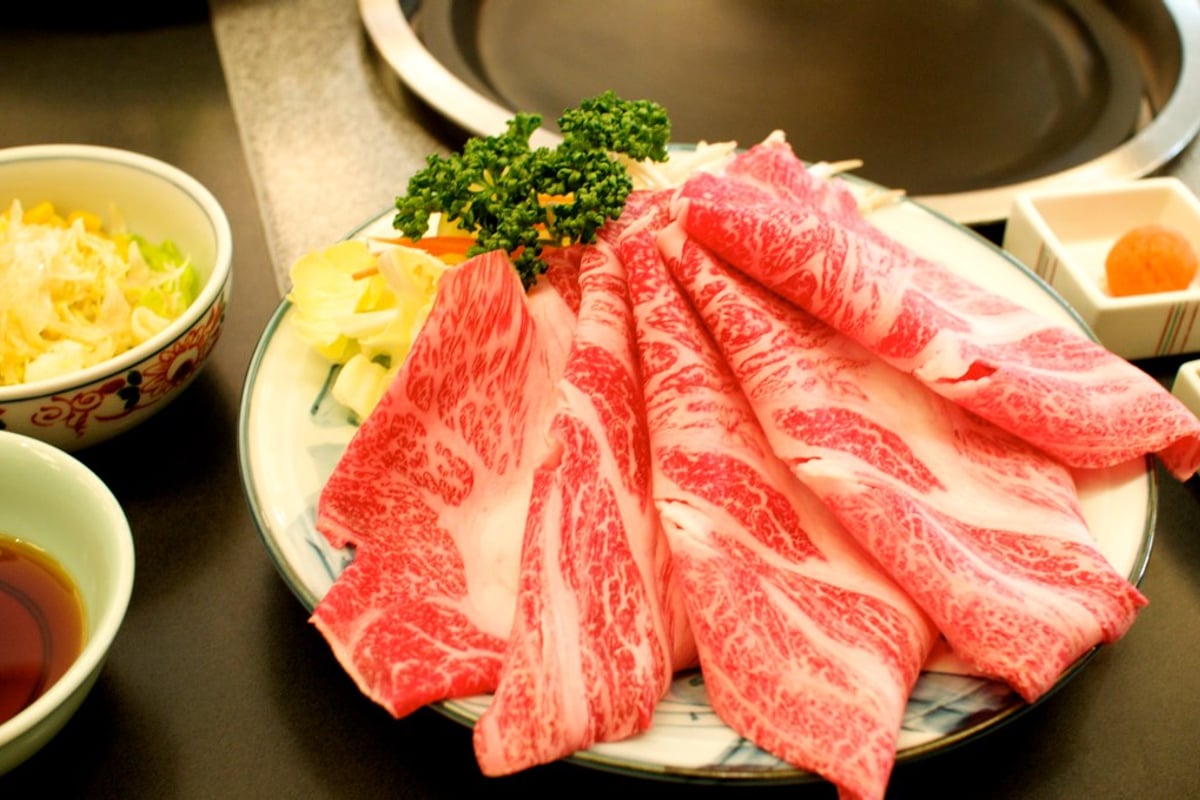
Saga Beef
Saga Gyu
Saga Beef is a branded beef designation reserved for Japanese Black cattle raised within the JA Group Saga area that meet strict standards set by the Japan Meat Grading Association: a meat quality grade of 4 or higher and a BMS (Beef Marbling Standard) number of 7 or higher. This rigorous system, under which only cattle meeting these standards may be called 'Saga Gyu,' consistently delivers finely marbled, tender meat. The brand traces its origins to 1984, when beef bearing a 'Saga Gyu' label was sold at a meat market in the Kansai region, and the trademark was registered in 2000. Nationally, Saga Beef is known for its stringent grading standards, sometimes described as second only to Sendai Beef in strictness, and it has grown into one of Saga Prefecture's leading culinary brands. Following the 2007 merger that formed JA Group Saga, the brand was expanded to cover all Japanese Black cattle raised within the JA Saga area, establishing a system in which quality is managed under unified standards regardless of production area or producer.
Ogi Yokan
Ogi Yokan
Ogi Yokan is a famous yokan (sweet bean jelly) product developed in Ogi City, Saga Prefecture, from the Meiji era onward. During the Edo period, the Nagasaki Kaidō, which connected Nagasaki and Kokura, was also known as the 'Sugar Road' because sugar brought by Nanban (European) trade was transported along it, and Ogi, one of the sugar collection points along the route, likewise developed a flourishing confectionery culture. In 1899, the founder of Muraoka Sohonpo learned yokan-making techniques from a yokan artisan in Nagasaki and began producing yokan there, and it is said that the second-generation head, Muraoka Yasukichi, was the first to use the name 'Ogi Yokan.' Ogi is a rare production area nationally, with more than twenty yokan shops clustered in a small town of about 50,000 people, and in 2020 it was certified as a component asset of the Japan Heritage designation 'The Nagasaki Kaidō That Spread Sugar Culture — the Sugar Road.' The fact that Ogi flourished as a castle town of the Nabeshima Domain is also said to have provided fertile ground for its confectionery culture to blossom.
Sicilian Rice
Sicilian Rice
Sicilian Rice is a local specialty said to have originated in Saga City. Thin-sliced meat is stir-fried with onion in a sweet-savory sauce and served over warm rice, arranged colorfully with raw vegetables such as lettuce, tomato, and cucumber, then finished with a drizzle of mayonnaise. It is said to have first appeared around 1975 as a staff meal at a coffee shop in central Saga City. Several theories surround the origin of its name, including one that the red of the tomato, the white of the egg, and the green of the vegetables evoke the Italian flag, and another linking it to Sicily, the island setting of the film 'The Godfather.' The ingredients and seasoning vary widely from shop to shop, and the dish is loved as a highly flexible local specialty, with some upscale restaurants even offering versions made with Saga beef steak. Because there is no fixed recipe or trademark, the Saga City Tourism Association's website and other sources note that 'the very fact that its origin remains unclear is part of its charm.'
Mutsugoro no Kabayaki (Grilled Mudskipper)
Mutsugoro no Kabayaki
Mutsugoro no Kabayaki is a local dish eaten along the Ariake Sea coast in Saga Prefecture. The mutsugoro (mudskipper) is a rare fish found in Japan only in the Ariake Sea and part of the Yatsushiro Sea; because it can breathe through both its gills and its skin, it is able to crawl across the tidal flats. The fish is skewered live and first grilled plain over charcoal, then repeatedly dipped into and slowly grilled in a sweet-savory sauce made of sugar, soy sauce, and sake, and can be eaten whole, head to tail. The fishing season runs from April to August, with the best time to eat it limited to the summer months of May through August, and this seasonal delicacy has been passed down in homes and restaurants along the Ariake Sea coast. During the spawning season of May to July, males can be seen repeatedly jumping to court females, making the mudskipper a local tourism draw not only as a dish but also as a creature of the tidal flats.
Funankogui (Kelp-Wrapped Carp Stew)
Funankogui
Funankogui is a local dish from Kashima City, Saga Prefecture, in which live crucian carp (funa) are wrapped whole in kelp and simmered for a long time together with vegetables such as daikon radish and lotus root, in a broth of red miso and starch syrup (mizuame). The long simmering softens the fish all the way to the bones, so it can be eaten whole, and it has a distinctive flavor with none of the fishy smell one might expect. It is said to have originated because sea bream, traditionally served at celebratory occasions, was once rare and expensive along the Ariake Sea, so the readily available crucian carp was used in its place. In Kashima's Hamamachi district, a market called the 'Funa-ichi,' where the carp and vegetables used in the dish are sold, has been held every January 19th for more than 300 years, and the following day, January 20th — known as Hatsuka Shogatsu ('Twentieth-Day New Year') — people still carry on the custom of offering this dish to the god Ebisu to pray for a good catch, business prosperity, and safety at home.
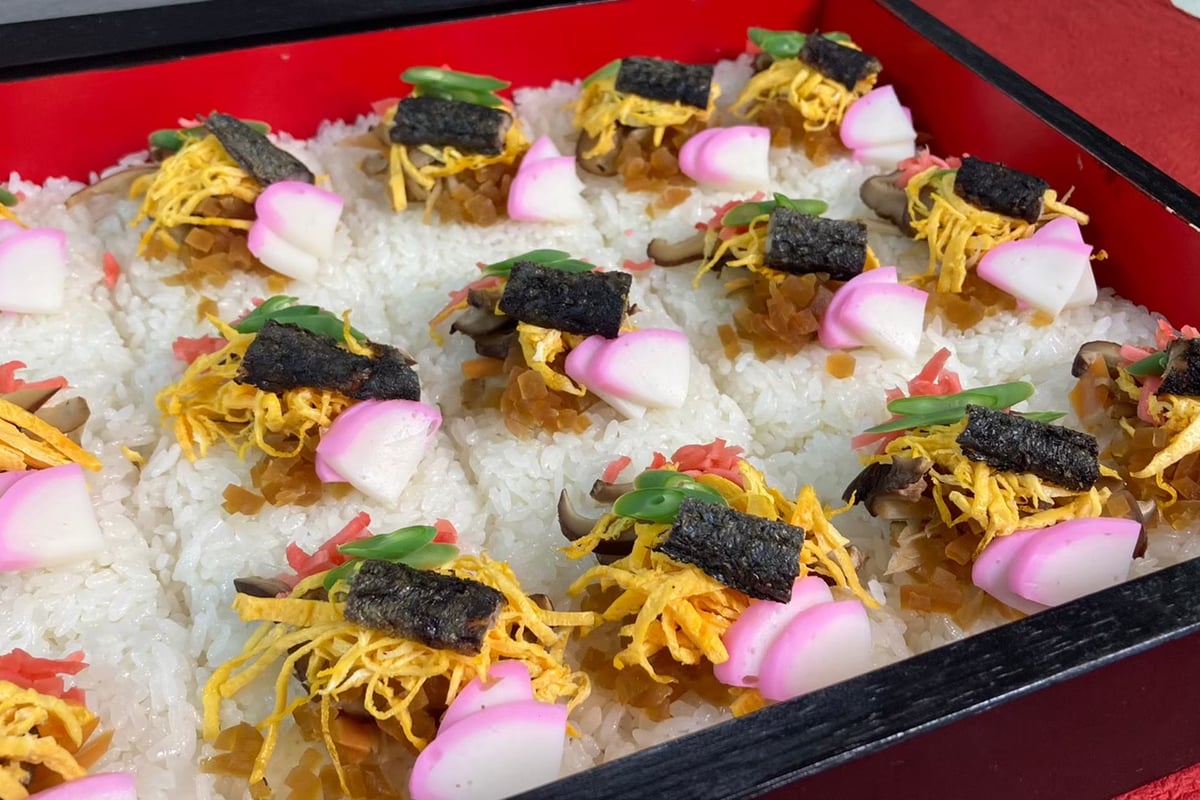
Sukozushi (Suko-Style Box Sushi)
Sukozushi
Sukozushi is a box-style sushi that has been passed down for about 500 years in the Suko area of Shiroishi Town, Saga Prefecture. Vinegared rice is packed into a shallow wooden box called a 'morofuta,' and topped colorfully with ingredients such as kabayaki-style grilled mudskipper (mutsugoro), shiitake mushrooms, burdock root, narazuke pickles, red pickled ginger, and thin shredded egg crepe (kinshi tamago). It is said to have originated when the local lord of Suko worked hard to improve the quality of rice for the farmers, and in gratitude the villagers made sushi using the bounty of the sea and mountains and presented it to him. Since then, the recipe has been handed down from mother to child and from child to grandchild, and it has been cherished as a dish for festivals, celebrations, temple visits, and for welcoming daughters home for a visit. In recent years mudskipper has become harder to obtain, so shrimp or gizzard shad (konoshiro) are sometimes used instead, but the dish is treasured as a local heritage, and efforts to pass it on continue, including through school cooking classes.
Dabu (Karatsu-Style Simmered Vegetable Soup)
Dabu
Dabu is a local dish from around Karatsu City, Saga Prefecture, made by simmering chicken with vegetables such as daikon radish, carrot, taro, burdock root, lotus root, and konjac in a dashi broth, seasoning it with salt or soy sauce, and lightly thickening it with potato starch. It has a distinctive custom of varying the preparation for celebratory and mourning occasions: for celebrations, colorful tama-fu (wheat gluten dumplings) and ginkgo nuts are added and the ingredients are cut into squares, while for funerals no tama-fu is used and ingredients such as konjac are cut into triangles instead. As for the origin of the name, one theory holds that 'dabu' is a corrupted form of 'zabu-zabu,' describing how the dish is finished with plenty of water. It is also said to have originated as a way to make full use of vegetable scraps left over from preparing dishes such as nishime (simmered vegetables), and there was a custom of neighbors gathering for weddings, funerals, and other ceremonial occasions to prepare a large potful together. Today it is still cherished as a 'taste of home' that people crave when returning to visit their hometown.
Warasubo Dishes
Warasubo
Warasubo dishes are a Saga Prefecture specialty made from the warasubo, a rare fish found in Japan only in the Ariake Sea. A member of the goby family, the warasubo has degenerated eyes and an eel-like, elongated body with an upward-opening mouth lined with fang-like teeth, which has earned it the nickname 'Alien of the Ariake Sea' after a monster from the movies. It burrows into the soft mud of the tidal flats, and during its peak season from May to October it is served in miso soup, as sashimi, or simmered; at other times of year it is gutted, dried, and eaten deep-fried or lightly grilled. Despite its unusual looks, its white flesh carries a strong umami flavor and has long been a familiar local ingredient. In recent years, changes to the tidal flat environment such as the reclamation of Isahaya Bay have reduced catches, and the fish is now listed as Vulnerable on the Ministry of the Environment's Red List of Threatened Species.
Ganzuke (Fermented Crab Paste)
Ganzuke
Ganzuke is a Saga Prefecture specialty made by grinding whole small crabs, such as fiddler crabs found on the tidal flats of the Ariake Sea, shell and all, then mixing them with salt, soy sauce, and chili pepper and letting them ferment and mature. Depending on the area it is also called 'ganizuke' or 'ganezuke.' It is said to be a preserved food with a long history, made along the Ariake Sea coast since the Edo period, born from the wisdom of using the tidal flats' wide difference between high and low tide to make full use of the small crabs found there in abundance. It is characterized by its rich salty flavor, strong crab taste, and the gritty texture of the crushed shells, and in Saga it is more commonly eaten spooned over hot rice than as a snack with alcohol. It is also sometimes used as a seasoning in fried rice, miso soup, or pasta.
Model Course
A full-day tour of the ceramics towns of Arita and Imari
Stroll through Arita, the birthplace of Japanese porcelain, taking in Tōzan Shrine and the kiln-lined streets, then head to Ōkawachiyama, the 'hidden kiln village,' to visit workshops carrying on the tradition of wares once made exclusively for the shogunate. A course that lets you savor the history and differing techniques of Japanese porcelain in a single day — Saga's signature pottery journey.
A half-day course pairing Karatsu-yaki with Yobuko squid
Experience the rustic, understated beauty of Karatsu-yaki pottery at a kiln workshop, then head to Yobuko Port to enjoy sashimi made from live kensaki squid caught in the Genkai Sea. A course that lets you enjoy both the wabi-sabi world of Karatsu-yaki and the translucent beauty of the squid in a single day.
Domain-era crafts and Saga cuisine in central Saga City
Try your hand at weaving Saga-nishiki brocade at the Saga City Museum of History and Folk Customs, then visit Soejima Glass to see the free-blown glass technique behind Hizen Biidoro. Finish with Sicilian rice, born in Saga City, and Saga beef — a course that lets you enjoy both domain-era craft culture and Saga's local cuisine in one visit.
Ariake Sea tidal-flat delicacies and Sukozushi
Observe mudskippers on the tidal flats of Kashima City, then sample Ariake Sea specialties found nowhere else, such as grilled mudskipper and ganzuke crab paste. Finish in Shiroishi Town with Sukozushi, a festive box sushi — a course for savoring the bounty of the Ariake Sea.
Craftwork and sweets in Takeo and Ogi
Experience the handcraft of Nishikawanobori bamboo ware and Yumino dolls in the Nishikawanobori district of Takeo City, then head to Ogi City to compare the historic yōkan shops that keep alive the sugar culture of the Nagasaki Kaidō. A course through a confectionery-producing area recognized as a Japan Heritage site.
Events
Arita Ceramic Fair
Every year, April 29 – May 5 / Kamiarita and around Arita Station, Arita Town, Nishimatsuura District, Saga Prefecture
View details →Karatsu Kunchi
Every year, November 2–4 / Karatsu Shrine and central Karatsu City (UNESCO Intangible Cultural Heritage)
View details →Saga International Balloon Fiesta
Every year, late October to early November / The Kase River floodplain, Saga City
View details →