Image: Wikimedia Commons
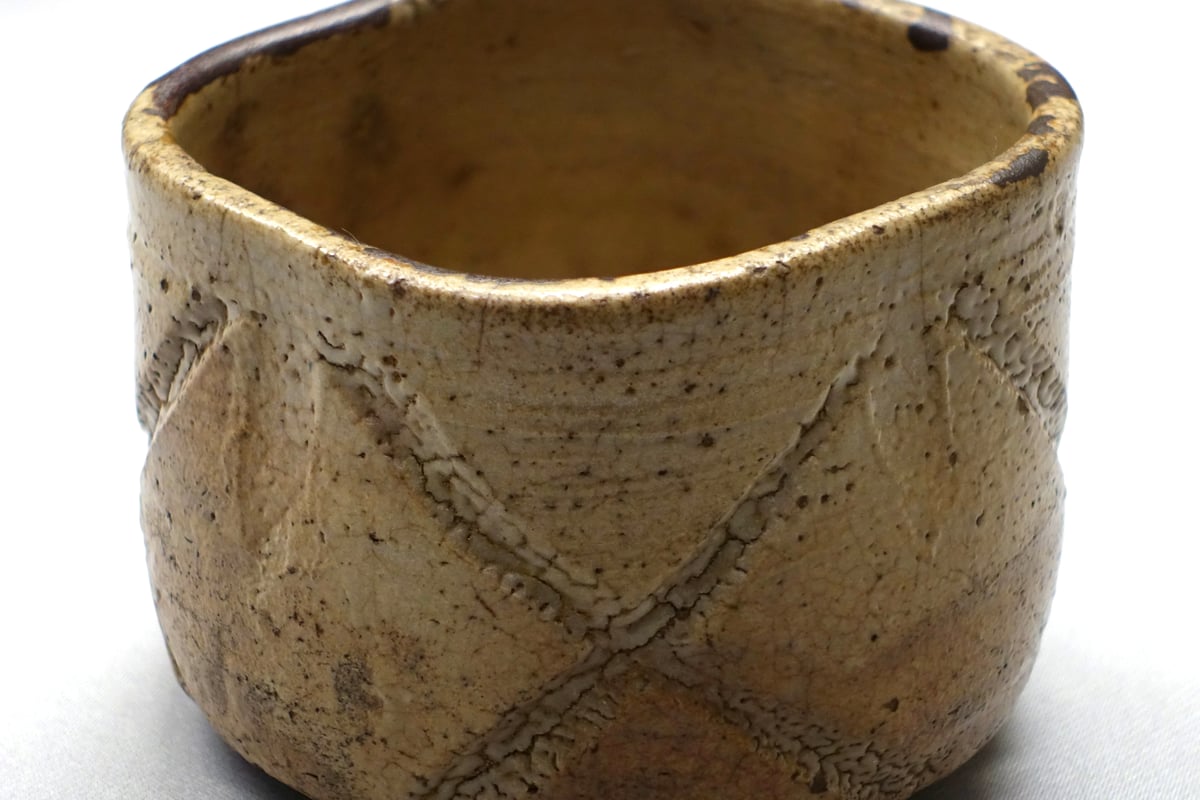
Karatsu ware is stoneware fired mainly around Karatsu City, Saga Prefecture, spanning from western Saga to northern Nagasaki Prefecture. Among tea practitioners it has long been prized alongside Raku ware and Hagi ware as one of the finest tea ceramics, summed up in the saying 'first Raku, second Hagi, third Karatsu.' Its origins are thought to date to the 1580s, when a kiln was opened under the patronage of the Hata clan, lords of Kishidake Castle. Korean potters brought back to Japan during Toyotomi Hideyoshi's invasions of Korea (the Bunroku-Keichō campaigns) introduced new techniques such as the kick wheel, multi-chambered climbing kilns, and hand-beaten forming (tataki-zukuri), dramatically advancing production. Distributed widely across western Japan via Karatsu Port, Karatsu ware was once so representative of the region that pottery in general came to be called 'karatsu-mono.' Production declined somewhat after the Meiji era, but was revived through the 12th-generation Nakazato Tarōemon (Muan), who restored Old Karatsu techniques, and the craft was designated a METI-designated Traditional Craft Product in 1988.
Origin
Recent kiln-site surveys suggest that Karatsu ware originated in the 1580s in the domain of the Hata clan, lords of Kishidake Castle. Korean potters brought back to Japan during Toyotomi Hideyoshi's Bunroku-Keichō invasions of Korea then introduced new techniques such as the kick wheel, multi-chambered climbing kilns, and hand-beaten forming, greatly advancing both production volume and technical standard. Records also survive of a tea bowl said to have been owned by the tea master Sen no Rikyū, showing that Karatsu ware was already highly regarded in the Momoyama period.
History
During the Edo period, Karatsu ware was shipped widely across western Japan from Karatsu Port to Kyoto, Osaka, and beyond, becoming so representative of the region that pottery in general came to be called 'karatsu-mono.' It declined somewhat after losing domain patronage in the Meiji Restoration, but in the Shōwa era, 12th-generation Nakazato Tarōemon (Muan) surveyed old kiln sites around Karatsu and revived the Old Karatsu techniques of the Momoyama period, leading to renewed appreciation. Muan was recognized as a Living National Treasure in 1976, and the craft was designated a METI-designated Traditional Craft Product in 1988.
Features
Karatsu ware avoids showy decoration, and its greatest feature is a simple, understated appeal that makes the most of the clay's natural texture. It comes in many varieties, including 'e-Karatsu' (painted Karatsu), decorated with plants and flowers in iron pigment; 'Chōsen Karatsu' (Korean Karatsu), combining iron glaze with straw-ash glaze; 'madara Karatsu' (mottled Karatsu), in which feldspar glaze creates mottled patterns; and 'oku-Kōrai,' which carries on the style of Korean tea bowls. Prized for its earthy, comfortable feel in the hand and the way its character deepens with use, it remains highly valued as tea ceramics today.
Techniques
Tataki-zukuri (hand-beaten forming)
An old technique in which slabs of clay are shaped by beating and compressing them. It produces even thickness and durability, supporting the bold forms characteristic of Karatsu ware.
Keirokuro (kick wheel)
A potter's wheel spun by kicking it with the foot to build momentum. Introduced from the Korean peninsula, it has been widely used in forming Karatsu ware.
Materials Used
Production Process
- 1
Preparing the clay
The clay is crushed and elutriated to remove impurities and adjust it for easy forming.
- 2
Forming
The vessel is shaped using the kick wheel or hand-beaten forming.
- 3
Drying and trimming
The formed piece is dried, and the foot and other details are trimmed to refine the shape.
- 4
Glazing and painting
Designs are painted in iron pigment, or iron glaze and straw-ash glaze are applied.
- 5
Climbing-kiln firing
The piece is fired at high temperature in a multi-chambered climbing kiln, bringing out the natural texture of the clay.
| Main Production Areas |
|
|---|
Artisans & Workshops
中里太郎右衛門陶房
A distinguished Karatsu ware family with a history of more than 430 years, tracing back to the first-generation Nakazato Matashichi. The 12th-generation Nakazato Tarōemon (Muan) was recognized as a Living National Treasure in 1976 for reviving Old Karatsu techniques. The nationally designated historic site 'Tōjinmachi Ochawangama' kiln also remains on the grounds.
Official site →How to Buy
- Nakazato Tarōemon Kiln Official Online Store
- The official online store of a Karatsu ware kiln with 430 years of history, offering one-of-a-kind works including e-Karatsu and Chōsen Karatsu pieces.Where to buy →PR
Hands-on Experiences
中里太郎右衛門陶房・御茶盌窯記念館
佐賀県唐津市町田3丁目6-29
Free to tour the pottery; general admission to the Ochawangama Memorial Museum is ¥400 (closed Wednesdays and Thursdays; 10 minutes on foot from Karatsu Station).