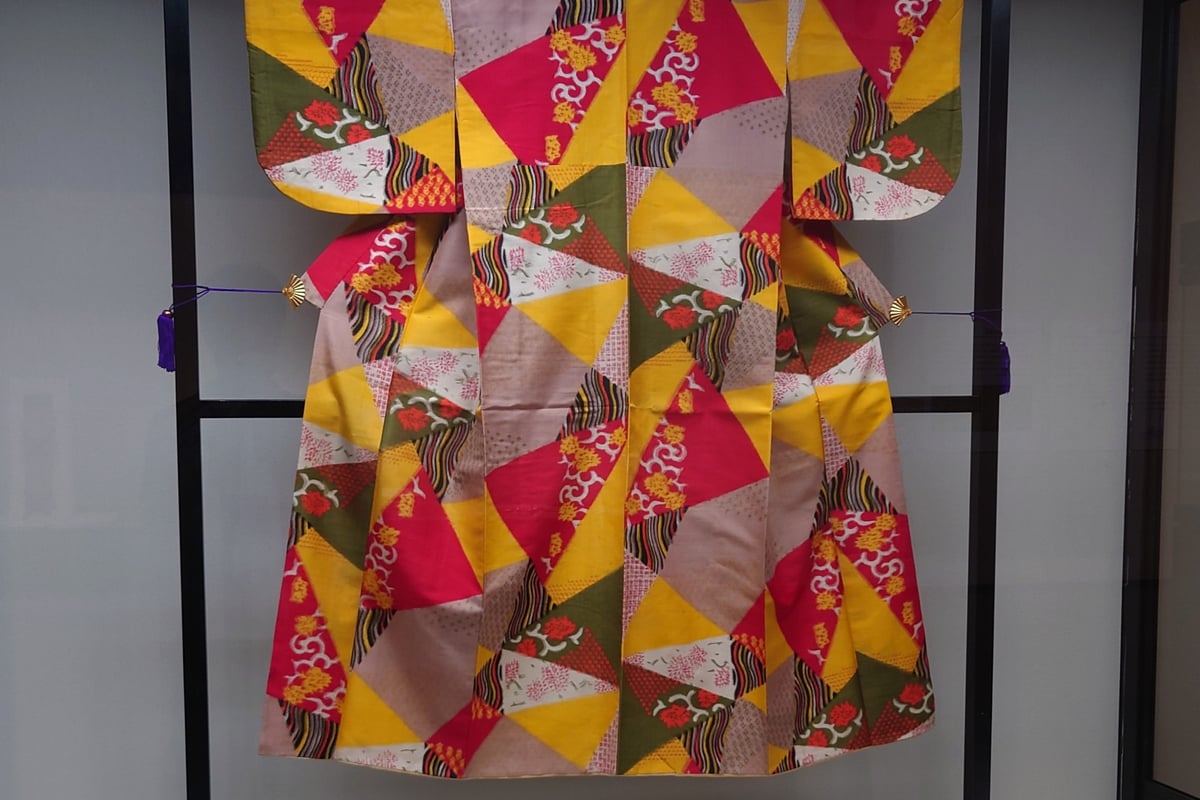
Image: Wikimedia Commons
Isezaki-gasuri is a silk textile produced in and around Isesaki, Gunma Prefecture, and a METI-designated Traditional Craft (Japan). The history of the production area is said to go back as far as the Kofun period, based on excavated hemp textiles, and commercial production began in earnest in the late Edo period. In 1880, the Isesaki Futori Company was established, improving both quality and output, and from the Taisho era into the early Showa era the area enjoyed a golden age in which production of the patterned meisen textile known as 'Isesaki meisen' accounted for roughly half of the nation's total. The region excels in ikat (kasuri) techniques using thread dyed in sections by hand-binding or itajime (board-clamp) methods, and in particular Combined kasuri, which uses ikat-dyed thread in both the warp and weft to weave intricate patterns, is considered a technique that developed only in Isesaki. It was designated a Traditional Craft in 1975, and the techniques continue to be passed down today, centered on the Isesaki Textile Cooperative and the Isesaki Textile Industry Association.
Origin
The origins of textile production in Isesaki are said to be old, with hemp textiles reportedly excavated from nearby burial mounds (kofun). In the late Edo period, the commercialization of a silk textile called futori advanced, and Isesaki became known as one of the leading silk-textile production areas in the Kanto region. In 1880, the Isesaki Futori Company was established, after which both quality and output improved significantly.
History
From the Meiji era onward, the area continued to develop while adopting overseas techniques, and from the Taisho era into the early Showa era, production of the patterned meisen textile known as Isesaki meisen reached its peak, said to have accounted for roughly half of all meisen produced nationwide. Production continued after World War II alongside demand for kimono, and in 1975 it was designated the METI-designated Traditional Craft (Japan) 'Isezaki-gasuri.' In recent years, initiatives such as the '21st Century Meisen Project' have also been underway to revive Combined kasuri, one of the traditional techniques.
Features
Isezaki-gasuri is a plain-weave textile using yarn-dyed thread, characterized by four ikat (kasuri) techniques: Kukuri-gasuri (binding ikat), Itajime-gasuri (board-clamp ikat), Combined kasuri, and Nukiso-gasuri (weft-only ikat). Among them, Combined kasuri, in which both the warp and weft threads are dyed with an ikat pattern beforehand and then woven together, can express intricate, vivid patterns created by the overlapping colors, and is considered an advanced technique that developed only in Isesaki. Part of its appeal is that the ikat pattern and sheen grow richer the more the fabric is used.
Techniques
Combined kasuri
A technique in which both the warp and weft threads are dyed in an ikat pattern beforehand and then woven together. The overlapping colors and patterns create intricate, vivid designs, and it is regarded as the pinnacle of Isezaki-gasuri techniques.
Itajime-gasuri (board-clamp ikat)
A technique in which warp threads are wound around ikat boards carved with patterns on both sides; several boards are stacked, clamped tightly with bolts, and then dipped in dye. It can produce precise patterns such as fine tortoiseshell (kikko) or well-curb (igeta) motifs.
Kukuri-gasuri (binding ikat)
A technique in which the parts of a thread bundle that should not be dyed are tightly bound with tape or similar material before dyeing. Because dye cannot penetrate the bound sections, they remain white, making it possible to create multicolored ikat patterns.
Nukiso-gasuri (weft-only ikat)
A technique in which the warp thread is left plain while only the weft thread is dyed beforehand in an ikat pattern to create the design. Compared with Combined kasuri, it produces a calmer, more subdued pattern.
Production Process
- 1
Design creation
A rough sketch of the pattern that will become the ikat design is created. For Combined kasuri, the patterns to be transferred for the warp and weft threads are each decided at this stage.
- 2
Stencil carving and gauze stretching
A stencil is carved based on the design, and gauze (sha) is stretched over it to complete the stencil used for dye printing. The finer the ikat pattern, the more precise the stencil-carving technique required.
- 3
Dye printing (nassen)
Using the stencil, dye is rubbed into bundles of thread to dye the pattern in sections. This process transfers the same pattern onto both the warp and weft threads.
- 4
Warping and thread winding
The dyed warp thread is wound in the correct order so it can be set on the loom, and the weft thread is also wound so its pattern will align, completing the preparations for weaving.
- 5
Weaving
The fabric is woven while aligning the positions of the ikat patterns on the warp and weft threads. It is a divided-labor process requiring advanced skill to keep the pattern from shifting.
| Main Production Areas |
|
|---|
Artisans & Workshops
シロテックス株式会社
A textile company headquartered in Isesaki that carries on the history of Isesaki meisen dating back to the Edo period. In addition to manufacturing and sales, it puts effort into outreach such as hosting school field trips.
Official site →How to Buy
- Isesaki Meisen Shop Hanabana
- A shop specializing in Isesaki meisen that opened in 2024. It carries about 300 kimono and haori items ranging from antique to contemporary, and is within walking distance of Isesaki Station.Where to buy →PR
- Isesaki Meisen-ya
- A business that plans and sells accessories and goods, such as slippers, uchiwa fans, and handbags, made from Isesaki meisen fabric. It also creates collaborative products with local companies.Where to buy →PR
Hands-on Experiences
いせさき明治館
群馬県伊勢崎市曲輪町31-4
A facility housed in the prefecture's oldest wooden Western-style clinic building, built in 1912. Admission is free, and it holds seasonal exhibitions of Isesaki meisen as well as selling accessories made from the fabric.
View details →