Image: Wikimedia Commons
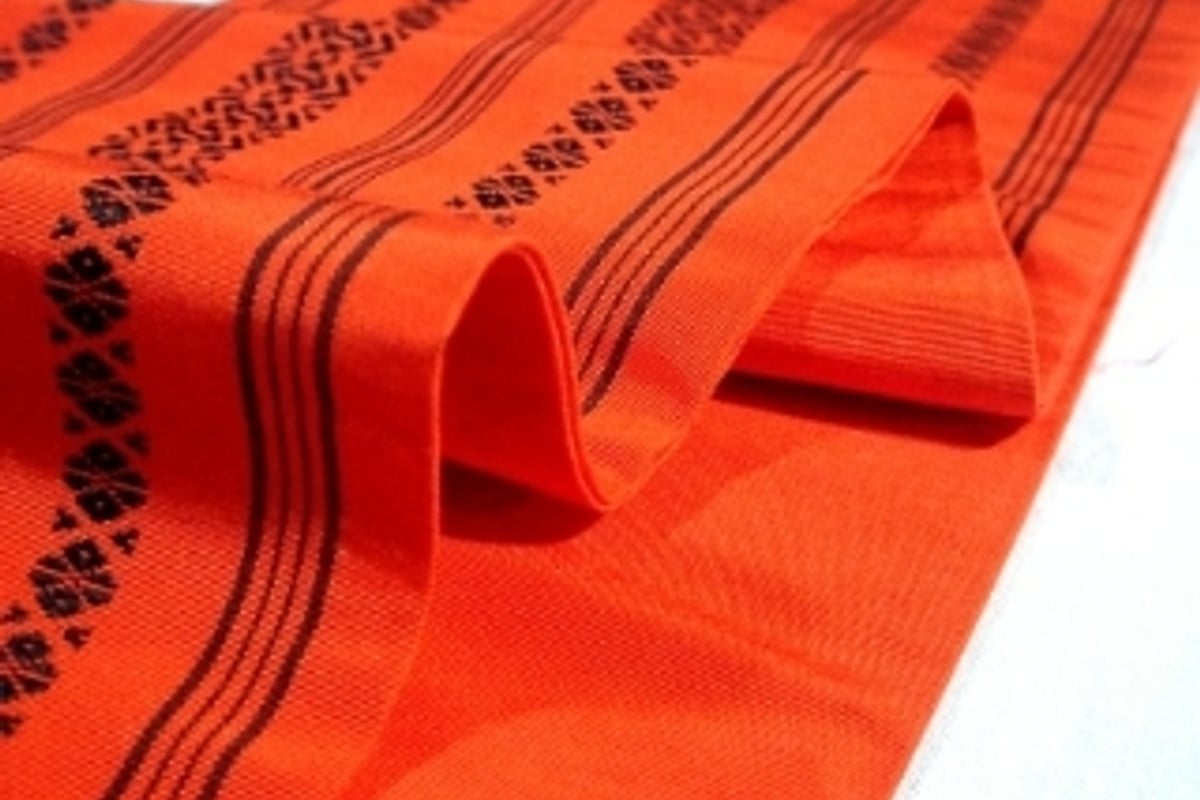
Hakata-ori is a silk textile woven in the Hakata district of Fukuoka City and is a Traditional Craft Designated by the Minister of Economy, Trade and Industry. Its origins are said to date back to 1241, when the Hakata merchant Mitta Yazaemon traveled to Song-dynasty China together with the Zen monk Enni (Shoichi Kokushi) and brought back weaving techniques. In 1600, at the start of the Edo period, Kuroda Nagamasa, who ruled Chikuzen, chose Hakata-ori as a tribute to the shogunate, beginning the annual custom of presenting obi fabric—giving rise to the name 'Kenjo Hakata-ori' ('tribute Hakata-ori'). Its representative design, the kenjo pattern, combines a motif based on the dokko and hanazara (Buddhist ritual implements) with 'oyako-jima' stripes symbolizing a parent protecting a child and 'koko-jima' stripes symbolizing a child's devotion to a parent. A distinctive weaving method—densely arranging warp threads and beating the weft in firmly—produces fabric with thickness and firmness, and the resulting obi have long been prized for staying tightly tied once fastened. Designated a national Traditional Craft in 1976, Hakata-ori has produced two Living National Treasures to date.
Origin
The origins of Hakata-ori trace back to 1241, in the Kamakura period. The Hakata merchant Mitta Yazaemon traveled to Song-dynasty China together with the Zen monk Enni (Shoichi Kokushi) and brought back weaving techniques learned there. His descendants are said to have later added weaving methods from the Guangdong region, establishing a technique known as 'Guangdong weaving,' which became the foundation of Hakata-ori.
History
When Kuroda Nagamasa took control of Chikuzen in 1600, Hakata-ori was chosen as a tribute to the shogunate, beginning the custom of presenting ten strips of obi fabric and three bolts of raw silk every March. From this practice of 'tribute' (kenjo), the design combining the dokko-and-hanazara motif with oyako-jima and koko-jima stripes came to be called the 'kenjo pattern.' In the Meiji era, the introduction of Jacquard looms brought technical innovation, and in 1976 Hakata-ori was designated a national Traditional Craft; two weavers have since been recognized as Living National Treasures.
Features
The defining feature of Hakata-ori is its distinctive weaving method, using many densely arranged warp threads and beating in thick weft threads firmly, producing fabric that is thick, firm, and durable. When tied, it makes a characteristic silk 'creak,' and once fastened it rarely loosens, making it a valued material for both men's and women's obi since ancient times. The 'kenjo pattern,' a stylized design based on the dokko and hanazara ritual implements, is the design that symbolizes Hakata-ori, and its color combinations—such as the five-colored kenjo—carry meanings drawn from Confucian virtues.
Techniques
Kenjo pattern (dokko and hanazara motif)
A design based on the dokko, an implement used in esoteric Buddhism, and the hanazara, a tray used for offering flowers to the Buddha. Combined with 'oyako-jima' stripes symbolizing a parent protecting a child and 'koko-jima' stripes symbolizing a child's devotion, it is the design that symbolizes Hakata-ori.
Warp-dominant plain weave
A technique of densely arranging many fine warp threads and firmly beating in thick weft threads. This gives the fabric thickness and firmness, producing a durable obi material that ties comfortably.
Materials Used
| Main Production Areas |
|
|---|
Artisans & Workshops
西村織物
Founded in 1587 as a raw silk trading house, it began weaving Hakata-ori in 1861, making it the oldest Hakata-ori weaving house. It produces a wide range of obi fabrics, from the traditional kenjo pattern to contemporary designs.
Official site →How to Buy
- Nishimura Orimono Online Shop
- The official online store of the oldest Hakata-ori weaving house, offering Hakata obi and accessories woven in-house.Where to buy →PR
Hands-on Experiences
西村織物 工場見学
福岡県筑紫野市紫7-3-5
A tour of a normally closed weaving factory, with an artisan's explanation included. Takes about one hour and costs from around ¥10,000 (includes a Hakata-ori souvenir; advance reservation required).
View details →