Image: Wikimedia Commons
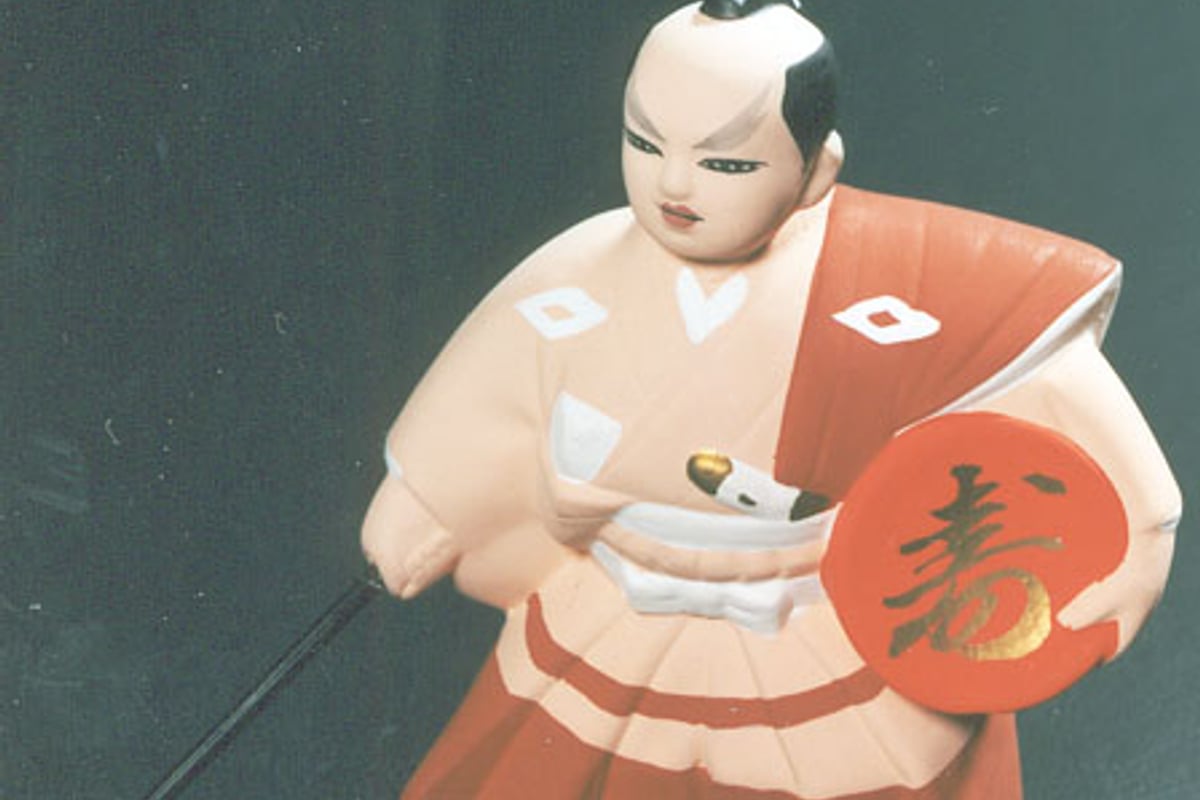
Hakata Ningyo are unglazed clay dolls traditionally made in and around Hakata Ward, Fukuoka City, and are a Traditional Craft Designated by the Minister of Economy, Trade and Industry. Their origins trace back to 1600, when Kuroda Nagamasa entered Chikuzen Province and gathered many craftsmen in Hakata; the technique of making unglazed clay dolls is said to have emerged from among them. Several lineages came together in their development, including figurative dolls made by deko craftsmen, Soshichi ware descended from roof-tile makers, and the line begun by Nakanoko Kichibei, who created folk toys in the late Edo period. A defining feature is that the dolls are fired unglazed after coloring, and they depict a wide range of subjects—from the realistic 'beauty' figures for which Hakata Ningyo are especially known to Kabuki and Noh characters, warriors, zodiac animals, and Fukusuke—with fine detail and realism. In the Meiji era, the dolls earned high acclaim at overseas expositions such as the Paris World's Fair, becoming known worldwide as a representative Japanese doll craft.
Origin
The origins of Hakata Ningyo are said to date back to 1600, when Kuroda Nagamasa entered Chikuzen Province and gathered many craftsmen there, giving rise to the technique of making unglazed clay dolls among them. Tradition holds that three lineages came together: figurative dolls descended from the deko craftsman Kobori Zenzaemon, who was invited from Kyoto in 1437 to make Yamakasa festival dolls; Soshichi ware, founded by the grandson of a roof-tile maker from Banshu; and the line begun by Nakanoko Kichibei, who created folk toy dolls in the late Edo period.
History
In the latter half of the Edo period, master craftsmen such as Masaki Soshichi, Nakanoko Kichibei, and Shiromizu Buhei emerged one after another, and the industry flourished, with dolls distributed nationwide. In the Meiji era, the dolls were exhibited at overseas expositions such as those in Paris, winning international acclaim and becoming an export craft known worldwide under the name 'Hakata Ningyo.' In 1976, the doll category was designated a national Traditional Craft, and the techniques have been passed down to the present day.
Features
The defining feature of Hakata Ningyo lies in the way the unglazed, fired texture of the clay body is used to full effect before coloring. After the body is formed using a plaster mold, the skin is finished with gofun (crushed shell powder), kimono patterns and other details are hand-painted one by one, and finally the expression is completed with 'menso'—painting the eyes and lips with a fine brush. Subjects range widely, from realistic 'beauty' figures to Kabuki actors, Noh characters, warriors, Fukusuke, and zodiac animals, with delicate modeling and soft coloring as their main appeal.
Materials Used
Production Process
- 1
Prototype
A master doll-maker—only the most skilled can do this—carves the doll's prototype in clay based on a sketch.
- 2
Mold-making
A plaster mold is taken from the finished prototype to allow the design to be reproduced.
- 3
Forming the body
Clay is pressed into the plaster mold to reproduce the body, then dried and fired unglazed.
- 4
Coloring
After the skin is finished with gofun, kimono patterns and other details are carefully painted on with pigments.
- 5
Menso (facial detailing)
Using a fine brush, the eyes, lips, and other facial details are finished, bringing the doll to life.
| Main Production Areas |
|
|---|
Artisans & Workshops
梶原博多人形工房(梶原正二)
A workshop where Shoji Kajiwara, a nationally certified Traditional Craftsman, has been making Hakata Ningyo for over 50 years. He has received numerous awards, including the Prime Minister's Award twice and the Minister of Land, Infrastructure, Transport and Tourism Award six times.
Official site →田中勇気博多人形工房
The workshop of Yuki Tanaka, who won the 'Yoichi Award,' a gateway prize for young Hakata Ningyo makers. He trained under Shoji Kajiwara starting in 2007 and became independent in 2016. Near the Kawabata Shopping Street in Hakata Ward, Fukuoka City, the workshop offers exhibitions and painting experiences.
Official site →How to Buy
- Hakata Traditional Craft Center
- A facility in front of Hakata Station displaying Hakata Ningyo and Hakata-ori. It includes a video exhibit on 'How Hakata Ningyo Are Made,' and its website introduces a list of shops where the dolls can be purchased. Admission is free.Where to buy →PR
Hands-on Experiences
田中勇気博多人形工房
福岡市博多区上川端9-35 A41(川端商店街内)
Holds a painting workshop where visitors paint unglazed clay dolls. The painting experience costs from around ¥1,650 and requires advance reservation.
View details →