Image: Wikimedia Commons
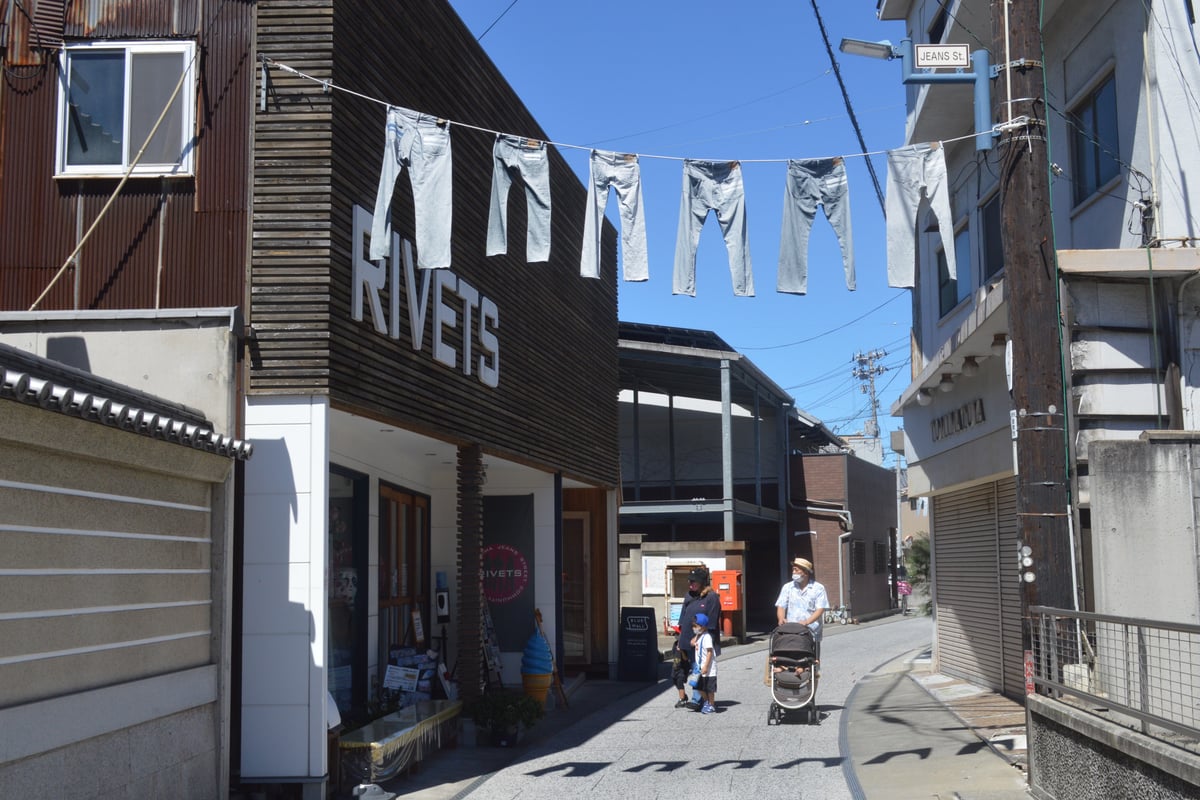
Kojima Denim is the general term for denim fabric and jeans produced in the Kojima district of Kurashiki City, Okayama Prefecture, known as the 'birthplace of Japan-made jeans.' In the Edo period, cotton farming resistant to salt thrived on land reclaimed from the shallow sea, and the cotton-weaving industry that grew from it gave rise to kokura-ori weaving and sanada-himo braided cords. In the Meiji and Taisho eras, the area developed as a center for tabi socks and school uniforms, and the techniques and know-how of this textile industry were later carried over into the denim and jeans industry. In 1965, Kotaro Ozaki of Maruo Seifuku (now Big John) used denim fabric imported from the United States, applying the sewing techniques used for school uniforms to manufacture and sell Japan's first domestically made jeans. In 1973, Kurashiki Spinning succeeded in producing domestic denim fabric, and Kojima developed into a production area capable of handling everything from yarn to fabric, sewing, and wash processing in one place. Today, about 40 specialty jeans shops line 'Kojima Jeans Street,' which runs from Kojima Station, and it has become a sightseeing spot visited by many people from Japan and abroad.
Origin
In the Edo period, cotton farming resistant to salt thrived on the land of Kojima, created by reclaiming a shallow sea. The textile industry that developed using this cotton, producing kokura-ori weaving and sanada-himo braided cords, marks the beginning of Kojima's textile industry. Through the Meiji and Taisho eras, the area developed as a center for tabi socks and school uniforms, building up a foundation of sewing techniques and manufacturing know-how.
History
In 1965, Kotaro Ozaki of Maruo Seifuku (now Big John), a school-uniform manufacturer, sewed denim fabric imported from the United States using school-uniform-making techniques, manufacturing and releasing Japan's first domestically made jeans. In 1973, Kurashiki Spinning succeeded in producing domestic denim fabric, and Kojima developed into a production area capable of handling everything from weaving and dyeing to sewing and wash processing in one place. Today, the area centered on the Kojima district and Ibara City remains a denim-producing region recognized internationally.
Features
The defining feature of Kojima Denim is that everything from yarn to fabric, sewing, and processing and finishing can be handled within the region. From fabric-making using indigo-dyed thread to wash processing that makes the most of fading, the sewing techniques and dyeing know-how cultivated in the school-uniform and tabi industries are applied throughout. About 40 specialty jeans shops line 'Kojima Jeans Street,' which runs from in front of Kojima Station, and facilities offering factory tours and jeans-making experiences are also scattered throughout the area.
Materials Used
Production Process
- 1
Spinning
The process of spinning yarn from raw cotton. Cotton yarn, the base material for denim fabric, is made through processes such as carding, drawing, roving, and spinning.
- 2
Dyeing (rope dyeing)
'Rope dyeing,' in which warp threads are bundled into a rope shape and dipped in indigo dye, is carried out. Only the surface of the thread is dyed while the core remains white, which is what produces the distinctive fading that develops with wear.
- 3
Weaving
Indigo-dyed warp threads and undyed weft threads are woven together to produce denim fabric with an indigo-blue face and an undyed back.
- 4
Sewing and processing
Cutting and sewing are carried out with a mix of artisan handwork, and wash processing and other techniques finish the fading and silhouette.
| Main Production Areas |
|
|---|
Artisans & Workshops
ジャパンブルー(桃太郎ジーンズ)
A denim maker led by Toshio Manabe, who proposed the creation of Kojima Jeans Street. It produces 'Momotaro Jeans,' domestically made jeans that place great emphasis on dyeing, weaving, sewing, and washing.
Official site →How to Buy
- 桃太郎ジーンズ 児島味野本店
- The main store of Momotaro Jeans, which handles everything from fabric to sewing in-house. It offers a wide selection, including models available only at the main store.Where to buy →PR
Hands-on Experiences
ベティスミス ジーンズミュージアム&ヴィレッジ
岡山県倉敷市児島下の町5-2-70
Admission is free. The jeans-making experience costs around 11,000 yen and up, letting you create a one-of-a-kind pair of original jeans.
View details →