Image: Wikimedia Commons
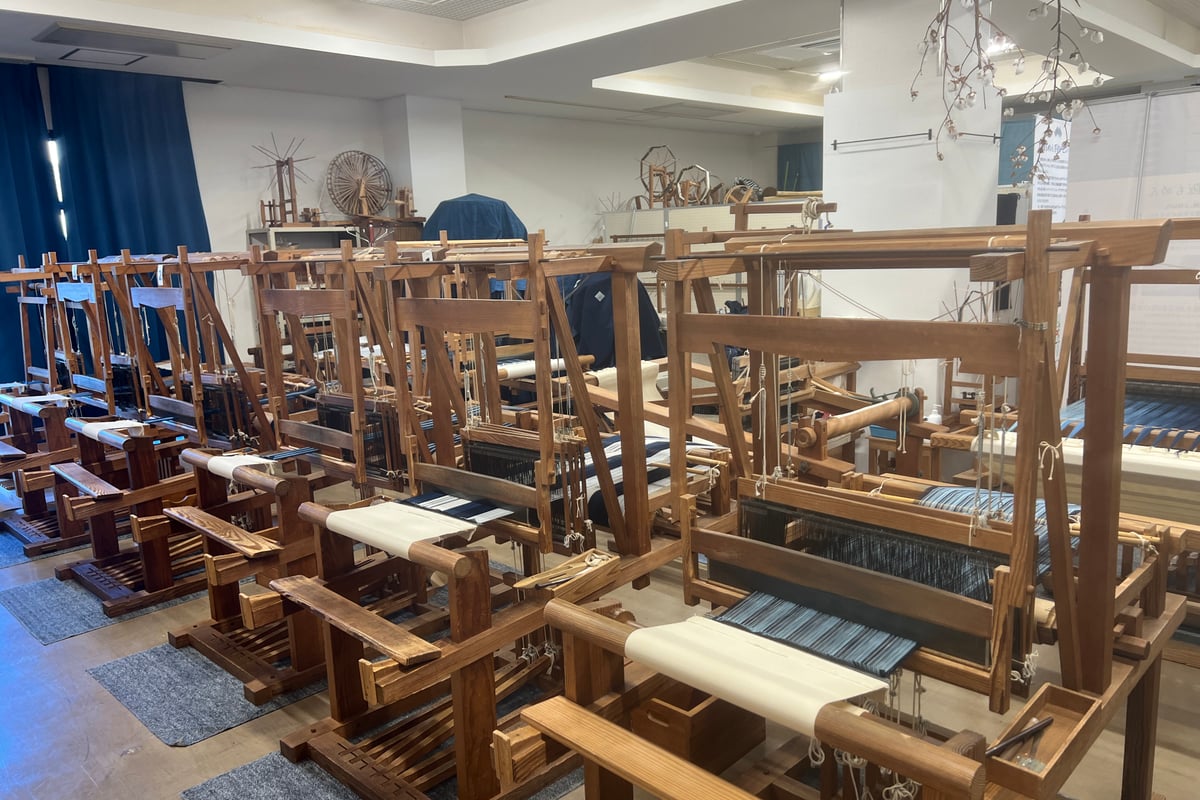
Matsusaka Momen is a cotton textile made in Matsusaka City and Meiwa Town, Mie Prefecture. It is characterized by being woven into fine stripes using yarn dyed beforehand with natural indigo. These stripes are also called 松阪縞 (Matsusaka stripes). The area around Matsusaka has long been known for spinning and weaving, and when cotton arrived around the 15th century, those skills were carried over into cotton weaving. In the Edo period it was woven extensively as a side job by farming households, and Matsusaka merchants such as the Mitsui, 長谷川 and 小津 families spread its sales in Edo. The pattern, which looks plain from a distance but reveals stripes up close, was prized as 'iki' (understated chic) in an era of sumptuary edicts. It is said that at its height, 500,000 to 600,000 tan (bolts) were sold in Edo in a single year. Today, 御絲織物 continues production by machine weaving, and the hand-weaving techniques are passed on by groups such as 松阪もめん手織り伝承グループゆうづる会. It is a Mie Prefecture Designated Traditional Craft.
Origin
Tradition holds that around the 5th century, the weavers known as Ayahatori (漢織) and Kurehatori (呉織), who possessed loom-weaving skills, came to the Matsusaka area from the continent. The area around the Miito (御糸) district on the lower reaches of the 櫛田川 River has long been a place where silk and hemp were woven. When cotton arrived around the 15th century, cotton cultivation also spread along the coast of Ise Bay. Matsusaka Momen is said to have been born from the combination of these ancient spinning and weaving skills with cotton. The stripe patterns are said to originate from ryujofu (柳条布) of the Kingdom of Annam (present-day Vietnam).
History
In 1588 (Tensho 16), Gamo Ujisato established a castle town in Matsusaka, laying the foundation for a town of merchants. Edo-period Matsusaka is said to have had more than 40 indigo dyers, and a striped pattern called Matsusaka-jima (松坂嶋) emerged. Mitsui Takatoshi, born in Matsusaka, opened the Echigoya (越後屋) kimono fabric store in Edo in 1673. Matsusaka merchants, represented by the Mitsui, 長谷川 and 小津 families, named this cotton 'Matsusaka Momen' and marketed it. Around the time of the Kyoho Reforms, it took Edo by storm for being inexpensive, durable and stylish in its stripes.
Features
Matsusaka Momen is a yarn-dyed cotton textile using yarn dyed with natural indigo. Because the yarn is dyed before weaving, a variety of stripes that make the most of the indigo color can be expressed. Representative patterns include sensuji ('a thousand stripes') and mansuji ('ten thousand stripes'), in which fine lines are densely arranged. The understated pattern, which looks plain from a distance but shows its stripes up close, was considered 'iki' in Edo, where showy kimono were restricted. Because it was woven as a side job by farming households, its pattern designs are said to be relatively simple. Being inexpensive and durable was another reason it spread among ordinary people.
Materials Used
| Main Production Areas |
|
|---|
Artisans & Workshops
御絲織物株式会社
A weaving house that carries on Miito-ori (御糸織), which has been woven around the 下御糸 area of Meiwa Town since the Edo period. It handles every step in-house, from dyeing yarn with plant indigo to weaving bolts of fabric by machine. It has registered 'みいと織' (Miito-ori) as a trademark. Factory tours are available by telephone reservation.
松阪もめん手織り伝承グループゆうづる会
A group that passes on the hand-weaving techniques of Matsusaka Momen. In October 2019 (Reiwa 1), it was added, following 御絲織物, as a prefecture-designated organization for Matsusaka Momen. 森谷尚子, a member of the group, was recognized in 2026 as a Mie Prefecture certified traditional craftsperson.
How to Buy
- 松阪もめん手織りセンター
- A facility on the first floor of the industrial promotion center in 本町, Matsusaka City, selling hand-woven bags, coin purses, stoles and more. Each hand-woven item is one of a kind. Clothing, kimono and accessories made of Matsusaka Momen are also available. Open from 9:00 to 17:00; closed on Tuesdays.Where to buy →PR
- Meiwa Town furusato nozei (hometown tax donation)
- Products of 御絲織物, which produces machine-woven Matsusaka Momen, are offered as return gifts for Meiwa Town's furusato nozei. If you would like to tour the factory and make a purchase at the same time, make a reservation by telephone on a weekday.
Hands-on Experiences
松阪もめん手織りセンター
三重県松阪市本町2176 松阪市産業振興センター1階
You can try hand-weaving on a traditional loom. The 'Petit Orihime Experience' (プチ織姫体験), in which you weave a small mat in about an hour, costs 1,500 yen, and the 'One-Day Orihime Experience' (一日織姫体験), in which you weave about 1 m of fabric in 4 to 5 hours, costs 5,000 yen. Reservations must be made at least three days in advance, and reception hours are 9:00 to 15:00. There are conditions such as a minimum height of 145 cm.
View details →FAQ
Q. Is Matsusaka Momen a national Traditional Craft?
A. It has not been designated a Traditional Craft by the national government (the Minister of Economy, Trade and Industry). It is a 'Mie Prefecture Designated Traditional Craft,' designated independently by Mie Prefecture. The designated organizations are two businesses: 御絲織物 and 松阪もめん手織り伝承グループゆうづる会, which was added in 2019.
Q. Is there a place where I can learn about the history of Matsusaka Momen?
A. The former 長谷川治郎兵衛 residence (旧長谷川治郎兵衛家) in 魚町, Matsusaka City, is the house of a wealthy merchant family that ran a cotton wholesale business in Edo, and is a national Important Cultural Property. It was built in the mid-Edo period, and extensions and renovations continued until the early Showa period. It is open from 9:00 to 17:00 and closed on Wednesdays. Cotton is also grown on the grounds.