Image: Wikimedia Commons
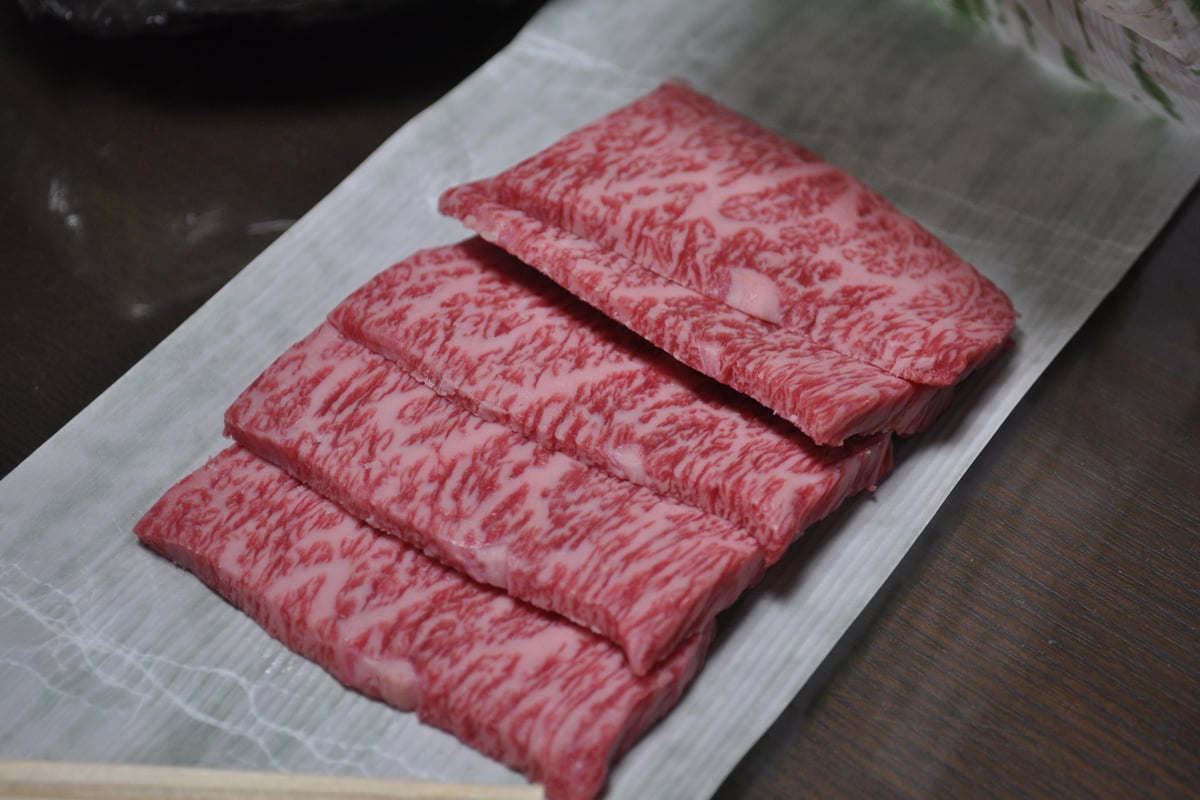
Matsusaka beef is a brand of Japanese Black cattle fattened in the area centered on Matsusaka City, Mie Prefecture. It is read either 'Matsusaka-ushi' or 'Matsusaka-gyu.' Only heifers that have never calved qualify, and each animal is registered in the 'Matsusaka Beef Individual Identification Management System.' Since long ago, the Matsusaka area has brought in young female cattle born in Tajima (present-day northern Hyogo Prefecture) as draft cattle for farm work. From the Meiji era onward, these cattle came to be fattened over a long period and shipped as beef cattle to Tokyo and other places. It is said that Matsusaka beef received the top honor award at the National Beef Cattle Livestock Exhibition in 1935 (Showa 10), and that its fame then spread nationwide. Its hallmarks are fine marbling (shimofuri) and fat that melts at a low temperature. When cooked, it is said to give off a sweet aroma called 'wagyu-ko' (wagyu aroma). Locally, the standard dish is sukiyaki, in which the meat is seared in an iron pot and seasoned with sugar and tamari soy sauce. Some restaurants also serve it grilled over a wire grill or as steak.
Origin
Even before farming was mechanized, the Matsusaka area purchased young female cattle born in the Tajima region and raised in Kishu (Wakayama Prefecture) to use as draft cattle. Draft cattle are cattle used for heavy work such as plowing fields. When the culture of eating beef spread in the Meiji era, people began fattening cattle that had finished their working lives over a long period and selling them as high-quality beef cattle.
History
Cattle from Matsusaka are said to have been shipped from the early Meiji era to Tokyo, where eating meat had become a boom. In 1935 (Showa 10), Matsusaka beef won an honor award at the National Beef Cattle Livestock Exhibition held in Shibaura, Tokyo, and became known throughout the country. In 2002 (Heisei 14), the Matsusaka Beef Council began operating the individual identification management system. In 2017 (Heisei 29), 'Tokusan Matsusaka Beef' (specially produced Matsusaka beef) was registered as a national Geographical Indication (GI).
Features
To be called Matsusaka beef, an animal must be a Japanese Black heifer that has never calved and must have been brought into the Matsusaka beef production area by the age of 12 months. The production area consists of 22 former municipalities, including Matsusaka City, Tsu City, and Ise City, and the animal's period of fattening within the area must be both the longest and the last. Among these cattle, those brought in from Hyogo Prefecture and fattened for 900 days or more are called 'Tokusan Matsusaka Beef.' The fat is rich in oleic acid and has a low melting point, giving the meat a texture that seems to melt in the mouth.
Main Ingredients
Food Culture
Matsusaka sukiyaki is basically Kansai-style, in which the meat is seared without using warishita (sukiyaki sauce). Beef suet is spread in an iron pot, the meat is laid out one slice at a time and seasoned with sugar and tamari soy sauce, and it is then dipped in beaten egg and eaten. Vegetables go into the pot only after the meat has been eaten and are seasoned in the same way. It is a way of eating that lets you enjoy the flavor of the meat itself first.
How It Differs from Home Cooking
Some specialty restaurants use Matsusaka beef raised on their own ranches. At some long-established restaurants, a server (nakai) sears the meat one slice at a time at your table. Besides sukiyaki, you can enjoy each restaurant's own ways of serving the beef, such as ami-yaki (grilled over a wire grill) and shio-chiri (a salt-flavored hot pot).
Famous Shops
和田金
三重県松阪市中町1878
A long-established Matsusaka beef restaurant said to have been founded in 1878 (Meiji 11). It has its own ranch and handles everything from fattening the cattle to cooking. Its specialty is sukiyaki (written 寿き焼), which a server sears in an iron pot and seasons with sugar, tamari soy sauce, and kombu dashi; courses cost around 20,000 yen.
View details →牛銀本店
三重県松阪市魚町1618
A restaurant said to have been founded in 1902 (Meiji 35) as a gyunabe (beef hot pot) shop, standing in an old townscape. Besides sukiyaki, Matsusaka beef can be enjoyed as shio-chiri, mizutaki, ami-yaki, and more. Sukiyaki starts at around 9,900 yen per person.
View details →| Beef Shigure-ni (和田金) | A tsukudani-style processed product made by 和田金, which simmers Matsusaka beef using its own method. It goes well with rice or ochazuke (rice with tea poured over it) and is also chosen as a gift. Sets that pair it with soboro-ni are also available, and it can be bought in store or by mail order. |
|---|
FAQ
Q. Which is the correct reading: 'Matsusaka' or 'Matsuzaka'?
A. The place name 松阪 is read without the voiced sound, as 'Matsusaka.' Both 'Matsusaka-ushi' and 'Matsusaka-gyu' are registered as readings in the trademark registration. Reading it as 'Matsuzaka-gyu' or writing it as 松坂牛 is incorrect.
Q. What is the difference between 'Matsusaka beef' and 'Tokusan Matsusaka Beef'?
A. Both are Japanese Black heifers that have never calved, fattened in the Matsusaka beef production area. Among them, those brought in as calves from Hyogo Prefecture and fattened over a long period of 900 days or more are 'Tokusan Matsusaka Beef.' Tokusan Matsusaka Beef was registered as a national Geographical Indication (GI) in 2017.
Q. Are Matsusaka cattle raised drinking beer?
A. Some farmers are said to give beer to cattle that have lost their appetite, for example in summer. This is because the yeast in beer is thought to help the stomach work. However, it is not a feeding practice common to all Matsusaka cattle. Some farmers are also said to spray the cattle with shochu and brush them.