Image: Wikimedia Commons
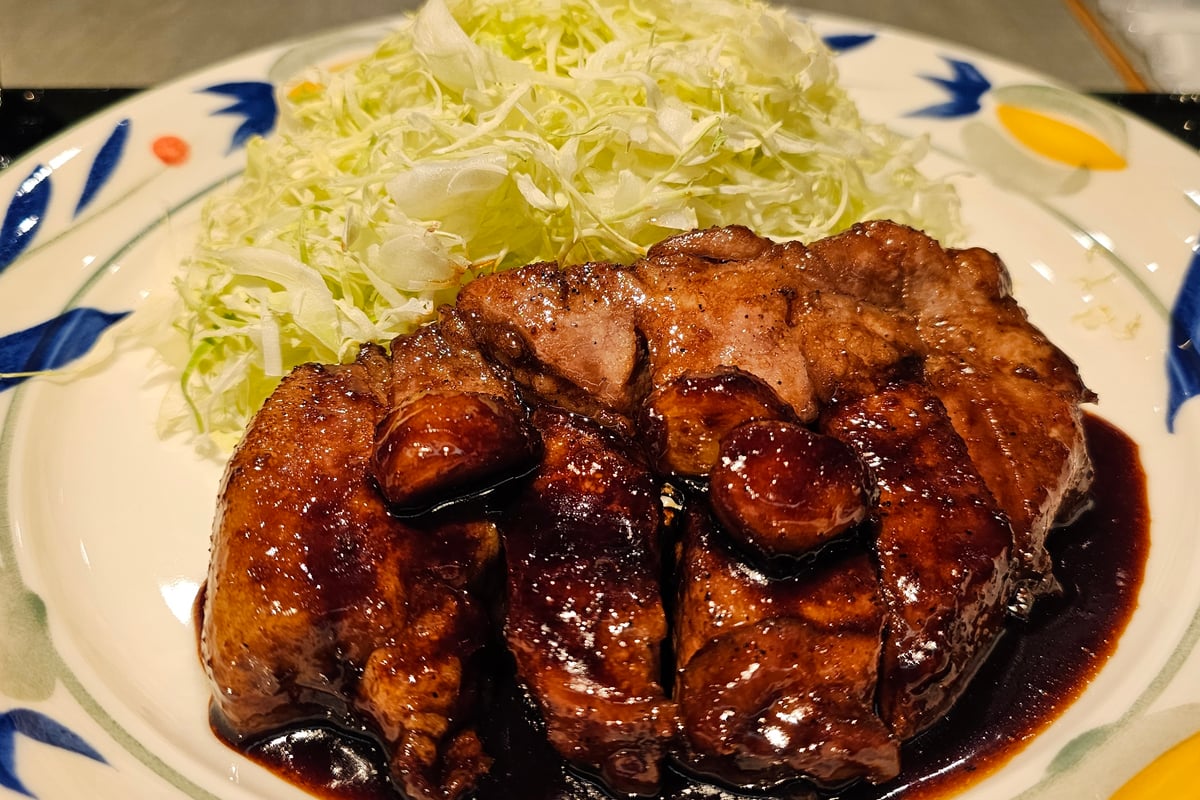
Yokkaichi tonteki is a local specialty dish (gotochi gourmet) of Yokkaichi City, Mie Prefecture, in which thick-cut pork is cooked with garlic and coated in a dark, blackish, rich sauce. The name combines 'ton' (pork) and 'teki' (steak). It is served with a generous helping of shredded cabbage on the side. The meat is cut with deep slits to keep it from shrinking as it cooks, and because this shape resembles a baseball glove, it is also called 'glove' (gurobu). It is said to have begun shortly after the war and to have been the signature dish of a Chinese restaurant in the city center. In Yokkaichi, where many people worked in the industrial zone, hearty, filling dishes that gave people energy were popular. Cheaper than beef steak, it is a down-to-earth dish loved by those who wanted to eat their fill. Since 2008, the Yokkaichi Tonteki Association has been promoting it, and it has also been entered in events such as the B-1 Grand Prix. Today it can be enjoyed at many kinds of eateries, including Chinese restaurants, set-meal diners (teishoku-ya), and coffee shops (kissaten).
Origin
Yokkaichi tonteki is said to have begun shortly after the war, when it was served at a restaurant in central Yokkaichi. A well-known theory holds that it was the signature dish of the Chinese restaurant 来来憲, which stood in 西新地 about 60 years ago. It later spread to other Chinese restaurants and specialty meat restaurants. Some say it dates from around the 1950s, and there are various theories about when it began.
History
Yokkaichi was a town with an extensive industrial zone where many workers lived. As an energy-boosting dish to eat after physical labor, tonteki took root locally. In 2008, the Yokkaichi Tonteki Association began its activities, and in 2010 (Heisei 22) it became the first entry from Mie Prefecture at the B-1 Grand Prix held in Atsugi City. In 2023, the East-West B-1 Grand Prix was held in Yokkaichi City, and the association took part as a local organization.
Features
The Yokkaichi Tonteki Association has set out four defining features: thick-cut sautéed pork, a dark, blackish sauce, garlic served alongside, and shredded cabbage on the side. The glove shape is typical for the meat, but some restaurants cut it into strips or sticks. Many restaurants use pork shoulder loin or loin, and the flavor of the sauce differs from restaurant to restaurant.
Main Ingredients
Food Culture
Tonteki is served not only at Chinese restaurants and set-meal diners but also at coffee shops, ramen shops, golf course restaurants, and expressway parking areas. It has taken root as a soul food that locals enjoy casually.
How It Differs from Home Cooking
At home, deep slits are cut into thick-cut pork, which is cooked with garlic and coated in a sauce made by reducing soy sauce, mirin, Worcestershire-style sauce, and other ingredients. Specialty restaurants each have their own particular approach to the cut and thickness of the meat and the blend of the sauce. Some serve large pieces of meat weighing more than 250 g.
Famous Shops
まつもとの来来憲
三重県四日市市松本2-7-24
A popular restaurant sometimes called the originator of Yokkaichi tonteki, which describes itself as carrying on the original taste of tonteki. Its specialty is 'Dai-Tonteki' (large tonteki): 250 g of glove-cut pork shoulder loin cooked in a rich, garlic-scented sauce. Set meals cost about 1,500 to 1,800 yen.
View details →一楽
三重県四日市市諏訪栄町10-2
A Chinese restaurant founded in 1972 (Showa 47). Its specialty is the 'Tonteki Set Meal,' in which pork shoulder loin selected each day is cut thick and boldly sautéed in a special soy-sauce-based sauce. It costs about 1,650 yen.
FAQ
Q. Is tonteki different from 'tonkatsu'?
A. Yes, they are different dishes. Tonkatsu is coated in breading and deep-fried, whereas tonteki is thick-cut pork cooked without any breading and coated in a rich sauce. The name combines 'ton' (pork) and 'teki' (steak), so it is essentially a pork steak.
Q. Is tonteki meat always glove-shaped?
A. The glove shape is typical, but it is not required. Under the Yokkaichi Tonteki Association's definition, meat cut into strips or sticks is also accepted. The glove-shaped slits are said to keep the meat from shrinking when it is cooked.