Image: Wikimedia Commons
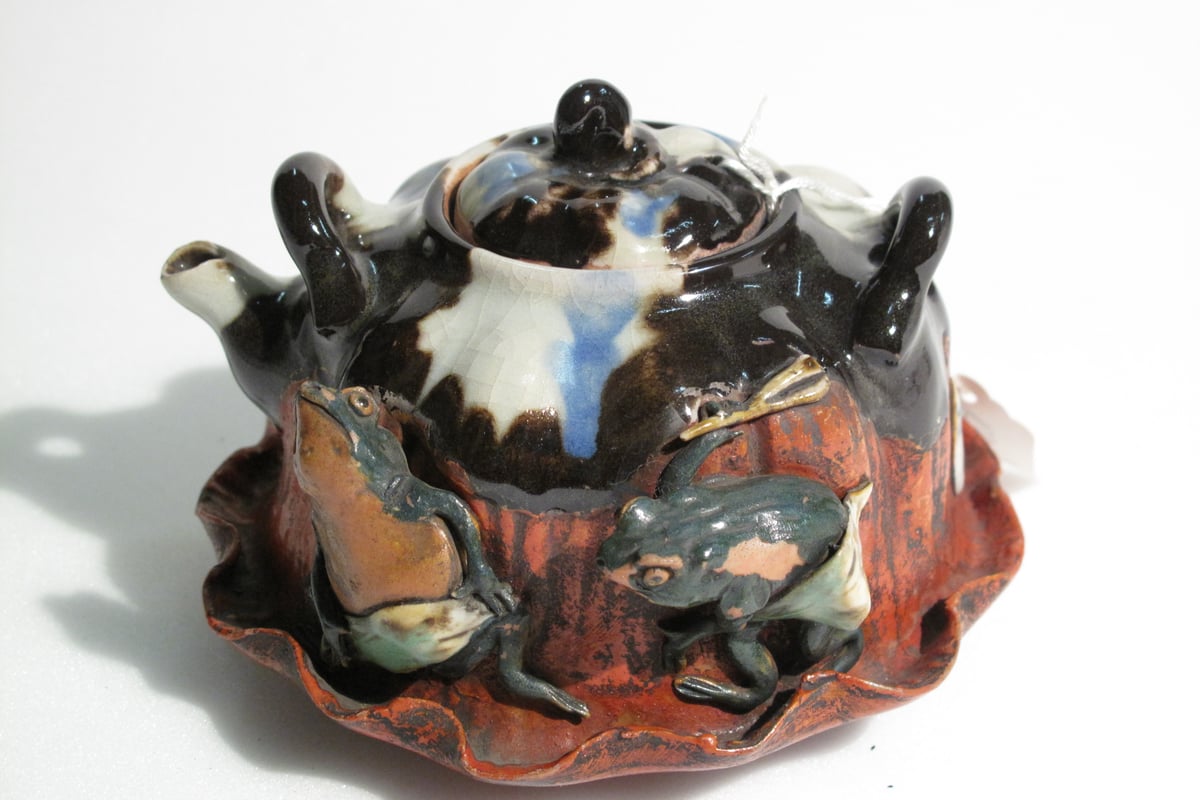
Yokkaichi Banko-yaki is ceramics made mainly in Yokkaichi City, Mie Prefecture. It began in the mid-Edo period when Nunami Rozan (沼波弄山), a wealthy merchant of Kuwana, opened a kiln in 小向, in present-day Asahi Town (朝日町). Rozan stamped the works with seals reading 'Banko' or 'Banko Fueki.' The seals carried the wish that the works would be handed down unchanged forever, and this became the origin of the name. The ware died out after Rozan's death, but in the late Edo period it was revived by 森有節 of Kuwana and others. From the end of the Edo period into the Meiji period, 山中忠左衛門 of Yokkaichi established a pottery method suited to mass production and developed the ware into a local industry. Its representative products are the azuki-bean-colored (reddish-brown) 'shidei kyusu (teapot)' and highly heat-resistant donabe (earthenware pots). Its donabe are said to account for about 80% of domestic production. Today it is one of Japan's leading ceramics-producing areas, with more than 100 kiln companies concentrated mainly in Yokkaichi City and Komono Town. In 1979 (Showa 54), it was designated a Traditional Craft Designated by the Minister of Economy, Trade and Industry.
Origin
The founder of Banko-yaki was Nunami Rozan, a wealthy Kuwana merchant who was fond of the tea ceremony. In the Genbun era (1736-1741), Rozan is said to have opened a kiln in 朝明郡小向村 (present-day 小向, Asahi Town, Mie Prefecture) and begun firing tea utensils. Hoping that the works would be handed down for a long time, Rozan stamped them with the seals 'Banko' and 'Banko Fueki,' and this became the name of the ware. It is also said that a kiln was later set up in 小梅 in Edo. Works from Rozan's time are called 'Ko-Banko (古萬古)' to distinguish them from later Banko-yaki.
History
When Rozan died in 1777, Banko-yaki died out for a time. In the Tenpo era (1830-1844), the brothers 森有節 and 千秋 of Kuwana revived it, devising 'kata-Banko (型萬古),' which uses wooden molds, the shoenji glaze (腥臙脂釉), and painted decoration in the style of yamato-e. These came to be called '有節萬古' and became a specialty of Kuwana. In Yokkaichi, 山中忠左衛門 built a kiln at home in Kaei 6 (1853). After studying 有節萬古, 山中忠左衛門 achieved full-scale mass production of Banko-yaki in 1870 (Meiji 3) and is said to have spread the techniques locally. After the war, in 1959, highly heat-resistant donabe were developed in step with the spread of gas stoves.
Features
Its representative products are kyusu and donabe. Kyusu are made from iron-bearing clay fired by reduction firing and finished in 'shidei,' the azuki-bean color unique to Banko-yaki. It is said that the more they are used, the more they take on a subdued luster. It is also said that the tannins in tea react with the iron in the clay, softening the bitterness and bringing out the sweetness. Donabe are made from clay mixed with a mineral called petalite, which suppresses thermal expansion. They withstand direct flame and being heated while empty, and are said to account for about 80% of donabe made in Japan.
Techniques
Reduction firing
A firing method in which the inside of the kiln is kept low in oxygen so that the pieces are baked as if smothered. The main firing is carried out at 1,180-1,200°C for a full day and night, and the iron-bearing clay develops the azuki-bean color unique to Banko-yaki. Even the same clay turns a variety of colors depending on the amount of oxygen and the temperature inside the kiln.
Wooden-mold forming (kata-Banko)
A technique of shaping pieces by pressing clay against a wooden mold made by combining many wooden pieces, said to have been devised by 森有節. The wooden pieces are made so that they can be easily fitted together and taken apart, and this became one of the distinctive features of 有節萬古, known as kata-Banko.
Making kyusu parts
The body, lid, handle, spout and strainer of a kyusu are formed separately and stretched thin so that the teapot will be as light as possible. The precisely finished parts are joined with clay dissolved in water and assembled into a single kyusu.
Materials Used
Production Process
- 1
Making the clay body (haido)
Several clays are blended to suit the product to make the clay used for forming. Before forming, air is removed by kneading, and the hardness of the clay is evened out by 'natauchi.'
- 2
Forming and finishing
Each part is shaped on the wheel, with press molds or by hand. Patterns such as openwork designs are added, and the parts are joined, trimmed, polished and dried.
- 3
Bisque firing
Products that will be glazed or given underglaze decoration are bisque-fired at about 800°C before moving on to the next step.
- 4
Main firing and overglaze decoration
Pieces are fired at 1,180-1,200°C for a full day and night, and reduction firing determines their coloring. Where needed, overglaze decoration such as raised painting (morie) is applied to finish them.
| Main Production Areas |
|
|---|
Artisans & Workshops
醉月(清水洋)
A potter in Yokkaichi City and the third generation to carry the art name '醉月,' handed down since the grandfather's generation. Known for an original technique of carving the surface of fired shidei to create geometric patterns, making use of the way the color changes with the depth of the cut. In 2025, the potter was recognized as a holder of Yokkaichi City's Intangible Cultural Property 'Banko-yaki (shidei kyusu).'
南景製陶園
Founded in 1913 as a clay-preparation business, it became a kyusu kiln in 1972. Using clay of its own blend, it follows a method of joining precisely finished parts with clay dissolved in water. Including the bisque and main firings, it takes about a month and a half to complete a piece. It is run by the third head, 荒木照彦.
銀峯陶器
A donabe maker in 三ツ谷町, Yokkaichi City, producing Yokkaichi Banko-yaki donabe and heat-resistant tableware. Its donabe such as '花三島鍋' and '墨貫入鍋' were certified as Mie Brand products in fiscal 2012.
How to Buy
- ばんこの里会館
- A hub facility for Banko-yaki in 陶栄町, Yokkaichi City. Products from each kiln are sold at the direct-sales shop 'うつわ亭' on the second floor, and the exhibition rooms host a permanent exhibition and seasonal special exhibitions. Closed on Mondays (except national holidays), during the summer period and over the New Year holidays.Where to buy →PR
- 四日市ばんこ焼陶器まつり
- A large-scale Banko-yaki sales event held every May. In 2024, it was held on May 18 and 19 at Yokkaichi Dome and ばんこの里会館, with sections for association members and handmade-craft artists. At the second venue, a painting experience from about 1,500 yen was also offered.
Hands-on Experiences
ばんこの里会館 陶芸教室
三重県四日市市陶栄町4-8
Visitors can make pottery or paint pieces under professional guidance. Reservations are required, and prices start from about 3,500 yen (shipping extra). According to the Mie Prefecture Tourism Federation, hand building costs 3,500 yen, the electric wheel 4,000 yen and painting from 1,500 yen. It takes about a month until the piece is fired.
View details →FAQ
Q. What does 'Banko Fueki' mean?
A. It is an expression meaning 'remaining unchanged forever.' Nunami Rozan is said to have stamped works with this seal, wishing them to be handed down for eternity. The seal itself became the name of the ware, leading to the present-day names Banko-yaki, written '萬古焼' or 'ばんこ焼.'
Q. Does brewing tea in a shidei kyusu change the taste?
A. Shidei is a clay rich in iron, and it is said that the tannins in tea react with the iron in the kyusu, lightening the bitterness and bringing out the sweetness. It is also said to absorb the astringency of tea and make it mellower. Because its subdued luster deepens the more it is used, it is a kyusu that many people cherish for many years.