Image: Wikimedia Commons
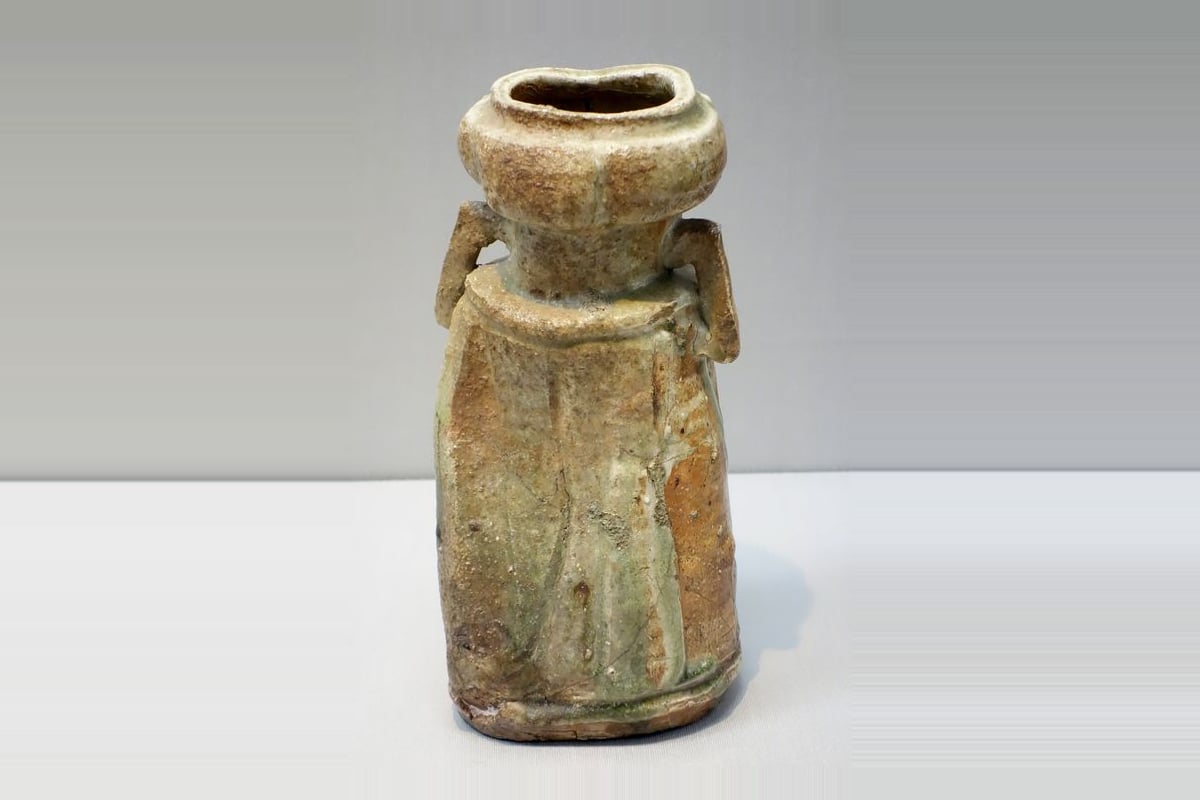
Iga-yaki is pottery fired mainly in the Marubashira (丸柱) district of Iga City, Mie Prefecture. Its origins are said to date back to around the Nara period, and locally it is introduced as pottery with a history of about 1,200 years. Its raw material is clay from the Kobiwako Formation (ancient Lake Biwa strata), deposited on the bed of ancient Lake Biwa about 4 million years ago. When fired, the clay develops many fine pores and retains heat well, so it is suited to cooking vessels such as donabe (earthenware pots) and yukihira (行平) pots. In the Momoyama period, as the tea ceremony flourished, bold flower vases (hanaire) and fresh-water jars (mizusashi) with pronounced distortions were fired. The green glassy 'bidoro' and the scorching ('koge') produced by the flames of the climbing kiln are regarded as highlights of Ko-Iga (old Iga ware). The Important Cultural Property 'Ko-Iga fresh-water jar named Yabure-bukuro (破袋),' held by the Gotoh Museum, is its representative work. After the early Edo period the kilns were temporarily abandoned, but they were revived in the mid-Edo period, after which everyday items such as donabe became the mainstay. In 1982 (Showa 57), it was designated a Traditional Craft Designated by the Minister of Economy, Trade and Industry.
Origin
Iga-yaki has ancient origins: it is said to have begun with the firing of agricultural vessels such as seed jars from the late 7th century to around the 8th century. Later, roof tiles for temples were also fired. The Iga-yaki Traditional Industry Hall (伊賀焼伝統産業会館) describes it as having developed into a full-fledged pottery-producing area from the late Heian period to the early Kamakura period. The main production area is Marubashira in the northwest of Iga City, which borders Shigaraki in Shiga Prefecture across the mountains. Like Shigaraki, it has used clay from the Kobiwako Formation.
History
In the Momoyama period, under Tsutsui Sadatsugu, who ruled Iga, and later under Todo Takatora and 高次, tea ceramics were fired in abundance. At the kilns of 槙山 and Marubashira, bold flower vases and fresh-water jars reflecting the tastes of Furuta Oribe and others are said to have been made. In the early Edo period, thin-walled wares called 'Enshu Iga' are also said to have been born under the guidance of Kobori Enshu. Later, when a system was introduced to prevent the indiscriminate digging of clay, many potters moved to Shigaraki, and the kilns were abandoned for about 100 years. In the Horeki era (1751-1764), they were revived with the encouragement of the Todo Domain, after which everyday wares such as yukihira pots and donabe became the mainstay.
Features
Clay from the Kobiwako Formation is highly fire-resistant; when fired, it develops countless fine pores and takes on a rough texture. Because it excels at storing heat, it is suited to donabe and rice-cooking pots. 伝統工芸 青山スクエア (Aoyama Square) describes it as harder and somewhat heavier than Shigaraki-yaki. In tea ceramics, the highlights are distorted forms, patterns incised with a spatula, bidoro formed from melted ash, and scorching caused by the flames. Such changes that occur inside the kiln are called yohen (kiln transformation).
Techniques
Bidoro
As pieces are fired in a climbing kiln (noborigama) or a tunnel kiln (anagama), wood ash falls on them and melts at high temperatures into a glassy coating. Its translucent green color is regarded as a highlight of Ko-Iga. Under the standards for national Traditional Crafts, when no glaze or painted decoration is applied, bidoro, hiiro (fire color) or scorching is to be produced in a climbing kiln.
Koge and hiiro (scorching and fire color)
A phenomenon in which the parts struck directly by the flames or buried in ash scorch to a blackish brown or take on a reddish color. Even within the same kiln, the appearance changes depending on where a piece is placed.
Forming and decoration
Potters choose among slab building (tatara: forming with clay rolled out into sheets), wheel throwing and hand building. Decoration techniques include line carving, fabric-texture impressions (nunome) and icchin (drawing lines by squeezing slip from a narrow nozzle), and ash glaze, lime glaze and bronze glaze (青銅釉) are used.
Materials Used
Production Process
- 1
Clay mining and preparation
Raw clay dug near Iga is refined either by elutriation (suihi: dissolving it in water, letting impurities settle and extracting the fine clay) or by a dry method, and made into clay that is easy to form.
- 2
Forming and finishing
Clay from which the air has been removed by chrysanthemum wedging (kikuneri) is shaped on the wheel, by slab building or by hand. Trimming and decoration are done while checking how dry the piece is, and it is then dried thoroughly in the sun or in a drying room.
- 3
Firing
After a bisque firing, pieces are given their main firing in a gas kiln, an anagama or a climbing kiln. In climbing kilns and anagama, wood ash and flames produce bidoro and scorching.
- 4
Unloading the kiln
Fired pieces are left to cool naturally inside the kiln before being taken out. Depending on their position in the kiln and the flow of the flames, each piece takes on a different appearance.
| Main Production Areas |
|
|---|
Artisans & Workshops
伊賀焼窯元 長谷園
A kiln in Marubashira, Iga City, founded in Tenpo 3 (1832). It is said to have begun when the first head, 長谷源治, built a climbing kiln with 16 connected chambers. It is known for the rice-cooking donabe 'Kamado-san,' launched in 2000, and the '16-chamber old climbing kiln' on its premises is a nationally Registered Tangible Cultural Property.
Official site →土楽窯
An Iga-yaki kiln that has continued since the Edo period. In 2015, 福森道歩, the fourth daughter of the seventh head, 福森雅武, and also a culinary expert, took over as the eighth head. The kiln is known for donabe thrown one by one on the wheel using local Iga clay.
How to Buy
- 伊賀焼伝統産業会館
- A facility for promoting Iga-yaki and training successors. On the first floor, it exhibits and sells works made by local kilns, ranging from traditional pieces to everyday tableware and contemporary works. The second floor is a resource room where visitors can learn about the history and production process of Iga-yaki. Closed on Mondays and national holidays.Where to buy →PR
- 伊賀焼陶器まつり
- A sales event that brings together wares by Iga-yaki kilns and artists. In 2025, it was held from September 19 to 21 at すぱーく阿山 in 川合, Iga City. As the dates and venue vary from year to year, it is best to check in advance with the organizing committee based in the Iga-yaki Traditional Industry Hall.
Hands-on Experiences
伊賀焼伝統産業会館 陶芸体験
三重県伊賀市丸柱169-2
Visitors can make pottery under the guidance of local potters. Prices include hand building (500 g of clay) for 1,650 yen, the electric wheel (1 kg of clay) for 3,960 yen and plate painting for 1,650 yen (firing fee and tax included). It takes about 1 to 2 hours, and reservations are required. Works are glazed and fired at a kiln and shipped at a later date.
View details →FAQ
Q. What kind of work is 'Yabure-bukuro (破袋)'?
A. It is the Important Cultural Property 'Ko-Iga fresh-water jar named Yabure-bukuro,' held by the Gotoh Museum, a fresh-water jar representative of Momoyama-period Iga-yaki. Furuta Oribe is said to have written in a letter, 'I think there will never again be anything like this.' Handed down in the Todo family of Iga, it clearly expresses the aesthetic of Ko-Iga through its large distortions and cracks and the appearance of its bidoro.
Q. Why are Iga-yaki donabe suited to cooking?
A. Because clay from the Kobiwako Formation develops many fine pores when fired and excels at storing heat. The pot stays hot even after being taken off the heat, making it suited to dishes that are cooked slowly. It is also said that with use, fine cracks and kannyu (fine crackle patterns on the surface) appear, and the pot becomes seasoned and easier to use.