Image: Wikimedia Commons
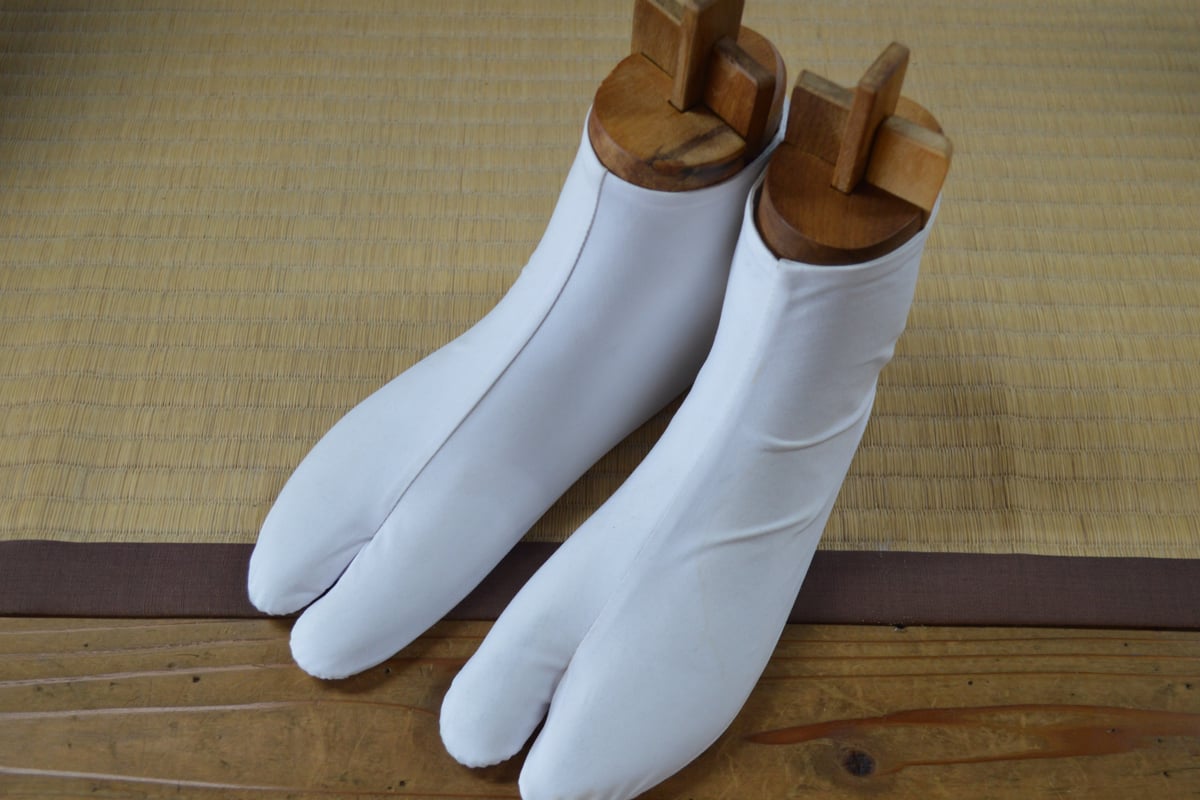
Gyoda Tabi is the traditional technique of tabi (split-toe sock) making handed down in Gyoda City, Saitama Prefecture, and is a Traditional Craft Product designated by the Minister of Economy, Trade and Industry (METI). Lying between the Tonegawa and Arakawa rivers, Gyoda has sandy alluvial soil, abundant water, and a hot, humid summer climate well suited to growing cotton and indigo, and in the Edo period it became a major production center for the indigo-dyed cotton cloth known as 'aojima.' Building on this cotton cloth and its sewing techniques, tabi making is said to have begun around the Jokyo-Kyoho era (late 17th to early 18th century), and by the Tenpo era the town had grown to house 27 tabi shops side by side. When sewing machines were introduced in the Meiji era, production expanded dramatically, and by 1938 Gyoda accounted for 80% of the nation's tabi output, making it Japan's leading tabi-producing area. Numerous 'tabi-gura' storehouses built of earthen walls and brick, which convey the prosperity of that era, still remain throughout the city, and in 2017 the city was certified as a Japan Heritage site under the title 'Tabi-gura Town of Gyoda, Supporting the Feet of Japanese Kimono Culture.' A collection of 5,484 related items has also been designated a Nationally Designated Important Tangible Folk Cultural Property, and local makers continue to produce a wide range of tabi today, from those for kimono wear to festival and running tabi.
Origin
Lying between the Tonegawa and Arakawa rivers, Gyoda has long been suited to growing cotton and indigo thanks to its sandy alluvial soil, abundant water, and hot, humid summers, and in the Edo period it was known as a production center for the indigo-dyed cotton cloth 'aojima.' Building on this cotton cloth and sewing techniques, tabi making is said to have begun around the Jokyo-Kyoho era (late 17th to early 18th century); a picture map from the Kyoho era records three tabi shops, and by the Tenpo era (1830-1844) the number is said to have grown to 27.
History
During the Meiji and Taisho eras, production shifted from handwork to factory manufacturing, and the introduction of sewing machines led to a dramatic increase in output. By 1938, Gyoda's tabi accounted for 80% of the national market, establishing its position as Japan's leading tabi-producing area. The 'tabi-gura' storehouses of earthen and brick construction that once supported production and distribution still remain throughout the city, and in 2017 they were certified as component cultural properties of the Japan Heritage site 'Tabi-gura Town of Gyoda, Supporting the Feet of Japanese Kimono Culture.'
Features
Gyoda Tabi has been designated a national Traditional Craft Product and registered as a regional collective trademark, and a collection of 5,484 related manufacturing tools and materials has also been designated a Nationally Designated Important Tangible Folk Cultural Property. Its distinctive feature is that each finely divided step of the process is carried out by hand by skilled craftspeople, and local tabi makers continue to produce goods suited to modern needs, from kimono tabi to jika-tabi (rubber-soled work boots) and running tabi. Known as the setting for the novel and film 'Rikuo,' Gyoda's tabi-making techniques continue to be passed down into contemporary manufacturing.
Artisans & Workshops
きねや足袋株式会社
Founded in 1929, this tabi maker has its workshop in Sama, Gyoda City. In addition to tabi for kimono wear, it also makes jika-tabi and running tabi, and is known as the model for products featured in the novel and film 'Rikuo.'
Official site →How to Buy
- きねや足袋
- A long-established maker with a direct-sale shop in Sama, Gyoda City, and an online store, offering a wide range of tabi from kimono and practice wear to running tabi.Where to buy →PR
Hands-on Experiences
足袋とくらしの博物館
埼玉県行田市行田1-2
A museum housed in the former factory of the Makino Honten tabi shop. Visitors can watch sewing-machine demonstrations, and on the second Sunday of every month a 'My Tabi Making' workshop is held (around 2,500 yen per pair, reservation required).
View details →