Image: Wikimedia Commons
Yuki-tsumugi is a silk textile woven for centuries across present-day Yuki City in Ibaraki Prefecture and, across the Kinu River, the area around Oyama City in Tochigi Prefecture. Its prototype is said to be 'ashiginu,' a silk fabric presented to the imperial court by Hitachi Province in the Nara period; in the Kamakura period its plain, sturdy look made it popular with warriors of the Kanto region, and Yuki became the center of its production. By the Muromachi period it was known nationwide as a specialty product presented to the shogunate under the name 'Yuki-tsumugi.' During the Keicho era (1596-1615), techniques were established through improvements led by the magistrate Ina Tadatsugu, and the textile was designated a Traditional Craft by the Minister of Economy, Trade and Industry on March 30, 1977, followed by UNESCO Intangible Cultural Heritage listing in 2010. Its defining feature is the 'jibata' (ground loom) technique, in which the weaver ties the warp threads to their own waist and weaves with the whole body, using almost untwisted thread hand-spun from silk floss - producing fabric lighter than that woven with reeled silk, with a distinctively soft feel and finely detailed kasuri (ikat) patterns.
Origin
The prototype of Yuki-tsumugi is said to trace back to 'ashiginu,' a silk textile presented to the imperial court by Hitachi Province in the Nara period, examples of which are preserved in the Shosoin Repository. In the Kamakura period, its plain yet sturdy look made it popular among warriors of the Kanto region, and the Yuki area developed as a center of textile production. By the Muromachi period it was known nationwide under the name 'Yuki-tsumugi' as a specialty product presented to the shogunate and the Kanto Kanrei.
History
It is said that Yuki-tsumugi became widely known throughout Japan thanks to the improvement and promotion efforts of the shogunate magistrate Ina Tadatsugu, who governed the area during the Keicho era (1596-1615). Through the Edo period, the technique of hand-spinning silk floss into thread and weaving it on a jibata (ground loom) became established, and the area along the Kinu River spanning present-day Yuki City in Ibaraki Prefecture to Oyama City in Tochigi Prefecture became settled as the main production region. It was designated a Traditional Craft by the Minister of Economy, Trade and Industry on March 30, 1977, and listed as a UNESCO Intangible Cultural Heritage in 2010.
Features
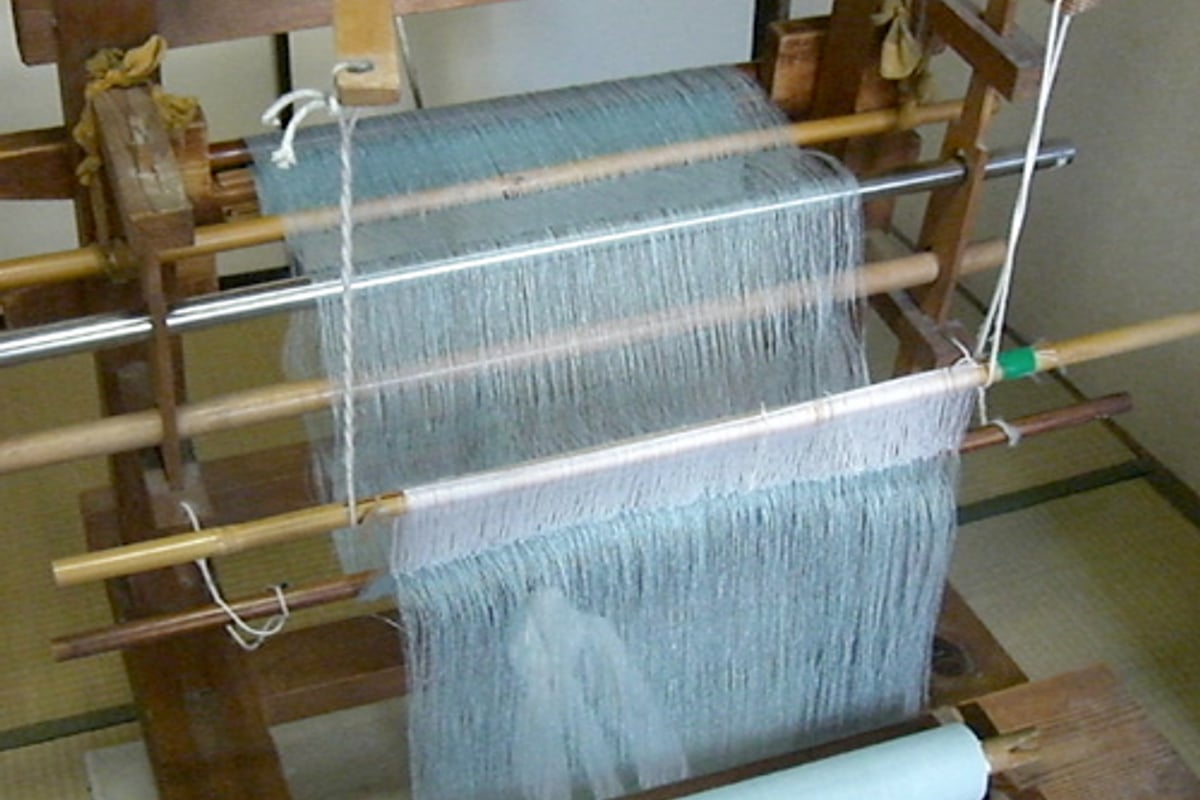
Its defining feature is the 'jibata' (ground loom) technique, in which almost untwisted thread - hand-spun from silk floss drawn out from cocoons - is used, with the weaver tying the warp threads to their own waist and weaving with the whole body. This method produces fabric that is lighter than that woven with reeled silk, with a soft texture that holds air. The kasuri (ikat) patterns are created using a technique called 'tebineri,' in which each thread is individually bound by hand before dyeing to prevent dye penetration, producing finely detailed, richly layered designs.
Materials Used
Production Process
- 1
Making silk floss
Cocoons are boiled, opened out, and stretched into sack-shaped silk floss.
- 2
Spinning thread
Thread is hand-spun from the silk floss without twisting.
- 3
Kasuri binding
The sections that will form the pattern are individually bound by hand with cotton thread to resist dye.
- 4
Dyeing
The thread is dyed, often with indigo, to create the kasuri pattern in sections.
- 5
Jibata weaving
The fabric is woven on a jibata (ground loom), with the warp threads tied to the weaver's waist, using the whole body.
| Main Production Areas |
|
|---|
Artisans & Workshops
坂入染織店
A Yuki-tsumugi weaving workshop in Takahashi, Oyama City, Tochigi Prefecture. One of the few workshops where a family handles the entire process in-house - thread spinning, kasuri binding, dyeing, and weaving - with a commitment to hand weaving on the jibata loom, carrying on the traditional technique today.
Official site →奥順株式会社(つむぎの館)
Founded in 1907, a wholesale producer of Yuki-tsumugi in Yuki City. Its facility 'Tsumugi no Yakata,' opened to mark its 100th anniversary, offers viewing of thread-spinning and weaving demonstrations alongside a museum, gallery, and shop, introducing the appeal of authentic Yuki-tsumugi from multiple angles.
Official site →How to Buy
- おやま本場結城紬クラフト館
- An information center for authentic Yuki-tsumugi near the west exit of Oyama Station. In addition to displays of finished bolts of fabric, visitors can buy small items made from fabric scraps and silk floss, as well as accessories by young artisans.Where to buy →PR
- つむぎの館(奥順株式会社)
- A complex facility for authentic Yuki-tsumugi in Yuki City. Its shop carries a wide range of items from bolts of fabric and obi sashes to small accessories, and visitors can choose pieces after examining the texture in person.Where to buy →PR
Hands-on Experiences
おやま本場結城紬クラフト館
栃木県小山市中央町3-7-1 ロブレ1F
A hands-on 'wearing experience' of authentic Yuki-tsumugi, no preparation needed, from around 1,000 yen. Demonstrations of thread spinning and jibata weaving are held on the first Saturday of every month, and workshops for making small items from tsumugi fabric scraps are also offered.
View details →つむぎの館(奥順株式会社)
茨城県結城市結城12-2
In addition to demonstrations of thread spinning and weaving, seasonal events such as yukata dyeing experiences and kimono-dressing lessons are also held. Located about a 13-minute walk from Yuki Station, making it easy to stop by.
View details →FAQ
Q. When was Yuki-tsumugi listed as a UNESCO Intangible Cultural Heritage?
A. In 2010, the technique of weaving hand-spun thread on a jibata (ground loom), known as 'authentic Yuki-tsumugi,' was inscribed on UNESCO's Representative List under the Convention for the Safeguarding of the Intangible Cultural Heritage - the first single listing for a Japanese dyeing and weaving technique.
Q. Where is Yuki-tsumugi produced?
A. The main production area centers on Yuki City in Ibaraki Prefecture and extends across the Kinu River to Oyama City and Shimotsuke City in Tochigi Prefecture. Weaving workshops in both areas cooperate to preserve the traditional technique through a division of labor covering everything from thread spinning to weaving.