Image: Wikimedia Commons
Ecchu Fukuoka Sugegasa is a sedge-woven hat made throughout the Fukuoka-machi area of Takaoka City, Toyama Prefecture, with a history of over 400 years as sun and rain protection used in farm work and festivals across Japan. Its origin is said to lie in the flooding of the Oyabe River more than 400 years ago, which turned the coastal area into a marsh where good-quality sedge began to grow wild, leading local villagers to start making hats as a side business. Around 1670, in the mid-Edo period, the craft developed into a full-fledged industry under the protection and encouragement of the Kaga Domain lord Maeda Tsunanori, and in the late Edo period, hat wholesalers emerged in Fukuoka-machi and began selling directly across Japan. At its peak in 1864, as many as 2.1 million sedge hats are said to have been shipped. Its distinctive feature is that men and women divide the labor between 'kasabone-zukuri' (making the conical bamboo frame from bamboo cut into thin strips) and 'kasanui' (sewing sedge grown specifically for the hats onto the frame), with the entire process from cultivation to finishing and shipping completed within the region. It still accounts for about 90% of domestic sedge hat production today. It was designated a nationally designated Important Intangible Folk Cultural Property in 2009 and a METI-designated Traditional Craft in 2017.
Origin
The origin of Ecchu Fukuoka Sugegasa is said to lie in repeated flooding of the Oyabe River more than 400 years ago, which turned the coastal area into a marshy wetland. Good-quality kasasuge (a species of sedge) began to grow wild on this land, and sedge hat making began as a side business for the local community.
History
Around 1670, in the mid-Edo period, sedge hat making developed into a full-fledged industry under the protection and encouragement of the Kaga Domain lord Maeda Tsunanori. Until the mid-Edo period, brokers carried the hats to Kanazawa, but in the late Edo period, hat wholesalers emerged in Fukuoka-machi and began selling directly across Japan. At its peak in 1864, as many as 2.1 million sedge hats are said to have been shipped. It was designated a nationally designated Important Intangible Folk Cultural Property in March 2009 (Heisei 21), and on November 29, 2017 (Heisei 29), it was also designated a METI-designated Traditional Craft.
Features
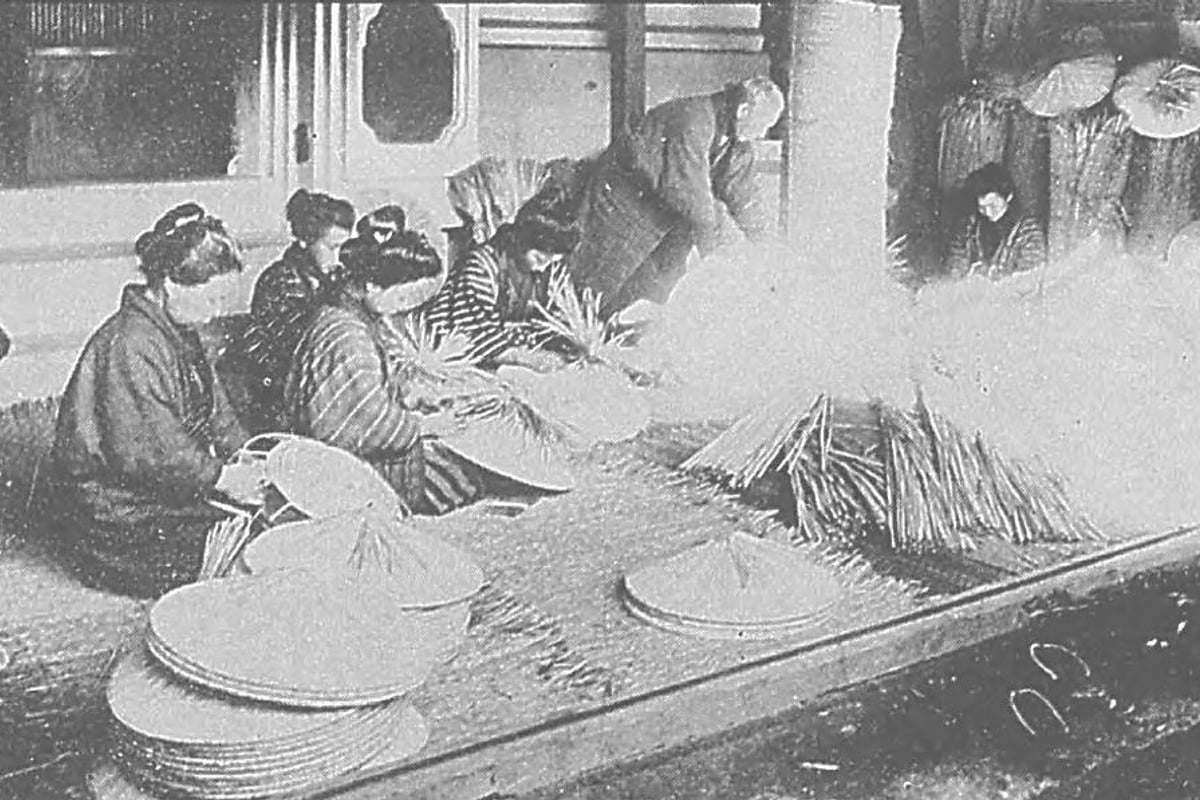
A distinctive feature of the craft is the efficient division of labor between men and women: 'kasabone-zukuri,' making the conical frame by processing bamboo into thin strips, and 'kasanui,' carefully sewing sedge grown specifically for the hats onto the frame. The entire process, from cultivating the sedge to making the frame, sewing, finishing, and shipping, is concentrated within the Fukuoka-machi area, which is highly valued as a cultural asset. It still accounts for about 90% of domestic sedge hat production today.
Materials Used
Production Process
- 1
Cultivating and harvesting sedge
Kasasuge sedge grown in dedicated fields is harvested in summer.
- 2
Drying and sorting sedge
The harvested sedge is sun-dried and sorted by length and quality.
- 3
Making the hat frame (kasabone-zukuri)
Bamboo is processed into thin strips and assembled into a conical frame for the hat.
- 4
Sewing the hat (kasanui)
The sorted sedge is carefully sewn onto the frame one strand at a time.
- 5
Finishing
The edges are trimmed and shaped to suit the intended use.
| Main Production Areas |
|
|---|
Artisans & Workshops
越中福岡の菅笠製作技術保存会
A preservation society dedicated to passing on the techniques of sedge hat making to future generations, working to train frame-makers and sewers through an apprenticeship system and craftsman training courses.
Official site →越中福岡の菅笠振興会
A local organization encompassing everyone involved in sedge hat making, from producers to sellers, working to promote sedge hats and train successors and growers of the raw material, kasasuge sedge.
Official site →How to Buy
- 越中福岡の菅笠振興会 公式ネットショップ
- The promotion association's official online shop, where visitors can purchase sedge hats suited to different uses, such as the ichimegasa (16,060 yen), a helmet-style hat (10,010 yen), and the kakugasa with a vertical pattern (11,880-12,430 yen).Where to buy →PR
- 高岡地域地場産業センター(ZIBA)
- A facility that displays and sells Ecchu Fukuoka Sugegasa and other traditional crafts of Takaoka.Where to buy →PR
FAQ
Q. How much of domestic production does Ecchu Fukuoka Sugegasa account for?
A. About 90% of Japan's sedge hat production is still made here in the Fukuoka-machi area of Takaoka City, with hats used for a wide range of purposes from farm work to festivals.
Q. What designations and certifications has Ecchu Fukuoka Sugegasa received?
A. It was designated a nationally designated Important Intangible Folk Cultural Property in March 2009, and in 2016 it was additionally recognized as a component cultural property of the Japan Heritage site 'Takaoka.' It was further designated a METI-designated Traditional Craft on November 29, 2017.