Image: Wikimedia Commons
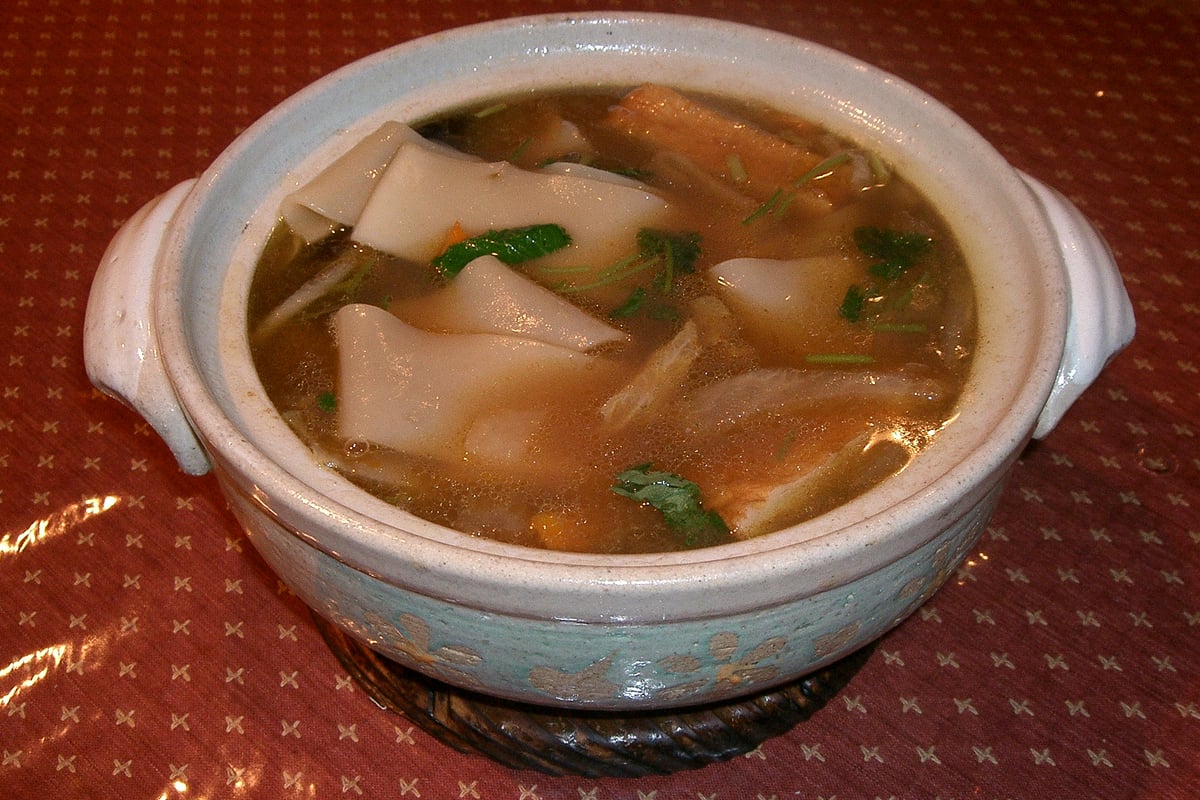
Okkirikomi is a signature local dish of Gunma Prefecture in which wide, flat wheat noodles are simmered slowly with seasonal vegetables such as taro, daikon radish, and mushrooms in a hearty miso- or soy sauce-based broth. The name is said to come from the process of rolling out the dough with a rolling pin, cutting it with a knife ('kirikomi'), and adding it straight to the pot; because the noodles go into the broth unboiled, still dusted with flour, the soup thickens naturally into a smooth, mellow broth. In Gunma, a major wheat-growing region, the dish is said to have spread as a meal that women in silk-farming households could prepare quickly and in large batches between farm chores, and it became an everyday staple from the mid-Edo period onward as stone hand mills came into common use. In 2014 it was designated an Intangible Folk Cultural Property of Gunma Prefecture as 'Gunma's Flour-Based Food Culture: Okkirikomi,' and it remains a beloved symbol of the region's food culture in both homes and eateries today.
Origin
Gunma Prefecture has long been known for wheat farming, and in rural areas where sericulture (silk farming) thrived, women who were busy with farm work are said to have spread okkirikomi as a dish they could prepare quickly and in large quantities, using whatever seasonal vegetables were on hand. The name 'okkirikomi' is said to come from the process of rolling the dough around a rolling pin and cutting it with a knife ('kirikomi') before adding it to the pot, and the dish developed as simple home cooking in which the thickness of the noodles and the choice of ingredients varied from household to household.
History
From the mid-Edo period onward, as stone hand mills spread among ordinary households, wheat-based noodle dishes became an everyday staple in Gunma's farming villages, and okkirikomi was made as one of them in homes across the region. Rather than being tied to a particular festival or occasion, it has been eaten as an everyday dish year-round regardless of season. In 2014 it was designated an Intangible Folk Cultural Property under Gunma Prefecture's measures for recording and preserving such traditions, as 'Gunma's Flour-Based Food Culture: Okkirikomi,' renewing recognition of it as part of the region's food culture.
Features
The defining feature is that the wide, flat raw noodles go straight into the pot without being pre-boiled and are simmered together with vegetables and mushrooms, so the flour dusted on the noodles dissolves into the broth, giving it a naturally thick, mellow texture. The use of unsalted noodles and the everyday habit of eating noodles that are never pre-boiled are unusual even by national standards, found only in a few regions such as Gunma, Saitama, Yamanashi, and Nagano.
Main Ingredients
Food Culture
The dish is said to have spread as one that women in silk-farming households could prepare quickly between farm chores, making full use of seasonal vegetables without waste. Rather than being reserved for special occasions, it has been passed down in homes as part of everyday cooking, embodying the wisdom of using every bit of the season's produce.
How It Differs from Home Cooking
At home, okkirikomi is often made by combining whatever vegetables are on hand in the refrigerator, whereas specialty restaurants take particular care with the noodles and broth, using hand-cut noodles made from local wheat and carefully prepared dashi to bring out the noodles' chew and the broth's refined flavor.
Famous Shops
三代目 小澤家
群馬県富岡市富岡29
A long-established local restaurant founded in 1936, just a short walk from the Tomioka Silk Mill. Its noodles are hand-cut from locally grown wheat and served in a broth made purely from dried sardine (niboshi) dashi, carrying on Tomioka's distinctive 'tatekkeeshi' style; a bowl costs around 1,190 yen (tax included).
View details →はや味
群馬県富岡市富岡51
A restaurant specializing in okkirikomi udon, located right in front of the main gate of the Tomioka Silk Mill. The owner, trained at a traditional Japanese restaurant, prepares a refined dashi and serves a hearty bowl loaded with daikon, mushrooms, taro, and chicken for 1,100 yen.
FAQ
Q. Where does the name 'okkirikomi' come from?
A. It is said to come from the process of rolling the noodle dough around a rolling pin, cutting it with a knife ('kirikomi'), and adding it to the pot. In some areas the dish is also pronounced 'okkirikomi.'