Image: Wikimedia Commons
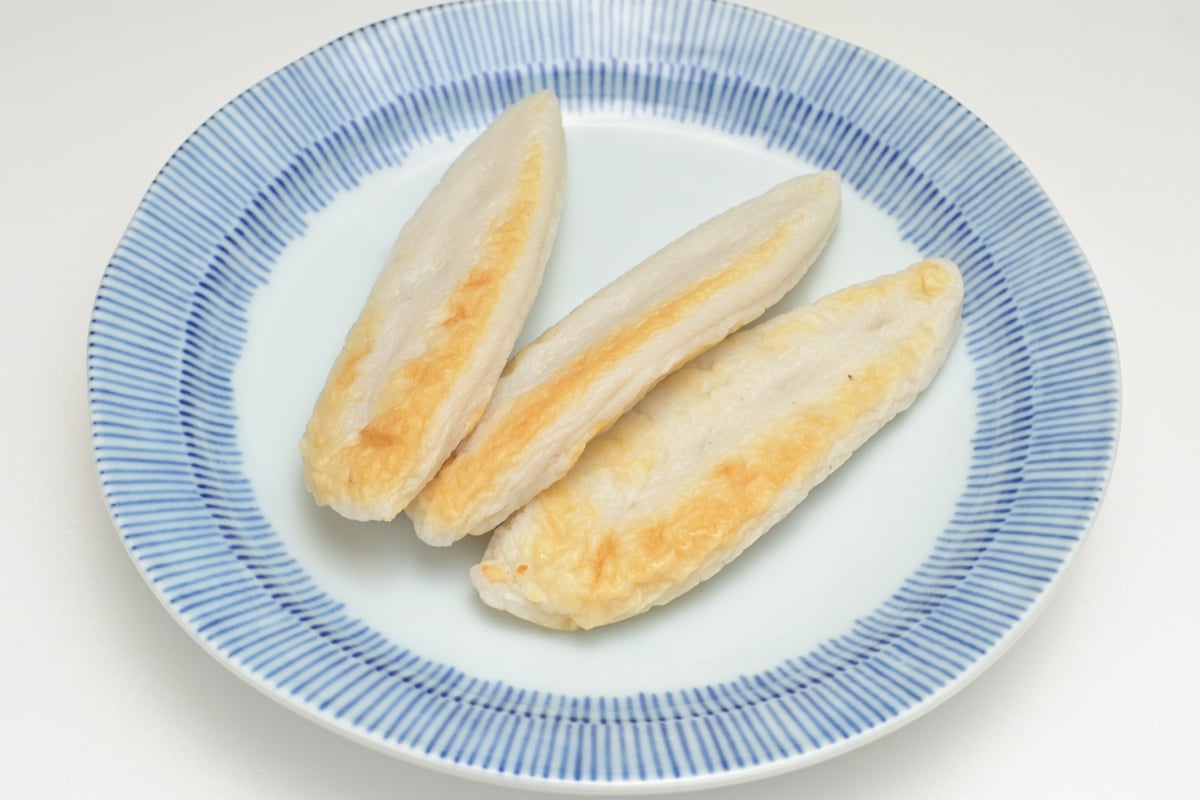
Sasa kamaboko is a fish cake shaped like a bamboo-grass leaf and grilled, made from pureed white fish — a local specialty representing Sendai. It is said to have originated in the mid-Meiji 30s (around 1900), when a series of large flatfish catches occurred along the coast from Yuriage to Mount Kinka; because transportation and storage capacity were insufficient at the time, grilled fish cakes were made to keep the surplus flatfish from going to waste. Because of its shape, it was originally called 'palm-shaped kamaboko' or 'tongue-shaped kamaboko' (berokamaboko), but it came to be called 'sasa kamaboko' because its shape resembled the bamboo-grass leaves depicted in the 'bamboo and sparrow' family crest of Date Masamune, the founder of the Sendai Domain. This name is said to have become standardized in the Showa era. While flatfish, a high-grade fish, was originally the main ingredient, as catches declined, white fish such as walleye pollock has become the main ingredient today. Low in fat and calories while rich in high-quality protein, it is a classic Sendai souvenir, with more than 40 producers said to exist within Miyagi Prefecture.
Origin
Sasa kamaboko is said to have originated in the mid-Meiji 30s, triggered by a series of large flatfish catches along the coast from Yuriage to Mount Kinka. At the time, transportation and storage capacity were insufficient, so to avoid wasting the large catches of the high-grade flatfish, kamaboko began to be made by pureeing and grilling the fish as a preserved food.
History
When kamaboko first appeared, it was known by names such as 'palm-shaped kamaboko' or 'tongue-shaped kamaboko' (berokamaboko), but it came to be called 'sasa kamaboko' because its shape resembled the bamboo-grass leaves depicted in the 'bamboo and sparrow' family crest of Date Masamune, the founder of the Sendai Domain. This name became standardized in the Showa era, and as the main ingredient shifted from flatfish to today's mainstream white fish such as walleye pollock in response to changing catches, the dish developed into a souvenir representing Sendai.
Features
The defining feature is that pureed white fish is kneaded with salt, mirin, sake, and other seasonings until it develops a firm elasticity, then shaped by hand into a bamboo-grass leaf and grilled. Rapidly cooling the cakes after grilling produces the springy, resilient texture characteristic of kamaboko. Loved as a healthy food that is low in fat and calories while rich in high-quality protein, it is enjoyed in many ways — eaten as is, lightly grilled, or prepared as isobe-age (fried with seaweed), among other dishes.
Main Ingredients
Famous Shops
阿部蒲鉾店 本店
宮城県仙台市青葉区中央2丁目3-18
Founded in 1935, a long-established shop said to be the originator of the name 'sasa kamaboko.' Its signature product, 'Abe's Sasa Kamaboko,' costs around 210-235 yen per piece.
View details →かまぼこの鐘崎 総本店 笹かま館
宮城県仙台市若林区鶴代町6-65
Founded in Showa 22 (1947), a long-established shop specializing exclusively in sasa kamaboko. It offers products made without chemical seasonings, preservatives, or starch.
View details →FAQ
Q. Does the 'sasa' (bamboo grass) in sasa kamaboko come from the shape of a flatfish?
A. No — the name comes not from the fish used as an ingredient, but from its resemblance to the bamboo-grass leaves depicted in the 'bamboo and sparrow' family crest of Date Masamune, the founder of the Sendai Domain. When it first appeared it was called things like 'palm-shaped kamaboko,' but the name 'sasa kamaboko' became established in the Showa era.