Image: Wikimedia Commons
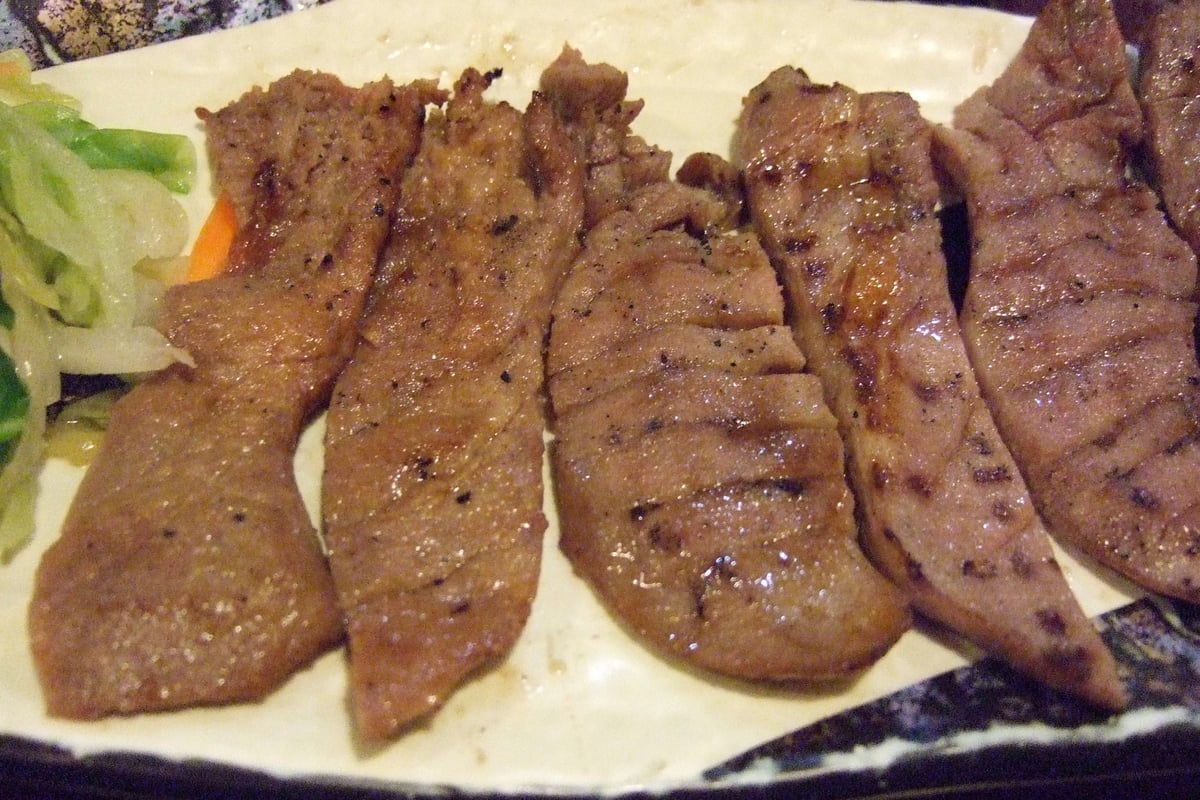
Gyutan yaki is a signature local dish of Miyagi Prefecture, centered on Sendai City, in which thickly sliced beef tongue is salted and grilled over charcoal. It is said to have originated in 1948 (Showa 23), when Sano Keishiro, a chef from Yamagata Prefecture who had trained in Tokyo, took note of beef tongue — then treated mainly as an ingredient for Western cuisine — and reworked it into a salt-grilled dish suited to Japanese tastes. Gyutan yaki was born when he opened the specialty restaurant 'Taisuke' in Sendai in 1950, and amid the post-war food shortages, a set-meal style took shape pairing the grilled tongue with barley rice in place of white rice and a tail soup made from beef tails, which were little used at the time. Today, dozens of specialty restaurants cluster around Sendai Station and the Kokubuncho district, and the 'gyutan set meal' — served with barley rice, tail soup, nanban miso, and light pickles — has become a standard Sendai specialty known nationwide.
Origin
The origin of gyutan yaki traces back to Sano Keishiro, a chef from Yamagata Prefecture who trained at a Western-style restaurant in Tokyo. Noticing the flavor of beef tongue, which was then treated as an ingredient for Western cuisine, he experimented extensively in Sendai shortly after the war and devised the salt-grilled charcoal-cooking method. Beef tongue itself was hard to obtain at the time, and he is said to have personally called meat markets in both Miyagi and Yamagata Prefectures in search of suppliers.
History
In 1950 (Showa 25), Sano Keishiro opened 'Taisuke,' a gyutan yaki specialty restaurant in Sendai, which is considered the birthplace of Sendai-style gyutan yaki. Since it was an era of rice shortages when the restaurant opened, he devised a set-meal format pairing beef tongue with barley rice and a tail soup simmered from beef tails, which were often discarded at the time. This combination became popular and was carried on by later specialty restaurants, becoming established as Sendai's standard style, and from the period of rapid economic growth onward it became known nationwide as a signature Sendai specialty.
Features
The defining feature is that thickly sliced beef tongue is salted and left to rest for about a night, given shallow cuts only on the surface, and then slowly grilled over charcoal. Its hallmark is a satisfying chewy texture and rich flavor, and the standard way to enjoy it is as a 'gyutan set meal' served with barley rice, tail soup, nanban miso, and light pickles. Specialty restaurants cluster around Sendai Station and the Kokubuncho district, and comparing the differences in seasoning and thickness among shops is a popular way to enjoy the dish.
Main Ingredients
Food Culture
Born out of the constraints of post-war food shortages, gyutan yaki reflects resourceful ingenuity in using ingredients without waste, such as barley rice and tail soup, and it is passed down as a dish symbolizing that spirit of creativity within Sendai's food culture. Today, specialty restaurants cluster around Sendai Station, and the dish is firmly established as a representative Sendai souvenir and local delicacy enjoyed by business travelers and tourists alike.
How It Differs from Home Cooking
While beef tongue cooked at home is usually thinly sliced and grilled quickly and casually, gyutan yaki at specialty restaurants differs greatly in that thickly sliced beef tongue is left to rest and mature overnight and then slowly grilled over charcoal. The set-meal style served with barley rice and tail soup was also established as part of specialty restaurant culture.
Famous Shops
味太助 本店
宮城県仙台市青葉区一番町四丁目4-13
The birthplace of Sendai gyutan yaki. Founded in 1950 by Sano Keishiro. Gyutan Set Meal B (5 slices) costs 2,000 yen (tax included).
View details →牛たん炭焼 利久 仙台駅店
宮城県仙台市青葉区中央1-1-1 仙台駅3F牛たん通り
The Sendai Station branch of a popular chain with more than 80 locations nationwide. A gyutan set meal costs roughly in the 1,000-yen to 3,000-yen range.
View details →FAQ
Q. Why is gyutan yaki served with barley rice and tail soup?
A. Around 1950, when creator Sano Keishiro opened his restaurant, it was an era of post-war rice shortages, so barley rice was paired with the dish to save rice while still providing a satisfying meal. At the same time, a tail soup simmered from beef tails, which were little used back then, was added, and this combination is said to have become the standard pairing.