Image: Wikimedia Commons
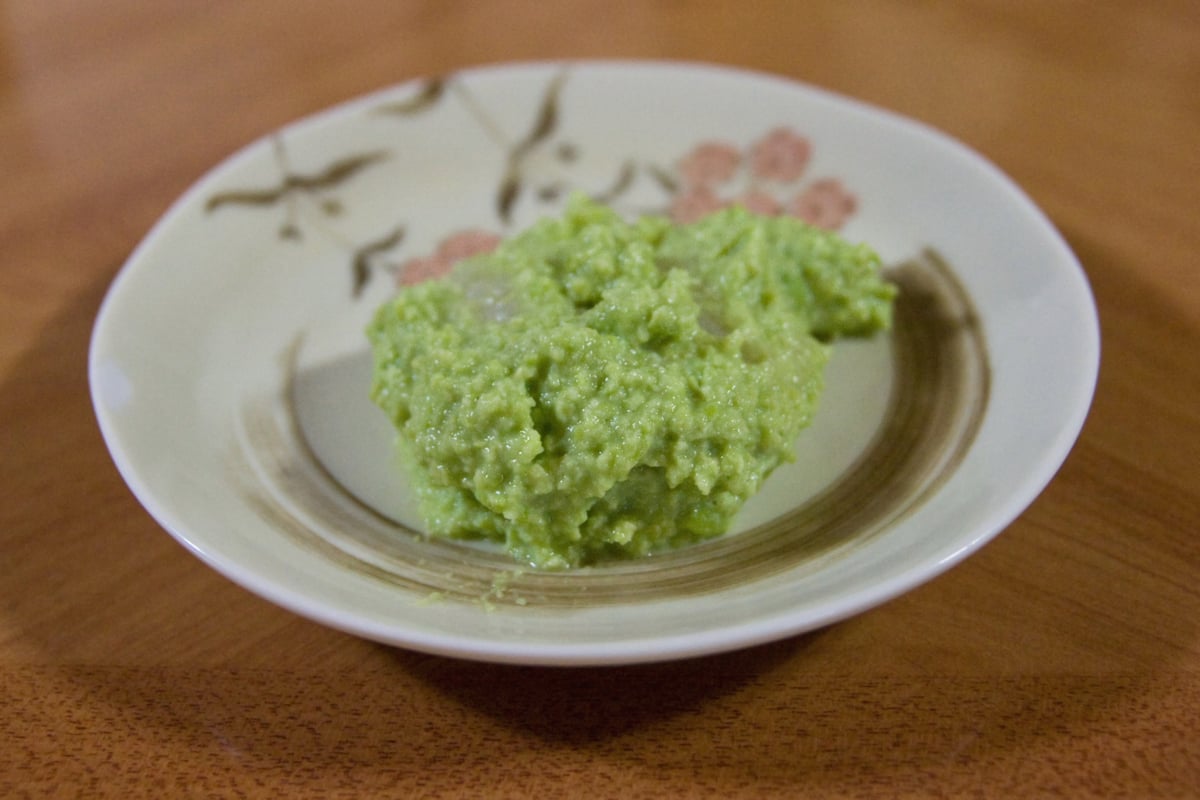
Zunda mochi is a signature local sweet of the Sendai region of Miyagi Prefecture, made by coating mochi with a vivid green paste called 'zunda,' produced by mashing boiled edamame (green soybeans). It is said that zunda had already become established as a coating for dishes by the late Edo period, and it was traditionally made as a whole-family effort during farm work or celebrations, with family members shelling the edamame and mashing them in a mortar. There are several theories about the origin of the name: one holds that it comes from a corruption of 'zuda,' a word describing the act of pounding beans, while another well-known but unverified story attributes it to an episode in which Date Masamune, founder of the Sendai Domain, is said to have had his soldiers crush edamame using the hilt of a sword (jin-tachi) in camp. However, there is no solid historical evidence directly linking Masamune to the dish, and this is generally regarded as a legend that spread in later eras. Today, zunda is used not only in mochi but also in a wide range of products such as shakes and Western-style confections, and it remains a beloved staple souvenir from Sendai.
Origin
There are several theories about the origin of the name 'zunda.' One holds that it comes from a corruption of 'zuda,' meaning the act of pounding beans; another traces it to a farmer named 'Jinta' who is said to have first made it. The best-known story attributes it to an episode in which Date Masamune had his soldiers crush edamame in camp using the hilt of a sword (jin-tachi), but this is regarded as a legend that spread in later eras, and no solid historical evidence has been found to support it.
History
Records confirm that zunda had already become established as a coating for dishes by the late Edo period. It originally arose as a home-cooked dish born from farmers' wisdom for using harvested edamame without waste, and it also had the character of a festive food made by the whole family, with children helping to shell the beans from their pods. After the war, a Sendai confectionery shop began selling it as a product paired with mochi, and this became the catalyst for zunda mochi to become known nationwide as a representative Sendai souvenir and local sweet.
Features
The defining feature is that freshly boiled edamame, including their thin skins, are mashed and seasoned with sugar and salt to make a vivid green 'zunda' paste, which is generously coated over freshly pounded mochi. When coating the mochi, it is often sweetened with sugar alone, and its hallmark is the flavor of the beans combined with a smooth texture. Today, zunda has expanded well beyond mochi into numerous derivative products such as zunda shakes and zunda roll cakes, forming a whole category within Sendai's food culture.
Main Ingredients
Food Culture
In the past, during the edamame harvest season from summer to autumn, shelling and mashing the beans was a laborious task carried out by the whole family. Today, specialty shops have driven commercialization, and a wide variety of zunda sweets are sold around Sendai Station, strengthening the dish's role as a Sendai souvenir and tourist treat.
Famous Shops
ずんだ茶寮 仙台駅ずんだ小径店
宮城県仙台市青葉区中央1-1-1 仙台駅3F
A zunda specialty shop operated by Kasho Sanzen. Zunda mochi comes in a 5-piece pack for 960 yen or a 10-piece pack for 1,920 yen (tax included).
View details →FAQ
Q. Is it true that Date Masamune invented zunda mochi?
A. It is widely known that Date Masamune is said to have had his soldiers crush edamame in camp using the hilt of a sword (jin-tachi), giving rise to the term 'zunda,' but there is no solid historical evidence for this, and it is considered a legend that spread in later eras. There are other theories about the origin of the name as well, such as one holding that it comes from a corruption of 'zuda,' meaning the act of pounding beans.