Image: Wikimedia Commons
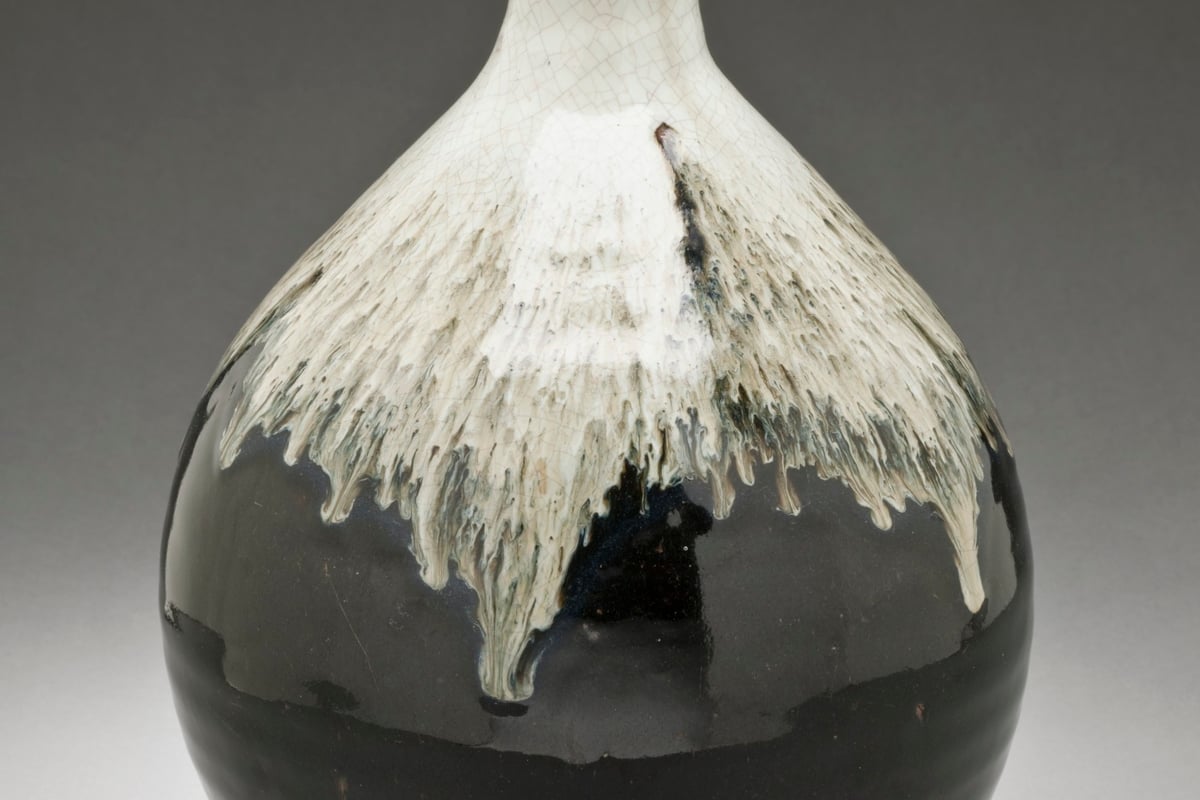
Tsutsumi ware is pottery produced in the former Tsutsumi-machi area of Sendai City (around present-day Tsutsumi-machi, Aoba Ward, Sendai), said to have begun in the Genroku era of the Edo period (1688-1704) when Date Tsunamura, the fourth lord of the Sendai Domain, invited potters from Kyoto to build a kiln there. It started as an official kiln producing tea utensils for the domain lord, later coming to mass-produce everyday vessels for common use, such as jars, urns, and spouted bowls. During the Edo period it was also known as a production center for unglazed clay dolls called 'Tsutsumi ningyo,' and together with Kyoto's Fushimi dolls it was celebrated in the phrase 'Fushimi in the west, Tsutsumi in the east.' Its defining feature is the bold application of black and white 'Namako-yu glaze,' made from local red clay combined with rock from around Sagi-ga-mori and ash from rice husks, producing a rustic, powerful texture. In the early Showa era it was also highly praised by Yanagi Sōetsu of the Mingei (folk craft) movement as a leading folk kiln of the Tohoku region. At its peak nearly thirty kilns operated, but today only 'Tsutsumi-yaki Kanbagama' continues to preserve the tradition. It is a Traditional Craft designated by the Governor of Miyagi Prefecture.
Origin
Tsutsumi ware is said to have begun in the Genroku era of the Edo period (1688-1704), when Date Tsunamura, the fourth lord of the Sendai Domain, invited potters from Kyoto and had them build a kiln in Tsutsumi-machi, located along the northern highway of the castle town of Sendai. It started as an official kiln producing tea utensils and everyday vessels for the domain lord. Using high-quality local red clay and inheriting techniques in the Kyoto Kenzan style, it developed into a rustic, powerful style suited to the climate of the Tohoku region.
History
During the Edo period, Tsutsumi ware flourished as a production center for everyday vessels, and it was also known for its unglazed clay dolls called 'Tsutsumi ningyo,' celebrated together with Kyoto's Fushimi dolls in the phrase 'Fushimi in the west, Tsutsumi in the east.' At its peak, close to thirty kilns are said to have operated. In the early Showa era, Yanagi Sōetsu, a leader of the Mingei (folk craft) movement, visited Tsutsumi-machi and praised it highly as a leading folk kiln of the Tohoku region. Over time the number of kilns declined, and today only 'Tsutsumi-yaki Kanbagama' carries on the technique. In 1982 (Showa 57), it was designated a Traditional Craft designated by the Governor of Miyagi Prefecture.
Features
The defining feature of Tsutsumi ware is a technique called 'Namako-yu glaze,' in which black and white glazes are boldly poured over the surface of the vessel. Using local red clay gathered from areas such as Daihara and Maruta-zawa as the base, and glazes made from rock found in the valleys of Sagi-ga-mori and ash from burned rice husks, each piece produces a unique, unrepeatable pattern by chance. Combining the refinement inherited from Kyoto with the strength nurtured by the Tohoku climate, its rustic, warm appearance is loved by many.
Materials Used
| Main Production Areas |
|
|---|
Artisans & Workshops
堤焼乾馬窯
The only kiln producing Tsutsumi ware. It carries on vessel-making using Namako-yu glaze and also holds tours of its climbing kiln and pottery-making experience classes. Experiences cost 3,200 yen for adults (1kg) and 1,600 yen for children (500g), both tax included.
Official site →How to Buy
- Tsutsumi-yaki Kanbagama direct sales / online
- Works are displayed and sold at the kiln in Izumi Ward, Sendai City, and can also be purchased at Fujisaki, Sendai Mitsukoshi, Sendai Parco's 'Tohoku Standard Market,' and the long-established shop 'Kokeshi no Shimanuki.'Where to buy →PR
Hands-on Experiences
堤焼乾馬窯 陶芸体験教室
仙台市泉区上谷刈赤坂8-4
Visitors can experience making vessels by hand-forming or on the potter's wheel. Held from March to the end of November; 3,200 yen for adults (1kg) and 1,600 yen for children (500g), tax included.
View details →