Image: Wikimedia Commons
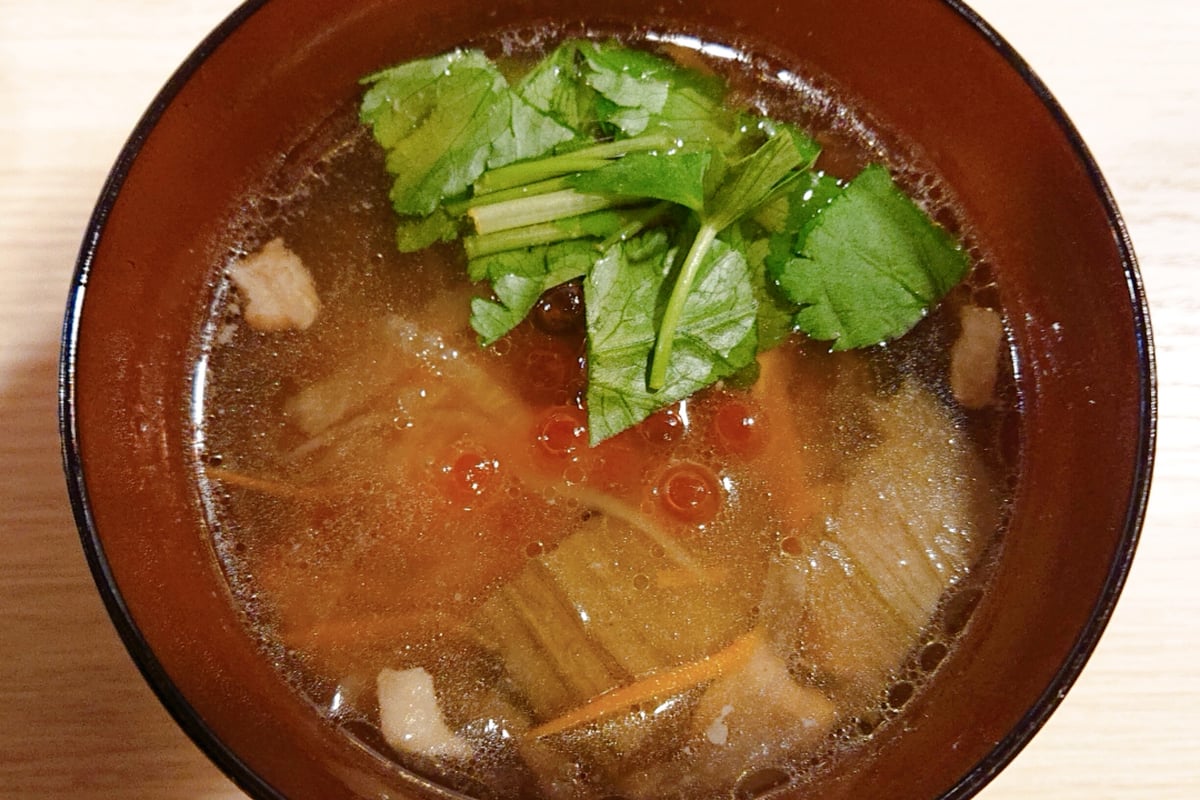
Sendai zoni is a New Year's soup from Sendai City, Miyagi Prefecture, topped with a whole grilled and dried goby fish (yaki-haze) so large it overhangs the bowl, and simmered in the fragrant broth this fish provides. It is said that in the late Edo period, when goby were caught in abundance in Matsushima Bay, the custom arose of grilling them over charcoal, sun-drying them, and stringing them together on straw to sell for the New Year — and using this dried fish as the base for a soup that became a fixture of Sendai households. Besides the grilled goby, the ingredients include harako (salmon roe) taken from salmon that migrate up the Abukuma River, Sendai-seri (Japanese parsley grown around Sendai), 'ohikina' — julienned daikon, carrot, and burdock root that is boiled and then frozen outdoors — as well as zuiki (taro stem) and frozen tofu. The result is a colorful, lavish bowl fit for a festive occasion. Around central Sendai, eating this zoni during the first three days of the New Year remains a common custom to this day. It is worth noting that records show the zoni Date Masamune himself ate was a different style altogether, made with a broth of dried abalone, dried sea cucumber, and herring — meaning the grilled-goby zoni is best understood as a local dish that took root and spread among ordinary people rather than a dish of Date Masamune's own table. In recent years, poor catches of goby and salmon roe have made the ingredients harder to obtain and pushed up prices, leading some to call it a 'luxury zoni.'
Origin
The origins trace back to the late Edo period. At that time, Matsushima Bay yielded large catches of goby in winter, and 'yaki-haze huts' for grilling the fish over charcoal and then sun-drying it lined the coast. The grilled goby, strung together on straw and sold as a New Year's good-luck item, came to be used as the base for a broth that gradually took root in Sendai households and became established as the zoni eaten during the first three days of the New Year. At the time it was not a special luxury item but a relatively accessible ingredient, which is thought to be one reason it spread among ordinary people.
History
Interestingly, records such as the 'Kimura Uemon Oboegaki' show that the zoni eaten by Date Masamune, lord of the Sendai Domain, himself was a different style made with a broth of dried abalone, dried sea cucumber, and herring. The grilled-goby zoni is thus considered a local dish that developed and spread among ordinary people rather than a dish served at the Date family's table. In recent years, poor catches of goby and salmon have driven up the price of both grilled goby and harako, leading to its nickname 'luxury zoni.'
Features
Its defining feature is its bold appearance: a whole grilled goby so large it overhangs the bowl, simmered in its own broth. It is typically finished with a soy-sauce-based seasoning and combined with harako (salmon roe), Sendai-seri, 'ohikina' (julienned daikon, carrot, and burdock root that is boiled and then frozen), zuiki, and frozen tofu — a colorful presentation that elevates its status as a dish for festive occasions.
Main Ingredients
Food Culture
Around central Sendai, eating Sendai zoni during the first three days of the New Year remains a custom handed down to this day. As grilled goby and harako have become harder to obtain, many households adjust the ingredients and quantities to their circumstances, yet still make a special effort at New Year's to recreate the original broth — making it a dish cherished as a symbol of the festive table. Groups such as the 'Miyagi Food Heritage Association' also hold events to pass the preparation methods on to the next generation.
How It Differs from Home Cooking
In recent years, poor catches of grilled goby have made it harder and more expensive to obtain, so many households make a simplified version of zoni for everyday use, substituting dried bonito flakes or kelp broth, and reserve the effort of recreating the original grilled-goby broth for the first three days of the New Year.
| Grilled Goby (Yaki-haze) from Miyagi Prefecture | The grilled goby essential for the broth of Sendai zoni is sold as a set of 10 medium-to-large fish (about 14-15 cm) from Miyagi Prefecture, strung together, for around 7,800 yen (shipping included). Poor catches in Matsushima Bay have made it harder to find, and it often sells out or runs low in stock ahead of the New Year.Where to buy →PR |
|---|
FAQ
Q. Is Sendai zoni a samurai dish handed down by the Date family?
A. Actually, records show that the zoni eaten by Date Masamune, lord of the Sendai Domain, himself was a different style made with a broth of dried abalone, dried sea cucumber, and herring. The present-day Sendai zoni made with grilled goby is instead thought to be a local dish that spread and took root among ordinary people against the backdrop of abundant goby catches in Matsushima Bay.