Image: Wikimedia Commons
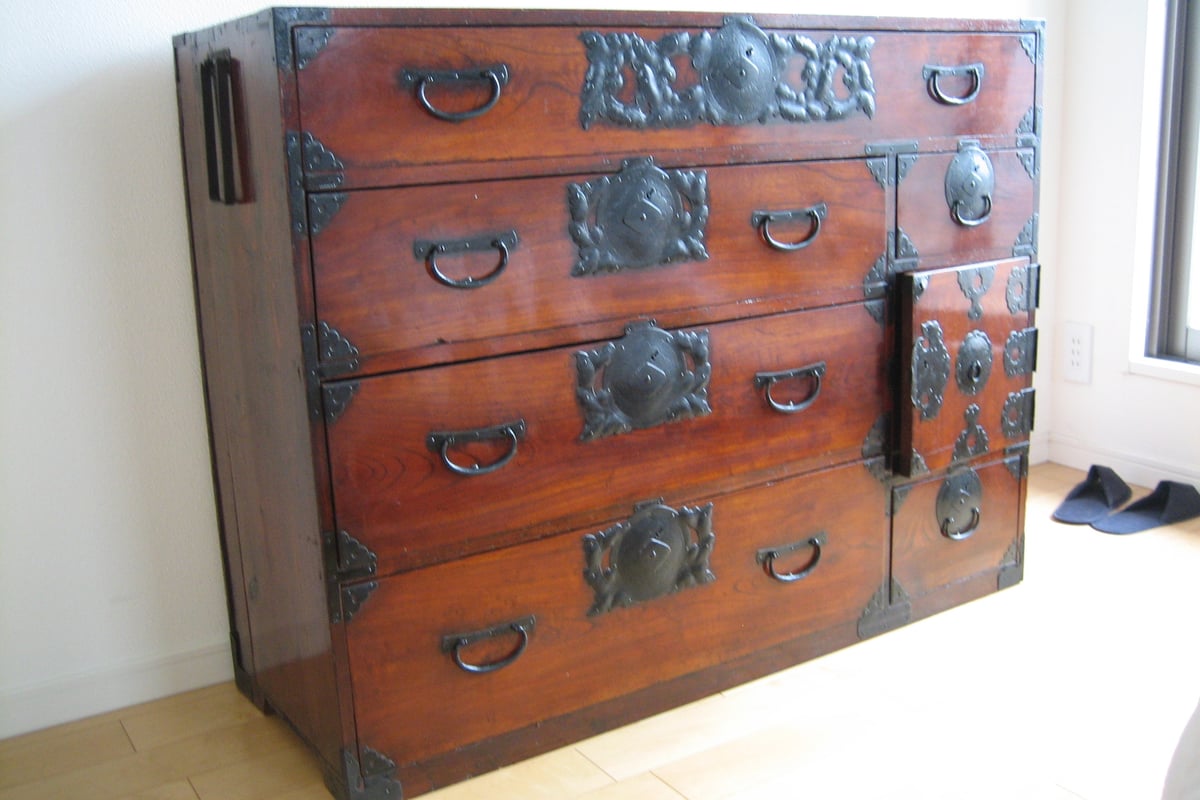
Sendai Tansu is a joinery-made chest of drawers produced mainly in Sendai City, a local industry born in the castle town of the Sendai Domain in the late Edo period. Originally made as a 'yaro-tansu,' a chest for storing swords and money, it was also actively exported to Europe and the United States from the Meiji through Taisho eras. Its greatest feature is a design in which solid wood such as zelkova or chestnut is finished with 'Sendai Kijiro-nuri,' a translucent crimson lacquer that beautifully shows off the wood grain, combined with imposing metal fittings hammered from iron plates about one millimeter thick into motifs favored by the samurai class, such as dragons, peonies, and Chinese lions (karajishi). The three processes of joinery, lacquering, and metalworking are each handled by specialized craftsmen through division of labor, a tradition still carried on today by craftsmen of the Sendai Tansu Cooperative. Sendai Tansu is also a relatively recent addition to the list of designated crafts: on June 18, 2015, it became the fourth Traditional Craft designated by the Minister of Economy, Trade and Industry (METI) in the prefecture, after Miyagi Dento Kokeshi, Ogatsu Suzuri, and Naruko Shikki, and the first new designation in the prefecture in 24 years.
Origin
Sendai Tansu is a joinery-made piece of furniture that emerged in the late Edo period in the castle town of the Sendai Domain, to meet the needs of samurai and merchant households. It was originally made as a 'yaro-tansu,' a chest of drawers built to store swords and money. It is said that the techniques used to make sword guards (tsuba) in the Sendai Domain were later applied to the decorative metal fittings of the chests, leading to the imposing designs seen today.
History
Sendai Tansu production peaked from the Meiji through Taisho eras, with lavish pieces featuring metal fittings of Chinese lions and dragons also exported to Europe and the United States. The three processes of joinery, lacquering, and metalworking developed through a division of labor, with each craftsman refining specialized skills. Long passed down as a local industry, it was designated a Traditional Craft by the Minister of Economy, Trade and Industry (METI) on June 18, 2015 - the first new designation in Miyagi Prefecture in 24 years - and today the handcrafted techniques continue to be passed down mainly through the Sendai Tansu Cooperative.
Features
Sendai Tansu is characterized by the beauty of its wood grain, brought out by 'Sendai Kijiro-nuri,' a translucent crimson lacquer applied to solid wood such as zelkova or chestnut, combined with imposing iron fittings hammered into motifs favored by the samurai class, such as dragons, peonies, and Chinese lions. Metalworkers use a technique called 'uchidashi' (repoussé), striking iron plates about one millimeter thick from behind with a chisel and hammer to create three-dimensional relief patterns. The division of labor among three specialized craftsmen - for joinery, lacquering, and metalwork - produces a single sturdy, ornate chest.
Techniques
Sendai Kijiro-nuri
A finish in which a translucent crimson lacquer is applied in layers to wood such as zelkova. Its mirror-like finish beautifully shows the wood grain through the lacquer, and the gloss and coloring deepen the more the piece is used.
Uchidashi metalwork
A metalworking technique in which iron or copper plates about one millimeter thick are struck from behind with a chisel and hammer to create three-dimensional relief patterns of motifs such as dragons, peonies, and Chinese lions. It developed further after the Meiji era for export products.
Materials Used
Production Process
- 1
Wood selection and joinery
Solid wood such as zelkova or chestnut is selected, and the body of the chest is assembled using joinery techniques that use no nails.
- 2
Undercoating and lacquering
Raw lacquer is rubbed into the wood to harden it, and layers from the undercoat to the final coat are applied to finish it in Sendai Kijiro-nuri.
- 3
Hammering the metal fittings
Iron plates are struck from behind with a chisel to hammer out three-dimensional motifs such as dragons and peonies.
- 4
Lacquer baking and assembly
Lacquer is baked onto the hammered fittings to prevent rust, and they are attached to the chest body to complete the piece.
| Main Production Areas |
|
|---|
Artisans & Workshops
欅(けやき)産業株式会社
A shop specializing in Sendai Tansu that works with joinery, lacquering, and metalwork craftsmen to produce custom-made Sendai Tansu. It handles a wide range of products, from a small Sendai kotansu starting at around 104,500 yen to larger pieces.
Official site →門間箪笥店
A long-established shop founded in 1872 (Meiji 5) in the Minamikajimachi area of Wakabayashi Ward, Sendai City, which has continued making Sendai Tansu ever since. It has an attached 'Sendai Tansu Denshokan,' where the production process is open to the public, passing on traditional techniques today.
How to Buy
- 欅産業オンラインショップ
- The online shop of a store specializing in Sendai Tansu. It carries a wide range from small Sendai kotansu to full-sized chests, priced from around 104,500 yen up to around 660,000 yen.Where to buy →PR
Hands-on Experiences
仙台箪笥歴史工芸館
宮城県仙台市青葉区本町2-7-3 ユノメ家具本店4階
A gallery operated by the Sendai Tansu Cooperative. It displays chests and metal fittings from different eras since the Edo period, and visitors can learn about the history and production process free of charge.
View details →仙台箪笥伝承館(門間箪笥店)
宮城県仙台市若林区南鍛冶町143
A facility attached to Monma Tansu Ten, founded in 1872 (Meiji 5). It continues to make chests today while opening its production process to public view.
View details →FAQ
Q. What is the greatest feature of Sendai Tansu?
A. It is the combination of 'Sendai Kijiro-nuri,' a translucent crimson lacquer applied to solid wood such as zelkova, with imposing iron fittings hammered into motifs such as dragons and peonies. It is made through a division of labor among three craftsmen: for joinery, lacquering, and metalwork.
Q. When was Sendai Tansu designated a national Traditional Craft?
A. It was designated a Traditional Craft by the Minister of Economy, Trade and Industry (METI) on June 18, 2015. It was the fourth such designation in the prefecture, after Miyagi Dento Kokeshi, Ogatsu Suzuri, and Naruko Shikki, and the first new designation in about 24 years.