Image: Wikimedia Commons
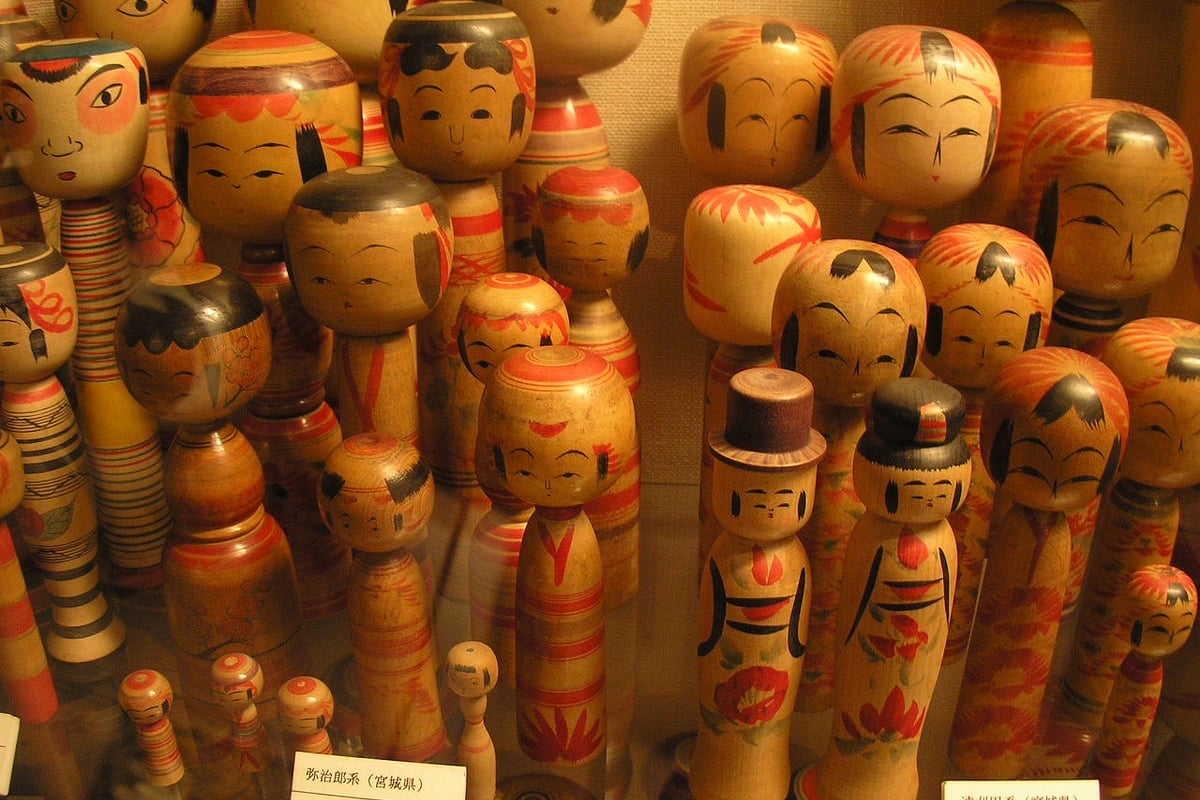
Miyagi Dento Kokeshi is a collective name for four lineages of kokeshi (doll) that developed within Miyagi Prefecture - the Naruko, Togatta, Yajiro, and Sakunami styles - all part of the wooden kokeshi tradition that began in the hot spring towns of the Tohoku region as souvenirs and toys for children in the late Edo period. On June 22, 1981, it was designated a Traditional Craft by the Minister of Economy, Trade and Industry (METI). Togatta kokeshi are believed to have already been made during the Bunsei era (1818-1830), making Togatta a leading candidate for the birthplace of kokeshi, though in recent years a theory tracing the origin to Sakunami Onsen in Sendai City has also drawn attention. The Naruko style is fitted tightly at the neck so that turning the head produces a squeaking sound; the Togatta style features a large head painted with a red hair ornament; the Yajiro style is known for its beret-like turned-line pattern on the head; and the Sakunami style is decorated with a crab-chrysanthemum (kani-giku) motif. The way each lineage differs completely in shape and painted design is one of the great appeals of Miyagi Dento Kokeshi. Even today, craftsmen at each hot spring town turn each doll by hand, keeping alive its simple, warm expression.
Origin
Kokeshi are said to have originated in the late Edo period in the hot spring towns of the Tohoku region as souvenirs for bathers and toys for children. In Miyagi Prefecture, Togatta Onsen (Zao Town) is believed to have already been making kokeshi during the Bunsei era (1818-1830), making it a leading candidate for the birthplace of kokeshi. Meanwhile, recent research suggests a theory that the woodworking techniques of craftsmen at Sakunami Onsen in Sendai City may be the common source of all the lineages, and the debate over the origin of kokeshi continues today.
History
From the Meiji era onward, craftsmen in the hot spring towns of Naruko, Togatta, Yajiro, and Sakunami passed down their techniques through family lines and master-apprentice relationships, and each lineage established its own distinct style. In the Showa era, kokeshi gained popularity as collector's items through kokeshi booms and the mingei (folk craft) movement, and on June 22, 1981, Miyagi Dento Kokeshi was designated a national Traditional Craft. Today, craftsmen in each production area continue to protect the hand-turning technique while also experimenting with new designs.
Features
Miyagi Dento Kokeshi is characterized by shapes and painted designs that differ greatly by lineage. The Naruko style has a fitted structure that squeaks when the head is turned, along with a layered chrysanthemum pattern; the Togatta style has a large head with a red hair ornament and a figure-eight-shaped decoration; the Yajiro style has a beret-like turned-line pattern on the head; and the Sakunami style has a slender body decorated with a pattern called kani-giku (crab chrysanthemum). The diversity of completely different expressions from one production area to the next, even under the same name 'kokeshi,' is the greatest highlight of Miyagi Dento Kokeshi.
Techniques
Naruko Lineage
Originating in Naruko Onsen, Osaki City. Its defining feature is a structure in which the head is fitted tightly into the body so that turning it produces a squeaking sound. The stable body narrows at the hem and is decorated with showy floral patterns such as layered or diamond-shaped chrysanthemums. About 50 craftsmen are still active today, with long-established workshops such as Sakurai Kokeshi Ten carrying on the technique.
Togatta Lineage
Originating in Togatta Onsen, Zao Town, and considered a leading candidate for the birthplace of kokeshi. It combines a large head with a slender, straight body, painted with a red hair ornament from the forehead to the cheeks and a figure-eight-shaped decoration. Its showy patterns of layered chrysanthemums and plum blossoms are distinctive, and it is said to have already been made during the Bunsei era.
Yajiro Lineage
Developed in the Yajiro district of Shiroishi City. The head is fitted into a socket, and lines turned repeatedly on the lathe decorate the crown like a beret. The body comes in both narrowed and straight cylindrical forms, giving the style a colorful, pop impression overall.
Sakunami Lineage
Originating in Sakunami Onsen, Sendai City. It is broadly divided into a type with a thin, rod-like body and small head, and a type with a stable, pedestal-shaped base. Its defining feature is the charming pattern known as kani-giku (crab chrysanthemum); today, Hiraga Teruyuki of Hiraga Kokeshi Ten is its sole remaining maker.
Materials Used
Production Process
- 1
Selecting and cutting the wood
Dried logs are cut to the dimensions needed for a kokeshi doll.
- 2
Rough turning
The head and body are roughly shaped on a lathe.
- 3
Finish turning
The details are refined with a blade, finishing smooth curves suited to each lineage's shape.
- 4
Painting
Using a brush and dye, the expression and pattern set by each lineage are painted on.
- 5
Assembly
The head and body are joined together and polished with wax to bring out a shine, completing the doll.
| Main Production Areas |
|
|---|
Artisans & Workshops
桜井こけし店
A long-established workshop in Naruko Onsen, Osaki City, carrying on the technique of Onuma Matagoro, said to be the founder of Naruko kokeshi. The fifth-generation craftsman Sakurai Akihiro and sixth-generation Naomichi preserve traditional techniques while also exploring new designs.
Official site →丑蔵庵(佐藤英裕工人)
A workshop and direct-sale shop for Togatta-style kokeshi located in the Shinchi area of Togatta Onsen, Zao Town. It carries on the traditional red hair ornament and chrysanthemum pattern while carefully hand-turning and selling its kokeshi.
平賀こけし店
A long-established workshop in Sakunami Onsen, Sendai City, spanning eight generations, run by Hiraga Teruyuki, the sole craftsman keeping the Sakunami style alive today. In 2014, he received the Prime Minister's Award at the All Japan Kokeshi Contest.
Official site →How to Buy
- 日本こけし館(鳴子温泉)
- A museum shop displaying about 5,000 traditional kokeshi. Visitors can purchase one-of-a-kind traditional kokeshi centered on the Naruko style, and also enjoy a painting experience for 1,500 yen.Where to buy →PR
- みやぎ蔵王こけし館
- The Zao Town Traditional Industry Hall in Togatta Onsen. Alongside watching craftsmen demonstrate their work, visitors can purchase Togatta-style kokeshi; the painting experience costs 1,000 yen per doll, and admission is 350 yen for adults.Where to buy →PR
Hands-on Experiences
弥治郎こけし村
宮城県白石市福岡八宮字弥治郎北72-1
The first floor has historical exhibits, and the second floor houses workshops and a painting experience corner. The painting experience costs around 1,000 yen or more, including the wooden doll; admission is free.
View details →FAQ
Q. What kind of craft is Miyagi Dento Kokeshi?
A. It is a collective name for the four traditional kokeshi lineages nurtured within Miyagi Prefecture - Naruko, Togatta, Yajiro, and Sakunami - which were designated a national Traditional Craft in 1981. Each lineage has a different shape and pattern.
Q. Where did kokeshi originate?
A. Togatta Onsen in Zao Town is a leading candidate, with records showing it was already producing kokeshi during the Bunsei era (1818-1830), but in recent years a theory tracing the origin to Sakunami Onsen in Sendai City has also been studied.