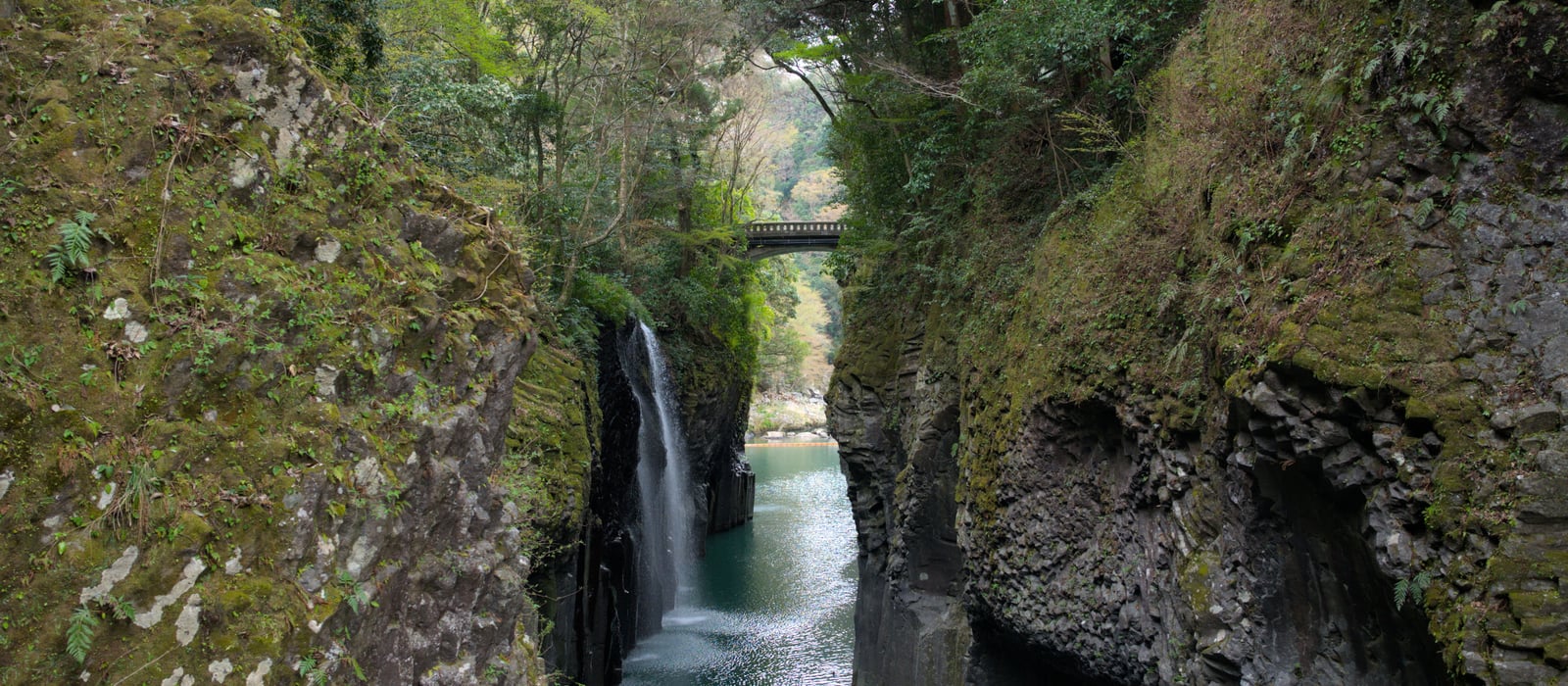
 Image: Wikimedia Commons
Miyazaki Prefecture
Miyazaki Prefecture lies in southeastern Kyushu and is a warm prefecture facing the Hyuga-nada Sea. Among its traditional crafts, the making of martial arts equipment thrives in Miyakonojo City, including Miyakonojo Daikyu, bows made from bamboo and haze (Japanese wax tree) wood, and Miyakonojo Bokuto, wooden swords carved out of kashi (Japanese evergreen oak). Go boards of Hyuga kaya (Japanese torreya) from Aya Town and Kobayashi City, and Hyuga Hamaguri Goishi, made from hamaguri clams in Hyuga City, are known as equipment for the game of go. In the mountainous Takachiho Town, kagura masks used in Yokagura (night kagura) are carved, and in Hinokage Town, bamboo craft such as the karui (bamboo back basket) has been handed down. Aya Town's tetsumugi (hand-spun silk), Sadowara Ningyo and Kunitomi Town's Hokkedake Uzura-guruma are also passed down in their respective areas. In food, Miyazaki is famous for Chicken Nanban, born in Nobeoka City; charcoal-grilled jidori chicken, seared black over charcoal; and Hiyajiru, a chilled soup made with grilled miso and poured over barley rice. Nobeoka's Karamen, Miyazaki City's Kamaage Udon, Nichinan's Uo Udon and Obiten, Lettuce Maki, Sadowara's Kujira Yokan and Cheese Manju are also flavors of Miyazaki.
Miyazaki's Traditional Crafts

Miyakonojo Daikyu (Bamboo Longbows)
Miyakonojo Daikyu (Bamboo Longbows of Miyakonojo)
Miyakonojo Daikyu are bamboo bows made in Miyakonojo City and in Mimata Town, Kitamorokata District, Miyazaki Prefecture. They are made from Miyakonojo madake bamboo and haze wood (Japanese wax tree), and a single bowyer (yumishi) finishes each bow almost entirely by hand through more than 200 steps. The production method is said to have been established in the early Edo period, and in 1994 (Heisei 6) the bows were designated a Traditional Craft Designated by the Minister of Economy, Trade and Industry. Miyakonojo City describes itself as the production area that makes most of Japan's bamboo bows. Figures for its exact share vary by source, with some saying about 90 percent and others 80 percent. In 2020 (Reiwa 2) they became the first traditional craft in Miyazaki Prefecture to be registered as a regional collective trademark. The rights holder is the Miyakonojo Bow Manufacturing Cooperative (都城弓製造業協同組合). It is said to take more than 10 years to become a fully fledged bowyer, and bowyers who are certified traditional craftspeople (Dento Kogeishi) have workshops in Miyakonojo City and Mimata Town.
Miyakonojo Bokuto (Wooden Swords)
Miyakonojo Bokuto (Wooden Swords of Miyakonojo)
Miyakonojo Bokuto are wooden swords made in Miyakonojo City, Miyazaki Prefecture. They are made from hard woods such as kashi (Japanese evergreen oak) and isu (Distylium racemosum) that grow at the foot of the Kirishima Mountains, and craftspeople shave and finish each one by hand with planes. Their shapes differ for each school of kendo and classical martial arts (kobudo), and according to the Miyazaki Prefecture booklet 'Hinata no Takumi,' more than 200 types are made. In 1984 (Showa 59) they were designated a Miyazaki Prefecture-designated Traditional Craft. Miyakonojo City says it accounts for most of Japan's wooden sword production. Some sources put the share at about 90 percent and others at more than 80 percent. The number of workshops, once about 20, had fallen to three according to a 2025 feature article. Besides wooden swords, the workshops also make wooden martial arts equipment such as wooden rifles (mokuju) and naginata (halberds).
Hyuga Kaya Goban (Go Boards of Hyuga Torreya)
Hyuga Kaya Goban (Go and Shogi Boards of Hyuga Torreya)
Hyuga Kaya Goban are go boards made from kaya (Japanese torreya) grown in Miyazaki Prefecture. Together with shogi boards made from the same wood, they are designated a Miyazaki Prefecture-designated Traditional Craft as 'Hyuga Kaya Goban and Shogiban.' Kaya from Miyazaki Prefecture is called 'Hyuga kaya' or 'Hyuga hongaya' and is said to have a beautiful luster and color, a distinctive fragrance and resilience. Board blanks are cut from large trees several hundred years old and dried naturally for three to seven years before being finished. The lines on the board surface are drawn with 'tachimori,' a technique in which lacquer is applied with a blade so that it stands up in a raised line. The legs are shaped like gardenia fruit, which is said to carry the meaning that no third party may comment on a game. Miyazaki Prefecture's traditional craft map lists Aya Town and Kobayashi City as production areas, and boards are made by shops such as 熊須碁盤店 in Aya Town and 松川碁盤店 in Kobayashi City.
Hyuga Hamaguri Goishi (Clamshell Go Stones)
Hyuga Hamaguri Goishi (Clamshell Go Stones of Hyuga)
Hyuga Hamaguri Goishi are go stones made in Hyuga City, Miyazaki Prefecture. The white stones are made from the shells of hamaguri clams, and the black stones from Nachiguro stone from Kumano City, Mie Prefecture. For the white stones, thick-shelled hamaguri clams from Okuragahama Beach in Hyuga City have long been considered the finest. They have countless fine stripes and a jewel-like sheen, and their hard, dense structure is said to give a pleasant feel when the stones are played. Today almost no shells are harvested in Hyuga, and most of the raw material is hamaguri clams from Mexico. Miyazaki Prefecture says Hyuga City is the only production area of clamshell go stones in Japan. 原田清吉 is said to have begun making go stones in Hyuga at the end of the Meiji era. At 黒木碁石店, founded in 1917, the white stones are finished over about three months through 24 stages of work. May 14 is registered as 'Go Stone Day' (Goishi no Hi), from a play on numbers in which 5 is read 'go' and 14 'ishi.'
Hokkedake Uzura-guruma (Quail-on-Wheels Toy)
Hokkedake Uzura-guruma (Quail-on-Wheels Toy of Kunitomi)
Hokkedake Uzura-guruma is a folk toy handed down as a good-luck charm at Hokkedake Yakushiji Temple in Kunitomi Town, Higashimorokata District, Miyazaki Prefecture. It is a simple wooden toy: a wooden body carved into the shape of a quail, fitted with wheels made from round slices of pine log. The body is made from inutara (karasuzansho, or Ailanthus-like prickly ash), which grows wild on Mt. Hokkedake. Because it is made by stripping the thorny bark from the wood, it is regarded as a charm against misfortune, and because quails are said to stay with one partner for life, it is also a charm for a happy marriage. In fiscal 1983 (Showa 58), it was named a Miyazaki Prefecture-designated Traditional Craft. For a long time 小山五雄 was its only maker, but in 2023 the preservation society 法華嶽うずら車保存会 was formed. In 2024, 小山 was certified as a Miyazaki Prefecture traditional craftsperson (Dento Kogeishi). It is a different toy from the 'Hisamine Uzura-guruma' of Sadowara, Miyazaki City.
Sadowara Ningyo (Sadowara Clay Dolls)
Sadowara Ningyo (Sadowara Clay Dolls)
Sadowara Ningyo are unglazed clay dolls handed down in Sadowara, Miyazaki City, and are a Miyazaki Prefecture-designated Traditional Craft. Their production is sometimes said to have begun about 400 years ago, but there are various theories about their origins, and no reliable records remain. Besides 'Manju-kui' (bun eater) and Tenjin dolls, which descend from the Fushimi dolls of Kyoto, kabuki dolls influenced by the local Sadowara kabuki have been made. Production has been carried on by the doll shop 佐土原人形店ますや (Masuya), founded in the late Edo period. After the death of the sixth-generation head, 阪本兼次, the family even considered dismantling the workshop. In 2025, however, his wife 阪本由美子, the eighth-generation head, took up the brush again for the first time in about seven years, and production by the founding family resumed. In 2026, renovation of the workshop and shop, which make use of the building of the former Sadowara Jinjo Koto Elementary School built in 1895 (Meiji 28), is under way.
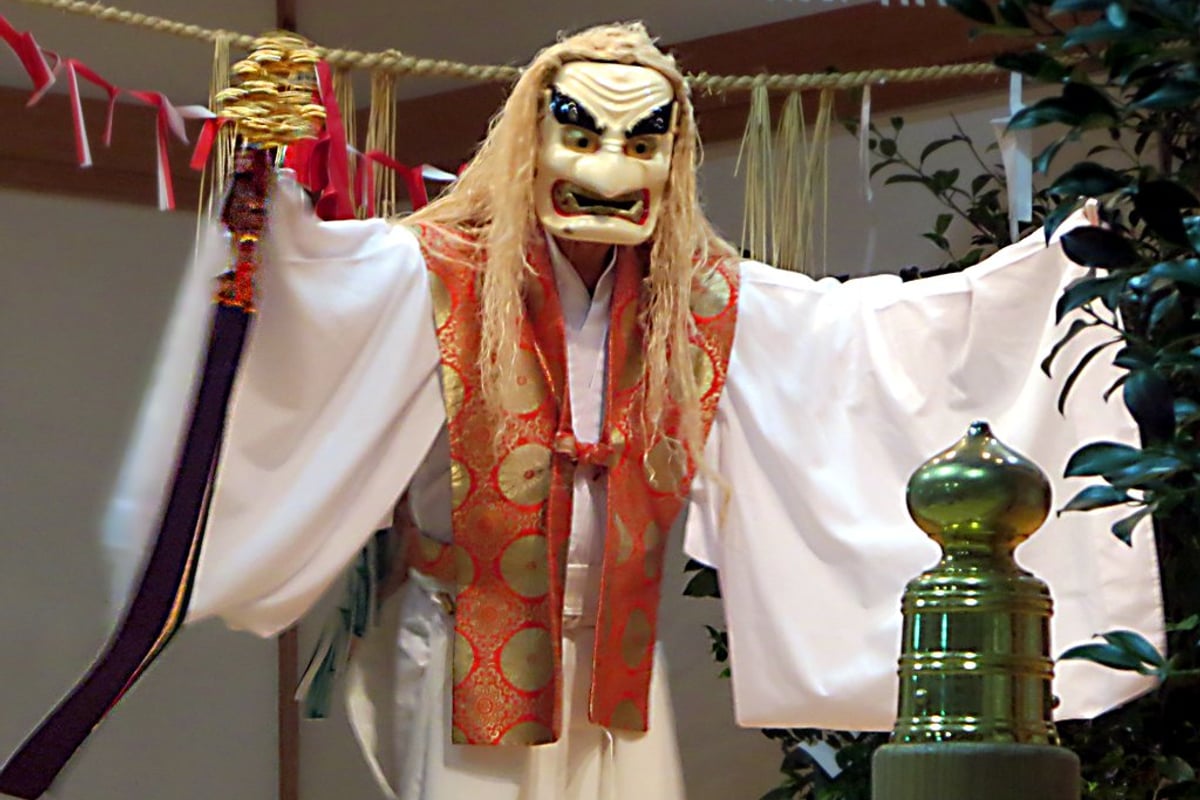
Takachiho Kagura Men (Takachiho Kagura Masks)
Takachiho Kagura Men (Takachiho Kagura Masks)
Takachiho Kagura Men are carved wooden masks made in Takachiho Town, Miyazaki Prefecture. They are based on the masks used in Takachiho Yokagura (night kagura), a national Important Intangible Folk Cultural Property. The masks of Yokagura are called 'omotesama' and have been revered as the gods themselves. According to a Miyazaki Prefecture booklet, the materials are light paulownia (kiri) for masks worn in kagura dances and fragrant camphor (kusu) for decorative masks. According to an explanation by the Japan Tourism Agency, most of the masks are made in family-run workshops; carving takes about two days and painting and coating about five days, so it takes more than a week to complete one mask. At 天岩戸木彫 (Amano Iwato Kibori), a kagura mask workshop in Iwato, Takachiho Town, 工藤浩章, a Miyazaki Prefecture certified traditional craftsperson (Dento Kogeishi), and his son 省吾 carve masks. Hung at the entrance of a home, the masks are said to ward off evil, and decorative masks are also made as gifts.
Aya no Tetsumugi (Hand-Spun Silk of Aya)
Aya no Tetsumugi (Hand-Spun Silk of Aya)
Aya no Tetsumugi is a silk textile made in Aya Town, Miyazaki Prefecture. It was created in 1966 (Showa 41) by 秋山眞和 (Akiyama Masakazu), who founded the workshop 綾の手紬染織工房 in Aya Town. At the workshop, every step is done by hand in one continuous process, from raising Koishimaru silkworms, said to be Japan's original native variety, to reeling, dyeing and weaving. Dyeing centers on natural indigo dyeing by the tennen aku hakko-date method, in which indigo is fermented with lye made from wood ash, and on shell purple (kaimurasaki) dyeing, which uses pigment from sea snails. Weaving also uses kasuri (ikat) and hanaori (floral weave) techniques that originated in Ryukyu. 秋山 was selected as a Contemporary Master Craftsman in 1995 and won the Grand Prix at the 3rd Mitsui Golden Takumi Award in 2020. In Miyazaki Prefecture's materials on traditional crafts, it is also listed under the name 'Miyazaki Tetsumugi'.
Hinokage Takezaiku (Karui Bamboo Back Baskets)
Hinokage Takezaiku (Karui Bamboo Back Baskets of Hinokage)
Hinokage Takezaiku refers to bamboo tools for daily life handed down in Hinokage Town in northern Miyazaki Prefecture. A representative example is the karui, a woven bamboo basket carried on the back, which is a Miyazaki Prefecture-designated Traditional Craft. Its name is said to come from 'karuu' (or 'karau'), a dialect word meaning to carry on the back. Seen from the side, it has a shape close to an inverted triangle, and its distinctive feature is that it can be leaned against something and set down even on steep slopes. In Hinokage, the bamboo craftsman 廣島一夫 (1915–2013) continued making baskets for about 80 years. His works are held in collections such as that of the Smithsonian Institution's National Museum of Natural History in the United States, and they spread the name of Hinokage overseas. The skills of 飯干五男, a master karui maker, have been passed on to 小川鉄平, who moved here from Nagoya. At the town's bamboo craft museum, visitors can see works by 廣島 and others.
Miyazaki's Local Food
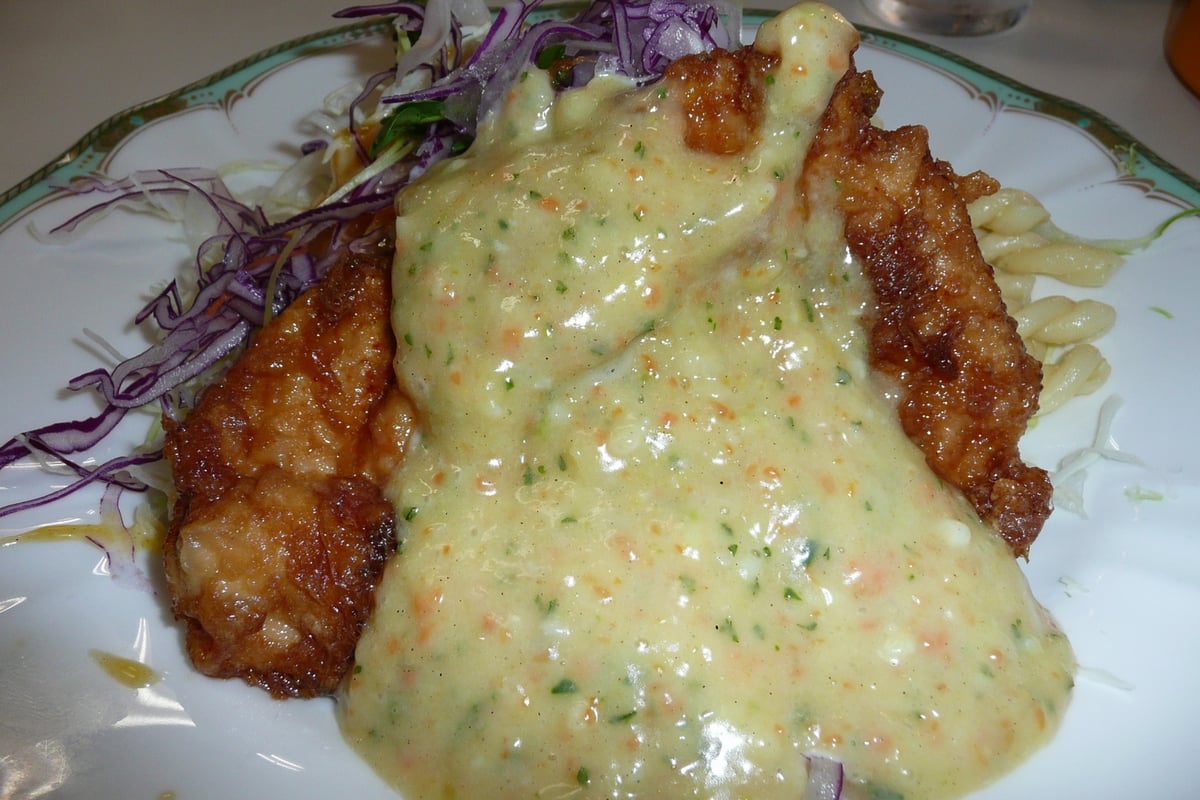
Chicken Nanban
Chicken Nanban
Chicken Nanban is a local dish of Miyazaki Prefecture made by coating chicken in flour and beaten egg, deep-frying it, and soaking it in sweet vinegar sauce (amazu). The Ministry of Agriculture, Forestry and Fisheries' 'Uchi no Kyodo Ryori' lists the entire prefecture as the main area where it has been handed down. It is said to have originated in Nobeoka City, and is said to have been born in the Showa 30s (1955–1964) as a staff meal (makanai) at a Western-style (yoshoku) restaurant in the city. At first it was simply fried chicken soaked in sweet vinegar sauce. Later, a style served with tartar sauce and salad appeared, and its popularity spread. Today there are two lineages: one eaten with sweet vinegar sauce only, and one topped with tartar sauce. It is eaten every day at home, in school lunches, and at restaurants in the prefecture, and has become widely known outside the prefecture as well. In Nobeoka City, a citizens' group has designated July 8 as 'Chicken Nanban Day' and continues to promote the city as the dish's birthplace.
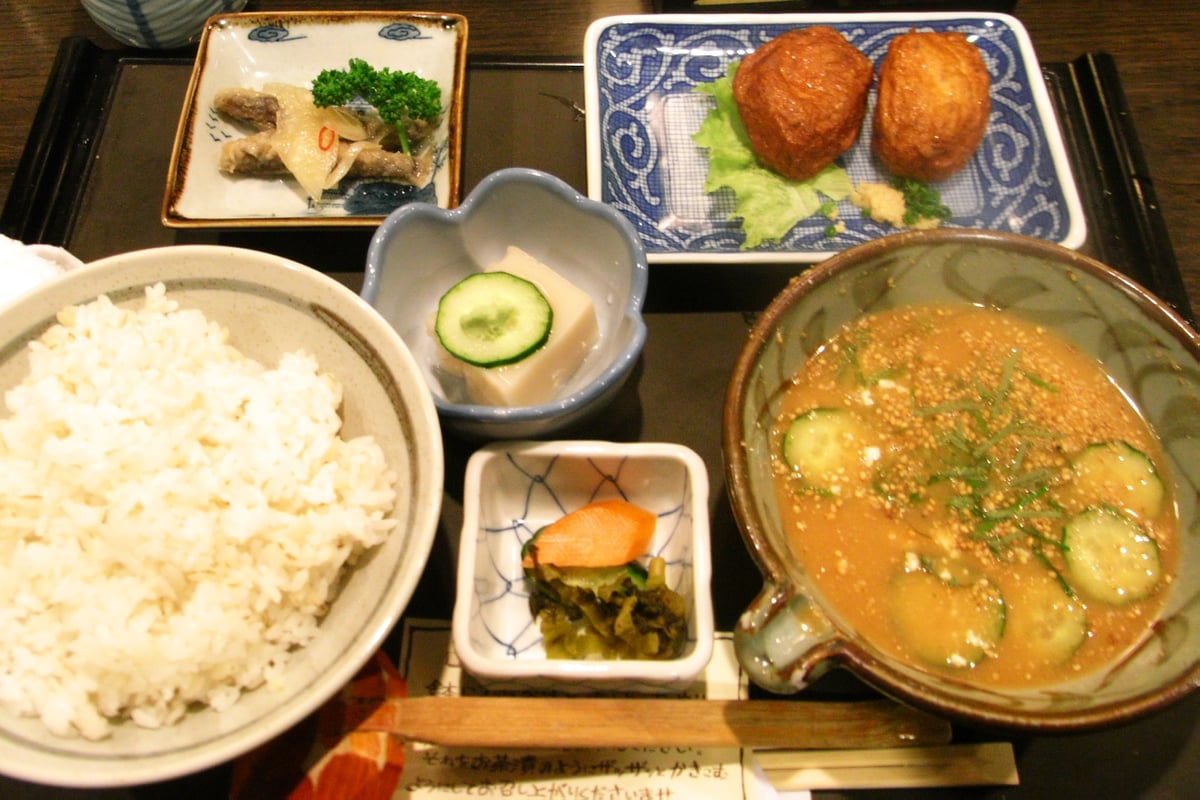
Hiyajiru (Chilled Miso Soup over Rice)
Hiyajiru (Miyazaki Chilled Miso Soup over Rice)
Hiyajiru is a local dish of Miyazaki Prefecture in which grilled miso, iriko (dried sardines), sesame, and other ingredients are ground in a mortar (suribachi), thinned with cold dashi broth, and poured over barley rice. The Ministry of Agriculture, Forestry and Fisheries' 'Uchi no Kyodo Ryori' lists the central region of the prefecture (Ken'o region) as the main area where it has been handed down. Summers on the Miyazaki Plain are harshly hot and humid, and it became established as a dish people could eat even when they had no appetite. Tofu, cucumber, green shiso, myoga ginger, and other ingredients are added to the soup. It is said to have originated from eating barley rice topped with raw miso and doused with water during breaks in summer farm work. There is also a theory that traces its roots to a Kamakura-period record. The flavor has been passed down in each household, and in recent years it has become known nationwide as a dish for beating the summer heat. Note that it is a different dish from Saitama Prefecture's Hiyajiru Udon.
Miyazaki Jidori Sumibiyaki (Charcoal-Grilled Jidori Chicken)
Miyazaki Jidori Sumibiyaki (Charcoal-Grilled Chicken)
Miyazaki Jidori Sumibiyaki is a specialty dish of Miyazaki Prefecture in which chicken is grilled over a hot charcoal fire, with flames and smoke blackening the surface. Many restaurants also grill bone-in thigh and other cuts and serve them as 'momo-yaki' (grilled thigh). The black color of the surface is soot from the flames and smoke that rise when dripping fat burns. Being smoked adds aroma and gives it a chewy texture. The Ministry of Agriculture, Forestry and Fisheries' page introducing Miyazaki Prefecture says that jet-black charcoal-grilled chicken with shochu is a classic combination. The chicken used varies by restaurant: in addition to 'Miyazaki Jitokko' (みやざき地頭鶏), branded chickens such as Hyuga-dori (日向鶏) are also used. Miyazaki Jitokko is a crossbred jidori (local free-range chicken) developed by Miyazaki Prefecture from the native breed 'Jitokko' (地頭鶏), which is designated a Natural Monument. Vacuum-packed charcoal-grilled chicken is also sold as a souvenir.
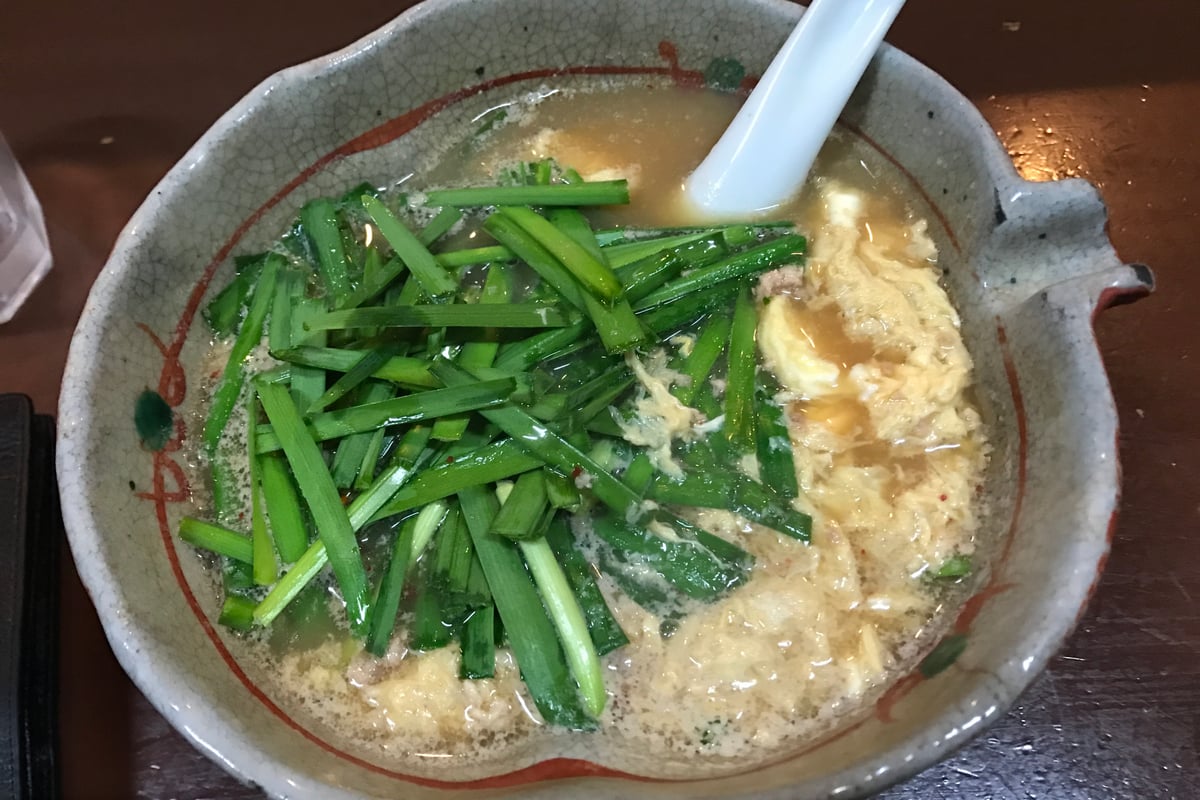
Miyazaki Karamen (Spicy Noodles)
Miyazaki Karamen (Spicy Noodles)
Miyazaki Karamen is a spicy noodle dish combining a soy-sauce-based soup with chili pepper, garlic, garlic chives, beaten egg, and ground meat. It is said to have originated at '元祖辛麺屋 桝元' (Ganso Karamen-ya Masumoto), headquartered in Nobeoka City, and its signature 'Ganso Karamen' (original karamen) is said to have been born in 1987. The noodles are made from wheat flour and buckwheat flour, and because of their konnyaku-like texture they are called 'konnyaku noodles,' although they contain no konnyaku. The spice level can be chosen in stages, and you can order from '0-kara' (level 0), which contains no chili pepper. It is said to have spread after becoming popular as a last bowl to end a night of drinking (shime) in Nobeoka City's entertainment district. Masumoto began expanding its chain of shops in 2001 and has opened shops in many areas. The Nobeoka Tourism Association writes it as 'Nobeoka Karamen.'
Miyazaki Kamaage Udon
Miyazaki Kamaage Udon
Miyazaki Kamaage Udon is a dish in which boiled udon is lifted straight from the pot without being rinsed in cold water, served in a bowl together with its cooking water, and eaten with a dipping sauce. Miyazaki udon is said to be characterized by soft noodles, and some shops use thinner noodles. The dipping sauce is a sweetish soy-sauce base, and many shops are said to use dashi made from iriko (dried sardines), saba-bushi (dried mackerel flakes), katsuobushi, and the like. According to a roundup article on a gourmet site, there are more than 100 kamaage udon shops in Miyazaki City, and many people choose udon to finish a night of drinking. In Miyazaki City, specialty shops founded in the 1960s are still in business. One of them, '重乃井' (Shigenoi), is known as a shop that Shigeo Nagashima and Sadaharu Oh frequented for many years. There is also a way of eating in which, at the end, you add the dipping sauce to the remaining cooking water and drink it.
Uo Udon (Fish Noodles)
Uo Udon (Nichinan Fish Noodles)
Uo Udon is a local dish of Nichinan City, Miyazaki Prefecture, in which fish paste (surimi) is shaped into noodles instead of using wheat flour. It also appears in school lunches in Nichinan City, where the menu describes it as a local dish made by processing fish such as flying fish landed in the city. It is said to have begun as a substitute food made from plentifully caught fish in a time when staple foods were scarce. Some accounts place that time during the war, while others place it in the food shortages after the war. Although it once stopped being made, the women's group of a fishermen's cooperative in Nichinan City revived it, and it came to be sold outside the prefecture as a souvenir. It has a springy texture similar to kamaboko (fish cake), and is characterized by not going soft easily even when simmered. It can be eaten at restaurants in Aburatsu, and products from fish-processing companies in the city can also be bought to take home.
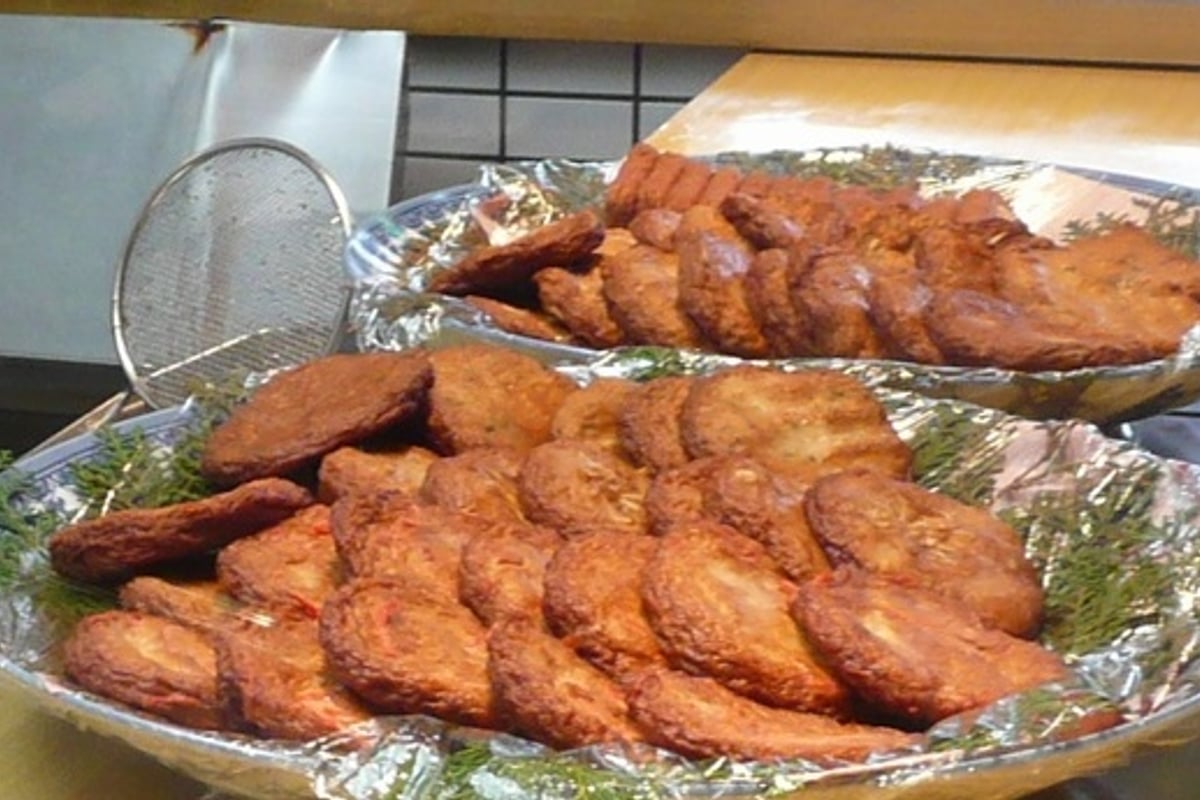
Obiten (Obi Sweet Fried Fish Cake)
Obiten (Obi Sweet Fried Fish Cake)
Obiten (also written 飫肥天) is a local dish of the Obi district of Nichinan City, Miyazaki Prefecture, made by combining fish paste (surimi) with tofu, brown sugar, and miso and deep-frying it. The Ministry of Agriculture, Forestry and Fisheries (MAFF) introduces Obiten as part of the food culture of southern Miyazaki Prefecture. In Obi, which flourished as the castle town of the Obi Domain in the Edo period, everyday fish such as sardines, horse mackerel, and flying fish landed at Aburatsu were eaten. Obiten is said to have been born as a way to make these fish delicious. It resembles satsuma-age from Kagoshima Prefecture, but because it uses brown sugar it is sweeter, brown in color, and fluffy in texture. In the castle town of Obi there are shops that combine live demonstration sales with dining, and Obiten can also be enjoyed using vouchers from a food-strolling map.
Lettuce Maki (Lettuce Sushi Roll)
Lettuce Maki (Miyazaki Lettuce Sushi Roll)
Lettuce Maki is a sushi roll that originated in Miyazaki City, Miyazaki Prefecture, in which shrimp and lettuce are dressed with mayonnaise and rolled up with sushi rice and nori seaweed. It was devised by Shoji Muraoka (村岡正二), the first-generation owner of the sushi restaurant '一平寿し' (Ippei Sushi) in Matsuyama, Miyazaki City. Miyazaki's Lettuce Maki is said to always use shrimp. The shop's official website explains that it was created in 1966 (Showa 41) for Masaaki Hirao, a composer with whom he was friends. At the time, raw vegetables and mayonnaise were thought not to go with sushi, but it spread by word of mouth, mainly among young people. Later, supermarkets and takeout sushi shops across Japan came to sell it under the name 'salad maki' (salad roll). In Miyazaki City, other sushi restaurants and izakaya also serve Lettuce Maki.
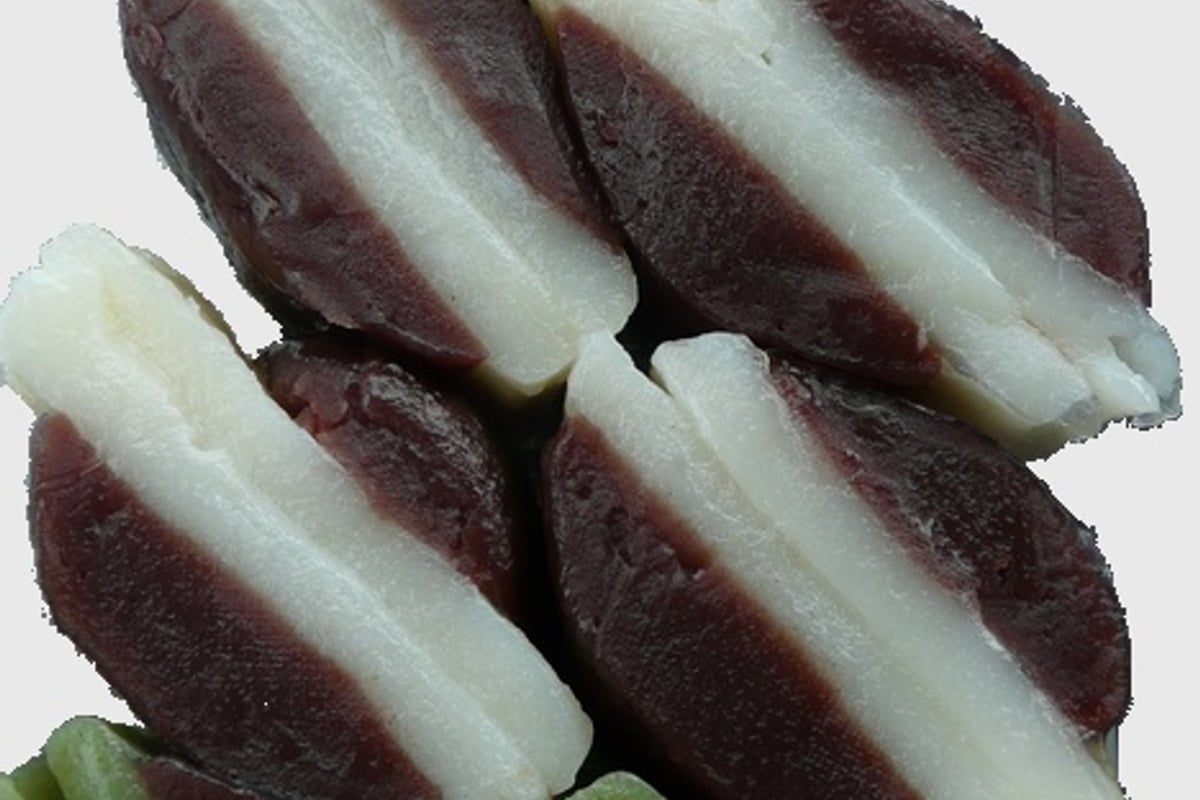
Kujira Yokan (Whale Yokan)
Kujira Yokan (Sadowara Whale Rice Cake)
Kujira Yokan is a local confection of Sadowara in Miyazaki City, Miyazaki Prefecture, made by sandwiching sweet bean paste between layers of dough kneaded and rolled out from rice flour, and then steaming it. Despite the name yokan, it is not a confection set with agar but a steamed confection. It is said to have begun in the Sadowara Domain in the Edo period, when a mother had it made in hopes of her young heir's growth. The name is said to carry the wish that the child would grow up strong and sturdy, like a whale swimming in the vast ocean. It is said that it later became a good-luck item for the Boys' Day festival (Tango no Sekku) in the Sadowara Domain. Because it contains no preservatives and does not keep long, it is also called the 'sashimi of sweets'. In the Kamitajima area of Sadowara, there are shops that have long continued to make it, and it sometimes sells out early in the day. It is a different confection from Kujira Mochi of Yamagata Prefecture and the kujira yokan of Onomichi City, Hiroshima Prefecture.
Cheese Manju (Cream Cheese Bun)
Cheese Manju (Miyazaki Cream Cheese Bun)
Cheese Manju is a renowned confection of Miyazaki Prefecture, made by wrapping cream cheese in a cookie- or scone-like dough and baking it. It is said to have been born in Kobayashi City, Miyazaki Prefecture, in the 1980s and to have spread throughout the prefecture. 風月堂 (Fugetsudo) in Kobayashi City explains on its official website that it was devised in 1983 (Showa 58) by the confectioner Ito (伊藤光輝). Some accounts also say the recipe spread through a study session of the Miyazaki Prefecture Western Confectionery Association in 1984 (Showa 59). Several shops claim to be the original, and there are various theories about its origin. As of 2024, it is said to be made by more than 200 companies in the prefecture, and the texture of the dough and the cheese blend differ from shop to shop. There are also versions with added flavors such as chocolate and mango, and it is also made by specialty shops in Miyazaki City.
Model Course
See Yokagura masks at Takachiho Shrine, then visit 天岩戸木彫 and the bamboo craft museum in Hinokage
At 神楽面工房 天岩戸木彫 (Amanoiwato Mokucho), a kagura mask workshop in Takachiho Town, masks of deities such as Tajikarao-no-Mikoto and Ame-no-Uzume-no-Mikoto are made and sold. It is said to be closed on Sundays, and you can confirm by phone before visiting. In the evening, head to the kagura hall of Takachiho Shrine (高千穂神社). Every night from 8:00 p.m. for about one hour, four representative pieces of Yokagura are performed, and the fee is listed as 1,000 yen. The next day, go on to neighboring Hinokage Town. The Hinokage Town Bamboo Craft Museum (日之影町竹細工資料館) displays bamboo craft by 廣島一夫 (Kazuo Hiroshima) and others. It opens by application, so please contact the Hinokage Town Tourism Association.
Savor Chicken Nanban, charcoal-grilled jidori, Hiyajiru and Kamaage Udon in downtown Miyazaki City
For lunch, have Chicken Nanban with tartar sauce at おぐら本店 (Ogura main store), behind the 山形屋 (Yamakataya) department store. According to published information, it costs 1,100 to 1,300 yen. In the afternoon, head to 一平寿し in Matsuyama, Miyazaki City. It is the birthplace of Lettuce Maki and is open until 2:30 p.m. for lunch. In the evening, at 丸万焼鳥 本店, you can enjoy grilled bone-in chicken thigh, said to have been devised in 1954. ぞうすいの店 お通 serves Hiyajiru all year round. Finish the day at 釜揚げうどん 戸隠 本店, which is open until late at night. Closing days vary by shop, so please check in advance.
Buy Kujira Yokan in Sadowara and visit the Sadowara Ningyo shop ますや
阪本商店 in Sadowara-cho, Miyazaki City, is a Kujira Yokan shop open from 8:00 a.m. until it sells out. According to a 2023 visit report, a pack of five was 420 yen. Because it sometimes sells out early, a morning visit is recommended. In the same Kamitajima district is 佐土原人形店ますや (Masuya), a Sadowara Ningyo shop that has continued since the Edo period. The shop has been closed for renovation since the end of August 2026 and plans to resume sales after the work is completed in late November. Please check the official website for the reopening date and the resumption of the painting experience.
Experience tetsumugi and Hyuga kaya go boards in Aya Town, then visit うずら舎 in Kunitomi Town
At the Aya International Craft Castle (綾・国際クラフトの城) in Aya Town, works by the town's craftspeople are displayed and sold, and classes in indigo dyeing and weaving are also held. The gallery of 綾の手紬染織工房 is open from 10:00 a.m. to 4:00 p.m. and is closed on Sundays and Mondays. At 熊須碁盤店, you can consult about buying or ordering go boards of Hyuga kaya. うずら舎 in neighboring Kunitomi Town is the base of activities for the Hokkedake Uzura-guruma Preservation Society. According to published information, an uzura-guruma costs 600 yen. It opens on irregular days, so please check its Instagram.
Visit a go stone workshop in Hyuga City, then eat Chicken Nanban and Karamen in Nobeoka
黒木碁石店 in Hiraiwa, Hyuga City, is a Hyuga Hamaguri Goishi shop founded in 1917. Its attached shop and restaurant closed in 2020, so please confirm by phone whether in-store purchases and visits are possible. Head north to 直ちゃん (Naochan) in Nobeoka City, which serves Chicken Nanban in its original form, without tartar sauce. It is said to close once everything sells out. In the evening, at 元祖辛麺屋 桝元本店, you can taste the original Karamen, born in 1987. Its hours are listed as starting at 7:00 p.m.
Snack on Obiten while strolling the castle town of Obi in Nichinan, then savor Uo Udon in Aburatsu
Obi in Nichinan City is a district where the townscape of a castle town remains. At 元祖おび天本舗, you can buy Obiten from 100 yen per piece. At おび天蔵, you can eat an Obiten set meal (listed from 1,500 yen) while watching it being made and sold on the spot. In the afternoon, head to 魚料理びびんや near Aburatsu Port. Its Uo Udon, made from fish paste, is listed at 702 yen. びびんや is closed on Mondays, and its business hours differ depending on the source, so please check in advance.
Learn about Miyakonojo's bow makers and a wooden sword workshop, then find Cheese Manju and Hyuga kaya boards in Kobayashi City
Miyakonojo City is home to a cluster of workshops of yumishi (bow makers) who make bamboo bows, such as 横山黎明弓製作所. 新留木刀製作所 is announced as open from 8:00 a.m. to 6:00 p.m. on weekdays and Saturdays. Both are workshops, so please inquire in advance about visits and purchases. Move on to Kobayashi City and visit 風月堂 (Fugetsudo), which calls itself the home of the 'original Cheese Manju' (元祖チーズ饅頭). It explains that the Cheese Manju was devised in 1983. ひなもり銘木 displays and sells go boards and shogi boards made of Hyuga kaya. The showroom is by reservation only and is closed on Sundays and public holidays.
Events
Takachiho Yokagura
Every year from mid-November to early February of the following year (dates vary by village) / About 20 villages in Takachiho Town