Takachiho Kagura Men (Takachiho Kagura Masks)
Takachiho Kagura Men (Takachiho Kagura Masks)
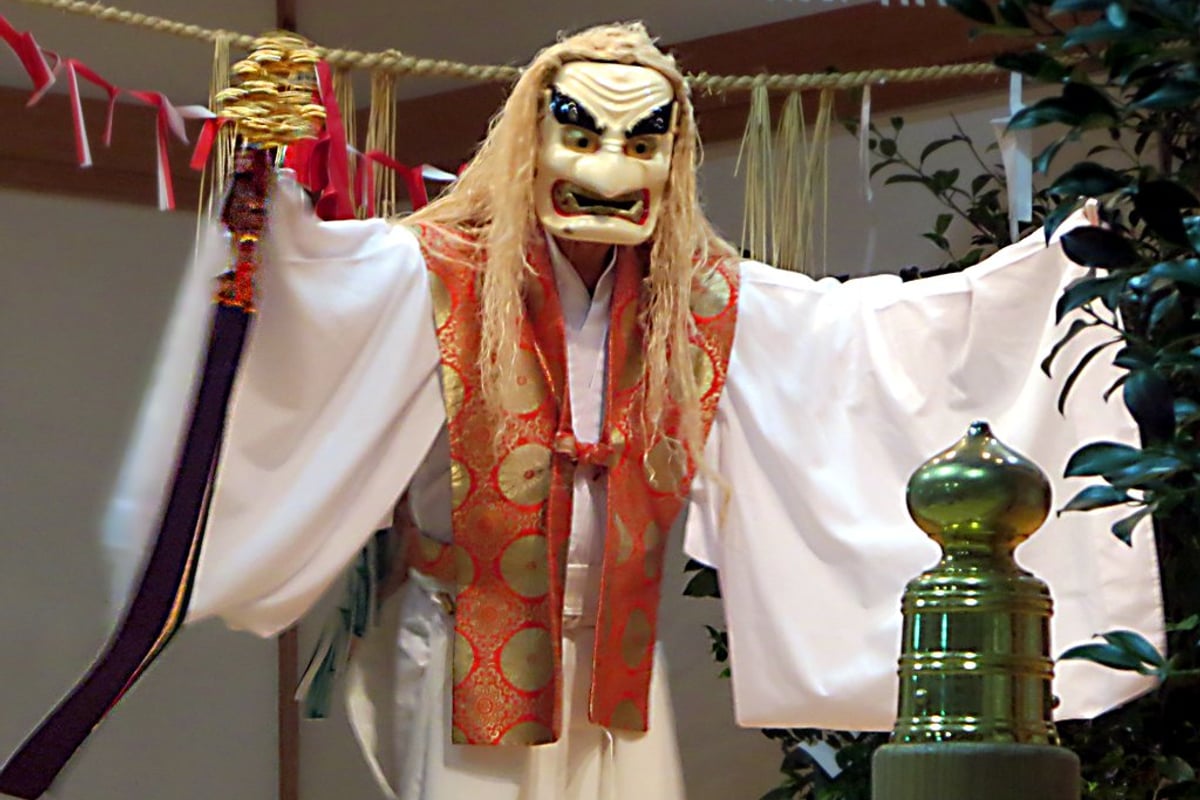
Image: Wikimedia Commons
Takachiho Kagura Men are carved wooden masks made in Takachiho Town, Miyazaki Prefecture. They are based on the masks used in Takachiho Yokagura (night kagura), a national Important Intangible Folk Cultural Property. The masks of Yokagura are called 'omotesama' and have been revered as the gods themselves. According to a Miyazaki Prefecture booklet, the materials are light paulownia (kiri) for masks worn in kagura dances and fragrant camphor (kusu) for decorative masks. According to an explanation by the Japan Tourism Agency, most of the masks are made in family-run workshops; carving takes about two days and painting and coating about five days, so it takes more than a week to complete one mask. At 天岩戸木彫 (Amano Iwato Kibori), a kagura mask workshop in Iwato, Takachiho Town, 工藤浩章, a Miyazaki Prefecture certified traditional craftsperson (Dento Kogeishi), and his son 省吾 carve masks. Hung at the entrance of a home, the masks are said to ward off evil, and decorative masks are also made as gifts.
Origin
Takachiho Yokagura is a Shinto performing art connected with the myth of Amano-Iwato (the Heavenly Rock Cave), and every year from November to the following February it is dedicated in about 20 communities. According to the Japan Tourism Agency's multilingual explanation, the masks of Yokagura are treated as the gods themselves and are received with the greatest respect. Old masks more than 800 years old, said to have been handed down since kagura began, still survive. Takachiho Kagura Men are crafts made with the skills that have carried on the carving of these masks.
History
Takachiho Yokagura was designated a national Important Intangible Folk Cultural Property in 1978 (Showa 53). A furusato nozei (hometown tax donation) website explains that its history goes back to the Muromachi period. According to the Japan Tourism Agency's explanation, some mask workshops have continued for four generations. 工藤浩章 of 天岩戸木彫 is a third-generation kagura mask carver and was certified as a Miyazaki Prefecture traditional craftsperson in fiscal 2012 (Heisei 24).
Features
Yokagura masks are indispensable for portraying the different deities who appear in the Amano-Iwato myth. According to the Japan Tourism Agency's explanation, mask makers need great skill to capture the characteristics of gods and goddesses in a mask, and locally they are also regarded as sculptors. Masks used in dances are said to receive a soul when dedicated to a shrine or similar place, and are then treated as gods. Decorative masks are hung at entrances in the hope of warding off evil and bringing good fortune, and are also used as celebratory gifts.
Techniques
Choosing paulownia or camphor
According to a Miyazaki Prefecture booklet, light paulownia is used for masks worn in kagura dances, and camphor, with its pleasant wood fragrance, for decorative masks. The Japan Tourism Agency's explanation also introduces workshops that carve masks from camphor and paulownia wood.
Plain-wood and painted finishes
天岩戸木彫's masks come in a plain-wood (shiraki) finish that makes the most of the natural wood, and a painted finish with color. Among the furusato nozei return gifts, masks of Tajikarao-no-Mikoto and Ame-no-Uzume-no-Mikoto are listed in both finishes.
Materials Used
Production Process
- 1
Preparing the wood
According to the Japan Tourism Agency's explanation, the workshops carry out every stage of mask making themselves, from felling the trees to the final coating. The wood is chosen according to use: light paulownia for dance masks and camphor for decorative masks.
- 2
Rough cutting and carving
According to a Miyazaki Prefecture booklet, after rough cutting with a carving machine, the mask is finished by hand. The Japan Tourism Agency's explanation says it takes about two days to carve an expressive face out of the wood.
- 3
Finishing the expression
Bringing the expression to life is said to be the most difficult step. The Miyazaki Prefecture booklet notes that the wood-carving skill that creates delicate expressions is highly regarded.
- 4
Painting and coating
Masks with a painted finish are painted and coated after carving. The Japan Tourism Agency explains that this step takes about five more days, so it takes more than a week to complete one mask.
| Main Production Areas |
|
|---|
Artisans & Workshops
神楽面工房 天岩戸木彫
A kagura mask workshop run by the 工藤 family at 399 Iwato, Takachiho Town. The mask carver 工藤浩章 is the third generation and was certified as a Miyazaki Prefecture traditional craftsperson in fiscal 2012. He also serves as a kagura dancer, known as a 'hoshadon'. His son 省吾 is also involved in production as a mask carver.
Official site →How to Buy
- 天岩戸木彫 (workshop)
- According to the Takachiho Tourism Association, the workshop makes and sells both masks for kagura dances and decorative masks. Many are masks of Tajikarao-no-Mikoto and Ame-no-Uzume-no-Mikoto, which are sought as gifts. You can call (0982-74-8901) to check before visiting.Where to buy →PR
- Furusato nozei (Takachiho Town)
- On furunavi, masks of Tajikarao-no-Mikoto and Ame-no-Uzume-no-Mikoto made by 天岩戸木彫 are listed separately in plain-wood and painted finishes. Shipping is stated to take about 30 days from application.Where to buy →PR
Hands-on Experiences
高千穂神社 神楽殿(高千穂神楽)
宮崎県西臼杵郡高千穂町三田井1037
Every evening from 20:00, for about an hour, four representative dances from the 33 dances of Yokagura are performed, including 'Tajikarao no Mai' and 'Uzume no Mai'. According to a listing updated in August 2025, admission is 1,000 yen (free up to elementary school age), and 80 of the roughly 150 seats can be reserved online.
View details →神楽面工房 天岩戸木彫(工房見学)
宮崎県西臼杵郡高千穂町大字岩戸399
A website introducing the Nishiusuki area lists business hours as 9:00–17:00, closed on Sundays (visits possible with advance notice). Visitors wishing to tour the workshop are asked to say so. There is parking for four cars.
View details →FAQ
Q. How do dance masks differ from decorative masks?
A. According to a Miyazaki Prefecture booklet, dance masks are made of light paulownia and decorative masks of fragrant camphor. Dance masks are said to receive a soul when dedicated to a shrine or similar place, and are then treated as gods. Decorative masks are hung at entrances and elsewhere in the hope of warding off evil and bringing good fortune.
Q. How do they differ from Iwami Kagura masks?
A. The Iwami Kagura masks of Shimane Prefecture are papier-mache (hariko) masks made by layering Sekishu Washi paper over a clay mold. Takachiho Kagura Men are wooden masks carved from paulownia or camphor wood. Both are crafts that grew out of the masks used in the kagura of their respective regions.