Image: Wikimedia Commons
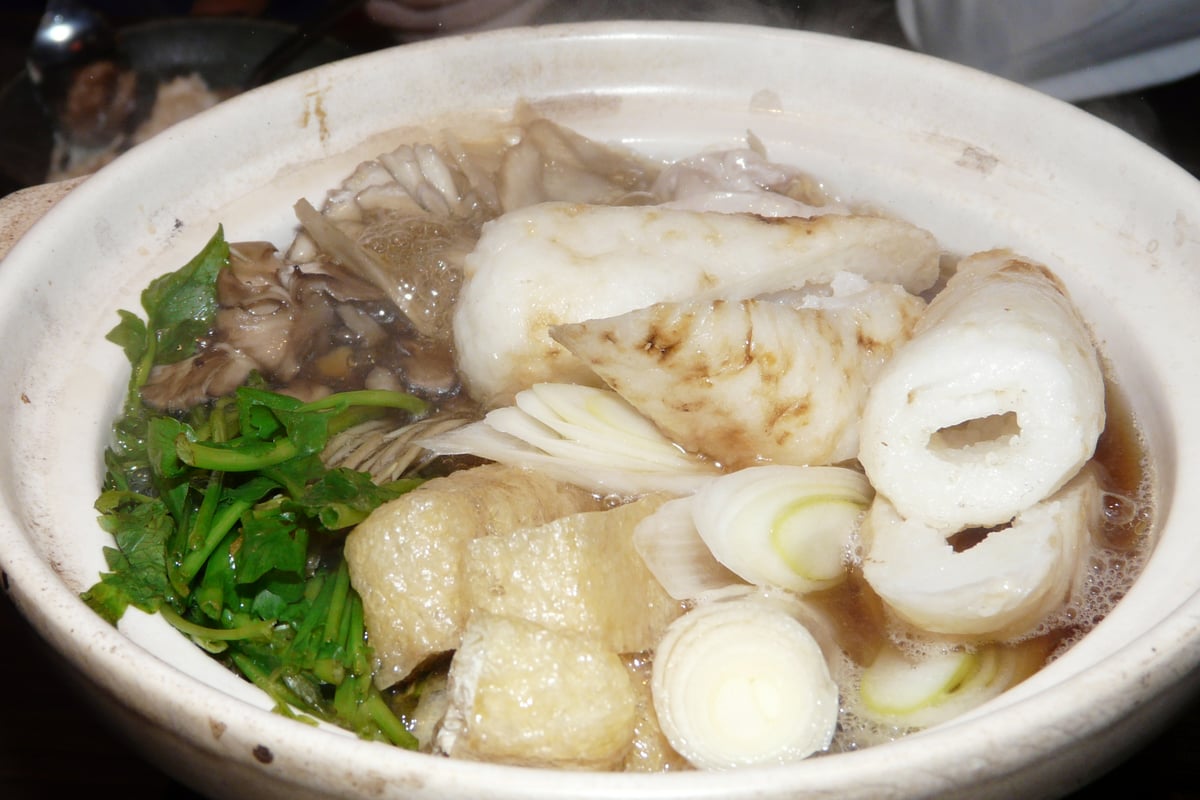
Kiritanpo Nabe is a signature local dish of Akita Prefecture in which kiritanpo — half-pounded rice wrapped around a cedar stick and grilled — is simmered in a broth made from Hinai-jidori (a breed of free-range chicken). It is said to have originated in the northern part of the prefecture, centered on Odate City and Kazuno City, where workers who stayed in the mountains for charcoal-making or cedar logging would mold leftover rice onto sticks and grill it over a fire. The soy-sauce-based broth, rich with the umami of Hinai-jidori, is combined with mountain ingredients of Akita such as burdock root, maitake mushroom, Japanese parsley (seri), and long green onion, and the kiritanpo is added at the end and simmered briefly so it soaks up just the right amount of broth. Made in homes from the season of new rice through winter, it is also cherished as an essential dish for celebrations, funerals, and entertaining guests.
Origin
The origins of Kiritanpo Nabe trace back to the northern part of Akita Prefecture, centered on Odate City and Kazuno City. It is said to have begun when workers who stayed in mountain huts for charcoal-making or logging Akita cedar mashed leftover rice or scorched rice (okoge), molded it onto sticks, and grilled it over the irori (sunken hearth). Another account traces it to Matagi (traditional mountain hunters), who are said to have added leftover rice balls to pots of bird or game meat.
History
The grilled rice on a stick is said to have come to be called 'tanpo' because its shape resembled a tanpo — a padded cover used to protect the tip of a spear — or a cattail flower spike. When the Hinai chicken was designated a national natural monument and could no longer be used as food, the dish faced a period of hardship, but through the efforts of the town of Hinai (now part of Kitaakita City), the Hinai-jidori breed was created, allowing it to return as the dish's centerpiece. Odate City still holds the annual 'Honba Odate Kiritanpo Festival' to this day.
Features
The defining feature is half-pounded non-glutinous rice molded onto round cedar sticks and grilled until fragrant on the surface. A rich broth made from Hinai-jidori bones and meat is seasoned with soy sauce and mirin, then simmered together with burdock root, maitake mushroom, seri, and long green onion. Its appeal lies in the fragrant grilled aroma and the chewy texture of rice that has absorbed the broth, and it is often eaten as the final course of a hot pot meal.
Main Ingredients
Food Culture
Made in homes and at family gatherings from autumn, when new rice is harvested, through winter, it is considered a taste passed down from mother to child around Odate City, and it is also regarded as a signature dish for entertaining guests.
How It Differs from Home Cooking
While households often simplify the dish using store-bought tanpo, specialty restaurants go to greater lengths — molding house-made tanpo onto cedar skewers and grilling them over charcoal, and taking broth from whole Hinai-jidori chickens. Some also offer dishes unique to specialty restaurants, such as Hinai-jidori sashimi or grilled miso-glazed tanpo (miso-tsuke tanpo).
Famous Shops
十字屋きりたんぽ店
秋田県大館市常盤木町18-9
A kiritanpo specialty shop founded in 1948 (Showa 23). Its hand-grilled miso-tsuke tanpo is also a signature item.
View details →秋田きりたんぽ屋 秋田駅前本店
秋田県秋田市中通2-7-6 緑屋駅前ビル1階
A local-food restaurant a 2-minute walk from the west exit of Akita Station. Kiritanpo Nabe costs around 1,870 yen and up.