Image: Wikimedia Commons
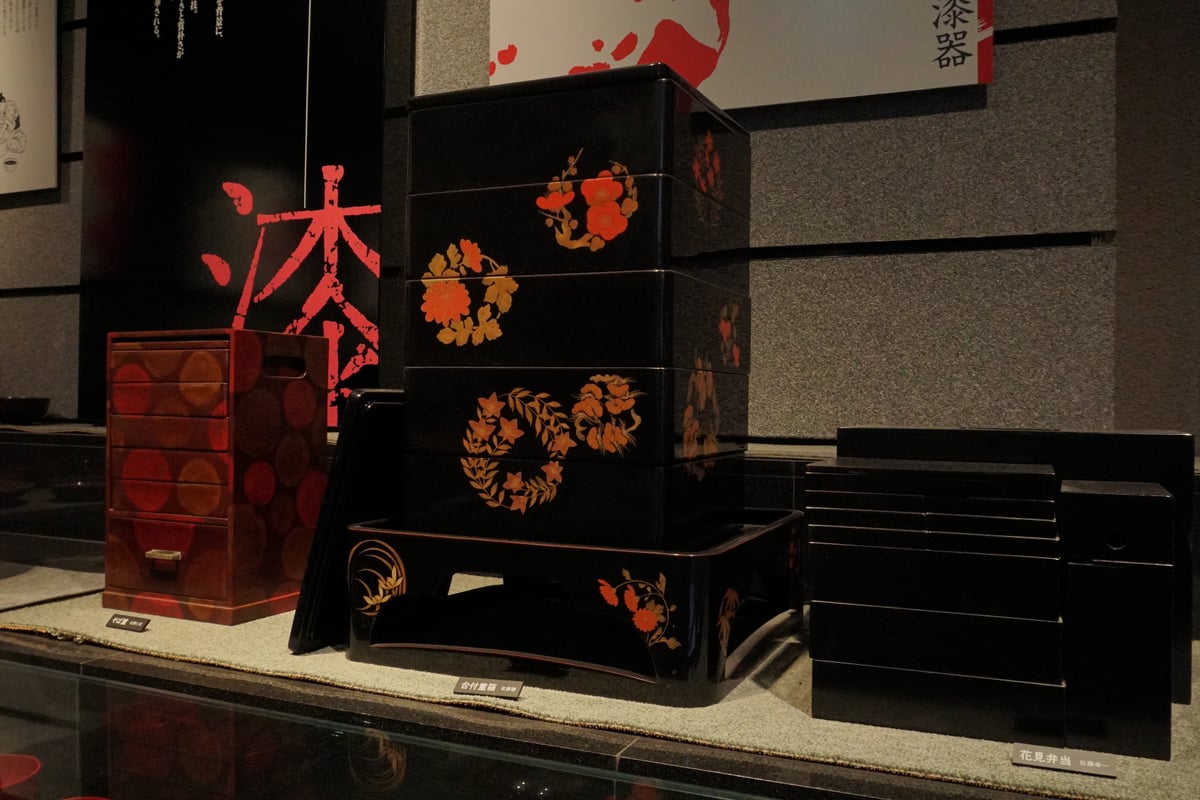
Kawatsura Shikki is lacquerware made in the area around Kawatsura, Yuzawa City, Akita Prefecture (formerly Inakawa Town), with a history said to span roughly 800 years. According to tradition, it began in 1193, when Lord Doku—younger brother of Onodera Shigemichi, a retainer of Minamoto no Yoritomo and lord of Inaniwa Castle—built a residence at Koshio-nojiri and had his retainers lacquer sword scabbards, bows, armor, and other weapons and equipment; the craft later developed into the making of everyday lacquered bowls. From the Genna era (around 1615) through the Genroku era in the early Edo period, roughly 26 households in and around Kawatsura village came to work as bowl makers, and in the latter half of the Edo period they obtained domain permission to expand their sales routes, producing a wide range of lacquerware including bowls, trays, and tiered boxes and adding decorative techniques such as chinkin and maki-e that helped establish the craft as an industry. Its defining features are the hananuri technique, in which the final coat of lacquer is left as brushed—without polishing or grinding afterward—and sturdy foundation work, making it a beloved everyday lacquerware valued for its practicality. It is a nationally designated Traditional Craft.
Origin
According to tradition, Kawatsura Shikki began in 1193, when Lord Doku—younger brother of Onodera Shigemichi, a retainer of Minamoto no Yoritomo and lord of Inaniwa Castle—built a residence at Koshio-nojiri and had his retainers apply lacquer to sword scabbards, bows, armor, and other weapons and equipment. The lacquering techniques used to reinforce and decorate weaponry gradually shifted toward making everyday bowls for the village, and the craft took root as a local industry.
History
The craft became a full-fledged industry in the early Edo period: records show that from the Genna era (around 1615) through the Genroku era, roughly 26 households in and around Kawatsura village worked as bowl makers. In the latter half of the Edo period they obtained domain permission to expand their sales routes, and a wide range of items—bowls, trays, tiered boxes, and more—came to be produced, with decorative techniques such as chinkin and maki-e also adopted, greatly strengthening the craft's industrial foundation. Today its techniques are passed down mainly through the Akita Prefecture Lacquerware Industry Cooperative.
Features
A defining feature is the soft luster and natural finish achieved through the hananuri technique, in which the final coat of lacquer is applied with a brush—guided by how the lacquer flows—and left unpolished and unground. Sturdy foundation work, built up through wood consolidation, cloth reinforcement, and multiple layers of undercoating, gives the lacquerware the durability to withstand daily use. The craft centers on everyday tableware such as bowls and chopsticks, and is highly regarded as practical lacquerware.
Materials Used
Production Process
- 1
Wood base making
Wood such as horse chestnut or zelkova is turned into the shape of bowls or trays and then dried.
- 2
Undercoating
Multiple layers of undercoating, including cloth reinforcement and lacquer mixed with powdered clay, are applied to build a sturdy base.
- 3
Middle coating
Lacquer is applied over the undercoating, with grinding repeated to smooth the surface.
- 4
Hananuri (final coating)
The final coat is left unground; the lacquer is applied with a brush while gauging how it flows.
- 5
Decoration
Patterns are sometimes added using techniques such as chinkin (incised gold) or maki-e (sprinkled gold).
| Main Production Areas |
|
|---|
Artisans & Workshops
佐藤善六漆器店
A long-established lacquerware shop in Kawatsura, Yuzawa City, founded in 1872 (Meiji 5). It manufactures and sells durable, affordably priced everyday lacquerware using the hananuri technique.
Official site →佐藤伊右衛門商店
A lacquerware shop in Kawatsura, Yuzawa City, now in its 12th generation. It produces sturdy, colorful lacquerware using traditional techniques, including everyday items such as sake cups and tea coasters.
Official site →How to Buy
- Kawatsura Shikki Traditional Craft Museum
- An exhibition and sales facility in Kawatsura, Yuzawa City. It always stocks more than 1,400 pieces of Kawatsura Shikki, with a wide selection ranging from chopsticks and bowls to low tables and chests.Where to buy →PR
Hands-on Experiences
川連漆器伝統工芸館
秋田県湯沢市川連町字大舘中野142-1
Admission is free. With advance reservation, visitors can try chinkin or maki-e decoration for around ¥2,750 per person (for groups of three or more), with decoration artisans supporting beginners.
View details →