Image: Wikimedia Commons
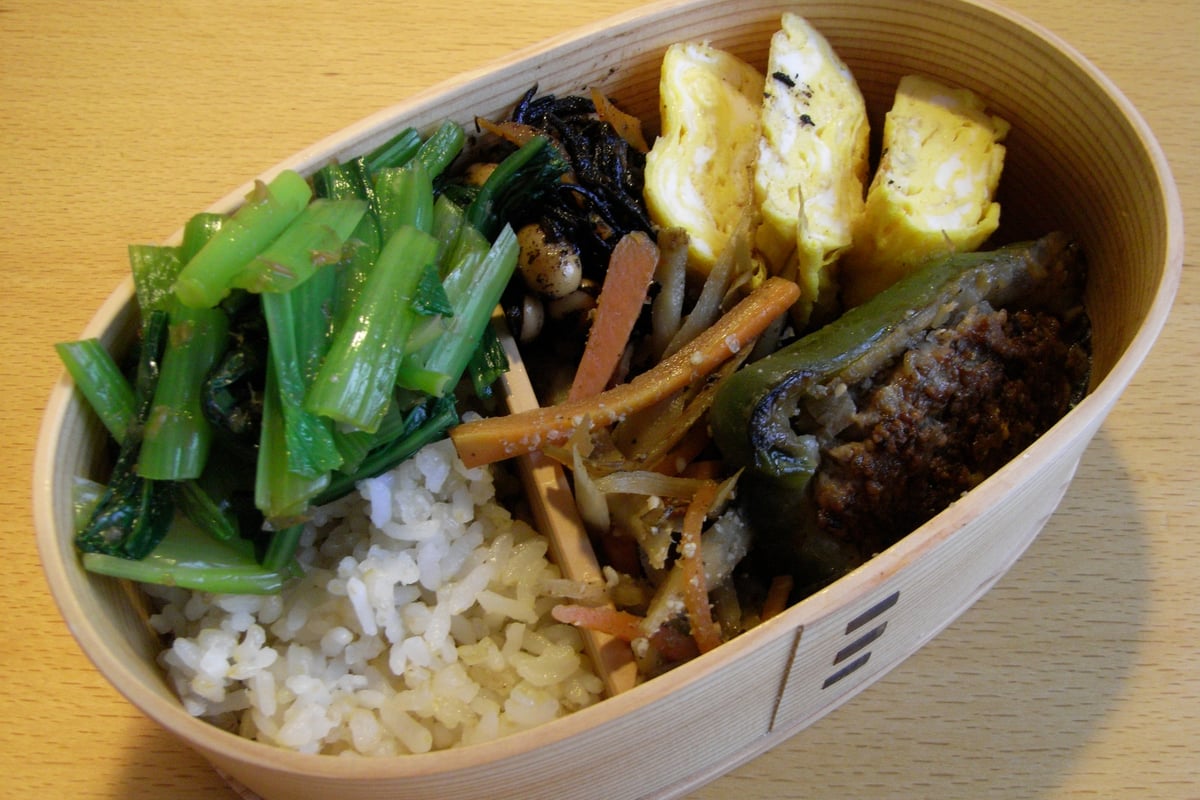
Odate Magewappa is a woodcraft made in Odate City, Akita Prefecture, using a technique in which thin sheets peeled from straight-grained (masame) natural Akita cedar are softened in hot water, bent into a cylindrical shape, and then stitched closed with the bark of the mountain cherry tree. The Odate Local History Museum holds a fragment of bentwood ware believed to date from the Heian period, suggesting that simple bentwood craftsmanship existed in the area from ancient times, but it was not until the latter half of the 17th century that it developed into a full-fledged industry. Its direct origin is said to be the encouragement of bentwood ware production as a side occupation by the Satake-Nishi family, lords of Odate Castle, who drew on the region's abundant Akita cedar resources to address the domain's financial difficulties and the hardship of its lower-ranking samurai. In addition to the cedar's beautiful grain, the wood's moderate humidity- and airflow-regulating properties are said to absorb excess moisture from packed rice and help keep it delicious, and Magewappa has recently drawn renewed attention as lunch boxes and rice containers. In October 1980 (Showa 55), it was designated a Traditional Craft Designated by the Minister of Economy, Trade and Industry.
Origin
The exact origin of Odate Magewappa is not clear, but a fragment of bentwood ware believed to date from the Heian period is held by the Odate Local History Museum, suggesting that simple bentwood items made from cedar and mountain cherry bark had long been produced in the area. Its development as a full-fledged industry began in the latter half of the 17th century, when the Satake-Nishi family, lords of Odate Castle, encouraged bentwood ware production as a side occupation, drawing on the domain's abundant Akita cedar resources to address financial difficulties and the hardship of its lower-ranking samurai.
History
With the encouragement of the Satake-Nishi family, a domain-wide production system took shape, with farmers required to transport raw timber to the castle town in place of part of their annual rice tax, and the resulting products grew into a specialty distributed as far as Sakata, Niigata, and the Kanto region. The craft's techniques continued to be passed down among Odate's artisans, and in October 1980 (Showa 55) it was designated a Traditional Craft Designated by the Minister of Economy, Trade and Industry by the Association for the Promotion of Traditional Craft Industries. Today, production is centered on companies and workshops belonging to the Odate Magewappa Cooperative.
Features
A defining feature is the process of thinly peeling straight-grained natural Akita cedar, softening it in hot water, bending it around a mold, and stitching the seam closed with mountain cherry bark. Beyond its beautiful grain, the cedar's moderate humidity- and airflow-regulating properties are said to absorb excess moisture from packed rice and help keep it delicious, which has brought renewed attention to Magewappa as lunch boxes and rice containers. It combines light, durable practicality with a simple beauty that makes the most of the wood's natural warmth.
Materials Used
Production Process
- 1
Wood selection and cutting
Straight-grained Akita cedar is thinly peeled and cut to the dimensions of the finished product.
- 2
Boiling and bending
The thin sheets of wood are softened in hot water, then bent into a cylindrical shape around a mold.
- 3
Drying and shaping
The bent wood is dried while still fitted to the mold so that its shape is fixed.
- 4
Kaba-nui (bark stitching)
The seam is stitched closed and reinforced with mountain cherry bark.
- 5
Fitting the base and finishing
A base is fitted into place, and the surface is polished to finish.
| Main Production Areas |
|
|---|
Artisans & Workshops
栗久
A long-established Odate Magewappa maker based in Nakamachi, Odate City. It continues to develop Magewappa that make the most of the natural beauty of Akita cedar while remaining easy to use in modern life.
Official site →柴田慶信商店
A Magewappa specialty shop headquartered in Onarimachi, Odate City. While preserving traditional techniques, it produces a wide range of items from lunch boxes to cups, and its Wappa Building shop also holds hands-on making workshops.
Official site →How to Buy
- Odate Kogeisha
- A Magewappa maker in Shakanai, Odate City, with an attached handicraft studio. It manufactures and sells lunch boxes, trays, and more, also available through its official online store.Where to buy →PR
- Shibata Yoshinobu Shoten
- Offers products across a wide range of sizes, shapes, and prices, including oval lunch boxes (small) from around ¥12,100 and rectangular lunch boxes (small) from around ¥14,300.Where to buy →PR
Hands-on Experiences
大館工芸社 ハンディクラフトスタジオ
秋田県大館市釈迦内字家後29番地15
Advance reservation required (by phone, Asoview, etc.). Prices vary by experience kit, such as a bread plate for around ¥6,600 or a small round lunch box for around ¥9,350.
View details →りょうび庵
秋田県大館市
Advance reservation required. A hands-on class to make a small oval lunch box costs around ¥7,500 per person and takes about an hour and a half.
View details →