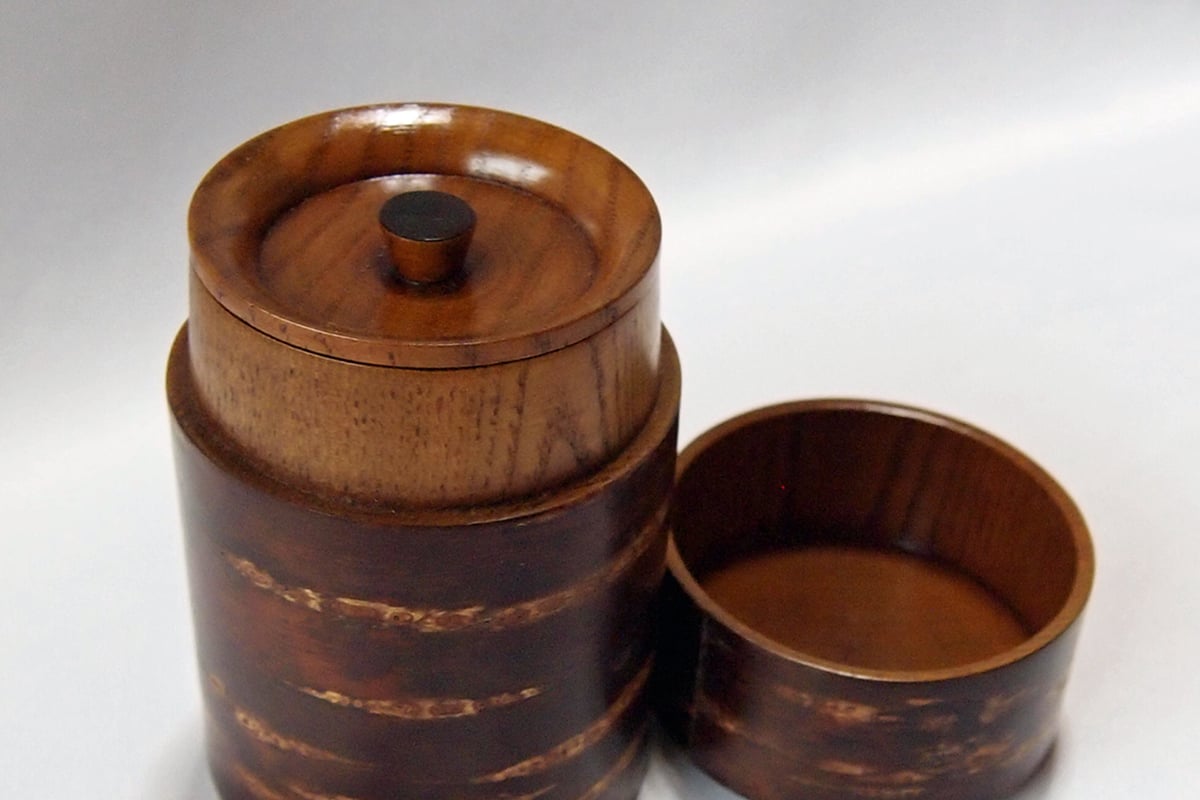
Image: Wikimedia Commons
Kabazaiku is a woodcraft made in Kakunodate, Semboku City, Akita Prefecture, using the bark ('kaba') of the mountain cherry tree. It is said to have originated in the Tenmei era (1781-1789), when Fujimura Hikoroku, a lower-ranking samurai of Kakunodate, learned the technique from the Gosho-no family, Shinto priests in Kamasawa, Aikawa, in northern Akita Prefecture, and spread it among the samurai of Kakunodate. At the time, the region was suffering repeated crop failures and famine, and lower-ranking samurai took up making inro (medicine cases) and netsuke as a side occupation using the low-cost bark of mountain cherry trees growing nearby. From the Meiji era onward, the emergence of influential wholesalers such as Nagamatsuya Shoten (trade name: Marugame) helped stabilize the craft as an industry, and around 1897 (Meiji 30) the kijimono technique—shaping the wood base on a lathe before applying the bark—was also added. In the Taisho and Showa eras, Ono Tozo is regarded as the figure who revived the craft, and following his encounter with Yanagi Soetsu, techniques were revitalized through workshops beginning in 1942 (Showa 17). In 1976 (Showa 51), Kabazaiku was designated a Traditional Craft Designated by the Minister of Economy, Trade and Industry, and the Kakunodate Kabazaiku Museum opened the following year, in 1978. Representative products include tea caddies, trays, and tobacco cases.
Origin
Kabazaiku is said to have originated in the Tenmei era (1781-1789), when Fujimura Hikoroku, a lower-ranking samurai of Kakunodate, learned the technique from the Gosho-no family, Shinto priests in Kamasawa, Aikawa, in northern Akita Prefecture, and spread it among the samurai of Kakunodate. At the time, the region was in a period of hardship marked by repeated severe crop failures and famine, and it began modestly, with lower-ranking samurai making inro and netsuke as a side occupation, using the low-cost bark of mountain cherry trees that grew wild in the surrounding hills as their material.
History
From the Meiji era onward, the emergence of influential wholesalers such as Nagamatsuya Shoten (trade name: Marugame) helped expand sales routes and enable mass production, guiding Kabazaiku toward becoming a stable industry. Around 1897 (Meiji 30), the kijimono technique of shaping the wood base on a lathe before applying bark was also introduced, broadening the range of products. From the Taisho into the Showa era, Ono Tozo is regarded as the figure who revived the craft, and following his encounter with Yanagi Soetsu of the Mingei (folk craft) movement, its techniques were revitalized through workshops beginning in 1942 (Showa 17). In 1976 (Showa 51), it was designated a Traditional Craft Designated by the Minister of Economy, Trade and Industry, and the Kakunodate Kabazaiku Museum opened the following year.
Features
A defining feature is making the most of the natural color and luster of wild mountain cherry bark to finish items such as tea caddies, trays, tobacco cases, and inro. Owing to its history of development as a side occupation among samurai, the craft has inherited a careful, one-piece-at-a-time approach. There are several techniques, including layering strips of bark over the wood base to create patterns and wrapping bark around a wooden mold, and part of its appeal lies in how the bark's luster deepens with use over time.
Materials Used
Production Process
- 1
Bark harvesting
Mountain cherry bark is peeled off carefully so as not to damage it, then sorted.
- 2
Bark processing
Unevenness on the harvested bark is scraped away, evening out its color and thickness.
- 3
Wood base making
The wood base that forms the foundation of items such as tea caddies and trays is shaped.
- 4
Bark application
Strips of bark are layered onto the surface of the wood base to create patterns.
- 5
Finishing
The bark is pressed on with a heated iron and polished to bring out its luster.
| Main Production Areas |
|
|---|
Artisans & Workshops
藤木伝四郎商店
A long-established Kabazaiku maker in Kakunodate, Semboku City, founded in 1851 (Kaei 4). While preserving traditional techniques, it continues to develop tea caddies, trays, and other products suited to modern life.
Official site →How to Buy
- Kakunodate Kabazaiku Museum
- An exhibition and sales facility in Kakunodate, Semboku City. It offers a wide range of Kabazaiku products, from tea caddies, trays, and chopstick rests to accessories such as brooches and earrings.Where to buy →PR
Hands-on Experiences
角館樺細工伝承館
秋田県仙北市角館町表町下丁10-1
Admission costs around ¥300 for adults. Reservations are required at least 10 days in advance, and visitors can try making items such as wall hangings and coasters using mountain cherry bark under an artisan's guidance.
View details →