Image: Wikimedia Commons
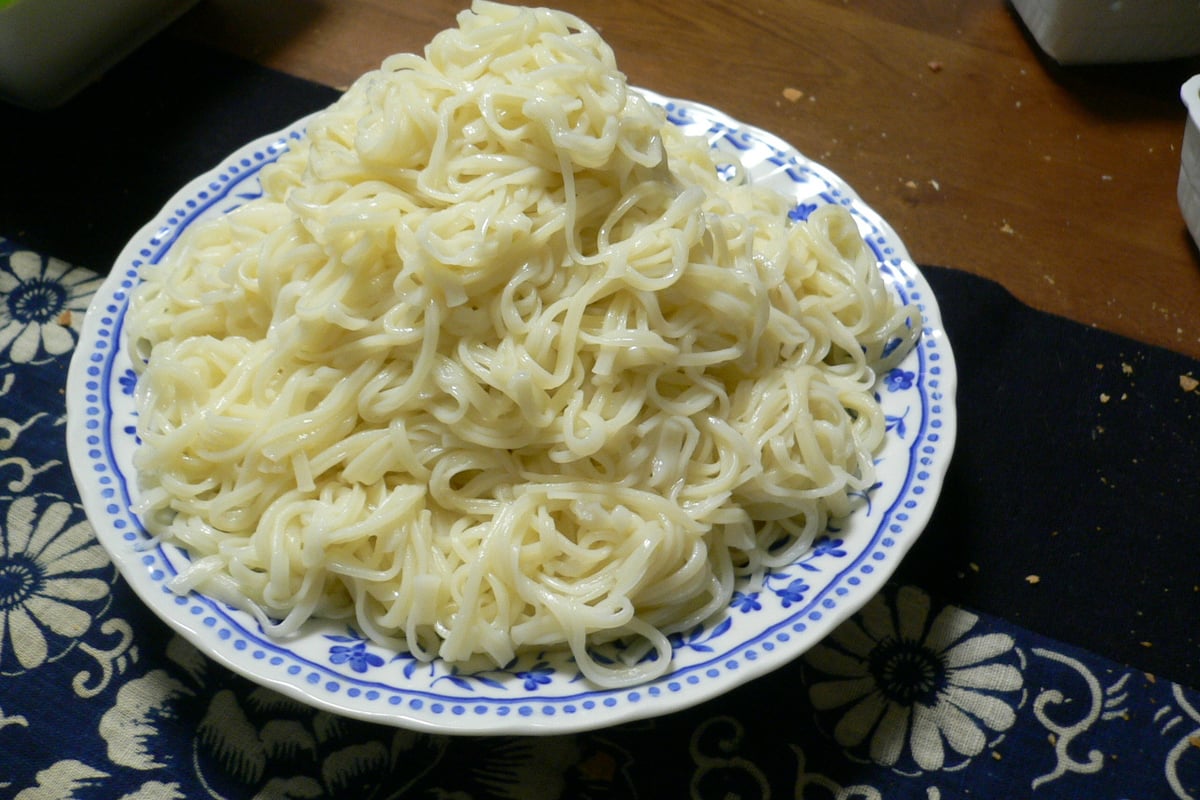
Inaniwa Udon is a hand-stretched dried udon noodle originating in the Inaniwa area of Yuzawa City, Akita Prefecture. It is made through a distinctive process in which the dough is kneaded, twisted into rope-like strands, aged, and then stretched thin by hand. The flat, ribbon-like noodles offer a smooth, slippery texture along with a firm bite. The technique is said to have been established in 1665 (Kanbun 5) in the early Edo period, and about 100 years later it was designated as an official product for the Satake family, lords of the Akita domain. It is sometimes counted, alongside Sanuki udon and Mizusawa udon, as one of Japan's 'three great udon.' Because the labor-intensive hand-stretching process limits production volume, it is also highly prized as a gift item, making it a signature noodle dish of Akita Prefecture.
Origin
Inaniwa Udon traces its origins to Sato Ichibee, who made noodles in the Ozawa hamlet of Inaniwa Village in the Akita domain (present-day Inaniwa, Yuzawa City); his technique was inherited and refined by Inaniwa Kichizaemon I. The hand-stretching method — in which the dough is aged and then stretched thin by hand — is said to have been established in 1665 (Kanbun 5), giving it a history of more than 350 years.
History
About 100 years after the technique was established, in 1752 (Horeki 2), Inaniwa Udon was designated as an official product for Lord Satake, the daimyo of the Akita domain, and came to be treated as a prestigious item. For a long time the technique was kept as a closely guarded secret passed down to only one heir per generation, but it was specially taught to Sato Yosuke II, and from then on it was passed down through multiple family lines. In 1860 (Man'en 1), the Sato Yosuke Shoten shop was founded, and it continues to preserve the handmade technique to this day.
Features
The defining feature is the hand-stretching method, in which the dough is twisted into rope-like strands, aged, and then stretched thin by hand without using a rolling pin. The noodles are flat in cross-section, combining a firm bite with a smooth, slippery texture. Since they are sold as dried noodles, they keep well, and their versatility — delicious served in a hot broth or chilled — is also part of their appeal.
Main Ingredients
Food Culture
Because the labor-intensive hand-stretching process makes mass production impossible, the noodles have long been prized as a gift item and as a special dish for entertaining guests. They are enjoyed year-round — as chilled zaru udon in summer and in a hot broth in winter.
How It Differs from Home Cooking
At home, it is common to boil the dried noodles and eat them with a store-bought noodle sauce, but at eateries operated directly by producers in the Inaniwa area, freshly made noodles selected by skilled artisans are served in a course-style meal that includes a Hinai-jidori dashi broth and tempura, setting the experience apart.
Famous Shops
佐藤養助 総本店
秋田県湯沢市稲庭町字稲庭80
A long-established shop founded in 1860 (Man'en 1). It also has an in-house eatery where visitors can watch the noodle-making process.
View details →| 佐藤養助商店 稲庭うどん 紙化粧箱入り | A gift box containing five bundles of 80g each, priced around 2,160 yen. A classic Inaniwa Udon souvenir sold at shops both in and outside Yuzawa City.Where to buy →PR |
|---|