Image: Wikimedia Commons
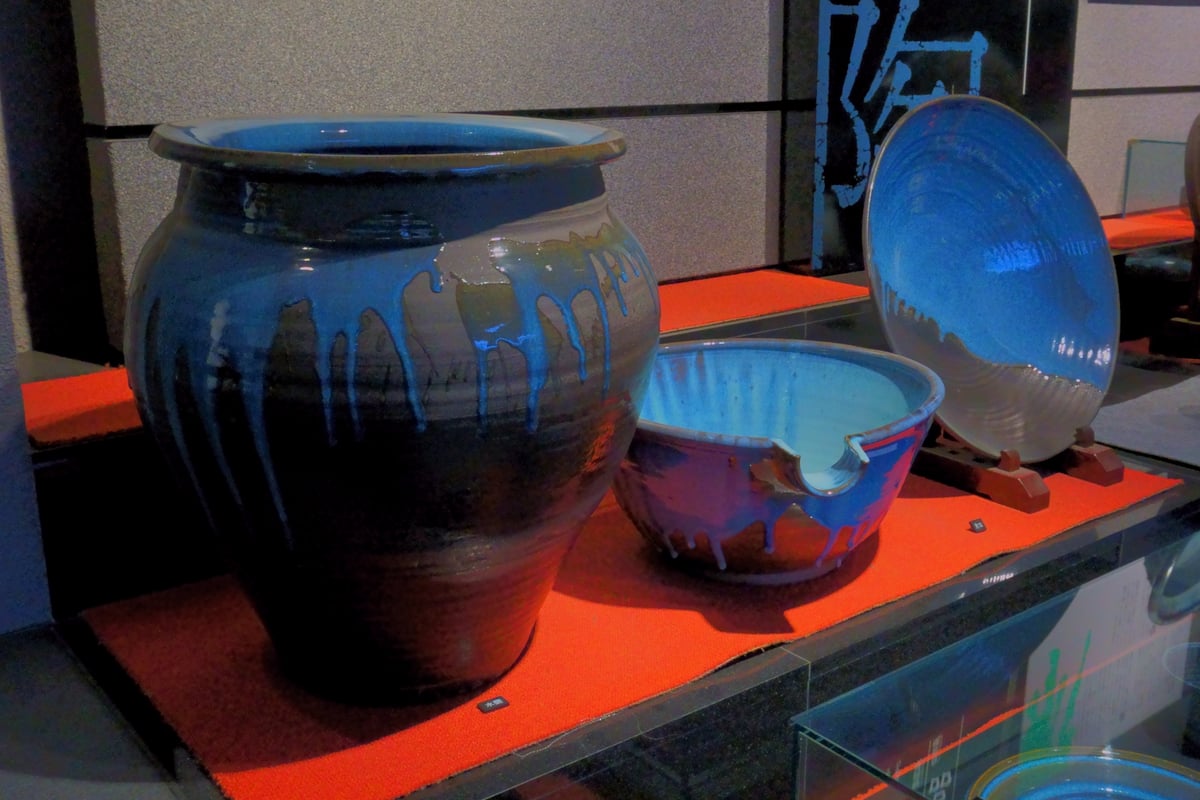
Naraoka ware is pottery fired in the Naraoka district of Nangai, Daisen City, Akita Prefecture, and is said to have the longest history of any pottery within the prefecture. It began in 1863 (Bunkyu 3), when Komatsu Seiji, a member of a local old family, invited a potter and built a kiln; in its early years the kiln mainly produced olive-colored tea utensils and the like, but from the mid-Meiji era onward, robust pieces using the bluish 'namako glaze (a bluish-grey glaze)' became the mainstream. Today, production continues in the Takano area of Nangai, to which the kiln relocated in 1908 (Meiji 41), using local clay and glaze and firing with wood in a climbing kiln. The Naraoka Togen kiln has kept the kiln running for five generations, and is also known for having received guidance from the potters Kato Tokuro and Shoji Hamada in the early Showa era to refine its techniques. The deep ultramarine of its ware was even used as inspiration for the interior design of the Green Car (first-class car) of the Akita Shinkansen's E6 series.
Origin
Naraoka ware is said to have begun in 1863 (Bunkyu 3), when Komatsu Seiji, a member of an old family in Nangai, Daisen City, invited a potter and built a kiln (accounts differ as to whether the potter came from the Terauchi ware or Soma ware tradition). The original kiln stood in the Osugi area on the west side of the Naraoka River, where olive-colored tea utensils and similar wares were fired. In 1908 (Meiji 41), the kiln was relocated to what is now the Takano area of Nangai, and pottery-making has continued there ever since.
History
From the mid-Meiji era onward, robust pieces using the bluish 'namako glaze' became the mainstream of Naraoka ware, and everyday household items in particular circulated widely both within and beyond the prefecture. In the early Showa era, the kiln received guidance from the potters Kato Tokuro and Shoji Hamada, leading to improvements in its glazes and forming techniques. The Komatsu family has kept the kiln running consistently since its founding, and today Naraoka Togen, now in its fifth generation, continues to make pottery using the traditional wood-fired climbing kiln.
Features
The greatest feature of Naraoka ware is its bluish 'namako glaze,' made from ingredients such as straw ash. As the glaze flows and blends during firing, it produces shading and patterns that are never quite the same on any two pieces. Because the ware is fired with wood in a climbing kiln, the result depends heavily on how the flames reach each piece, and it is said that only about 60 percent of pieces come out with the intended coloring, making it a ware left largely to the forces of nature. Its deep ultramarine color was even adopted for the interior design of the Green Car (first-class car) of the Akita Shinkansen's E6 series.
Materials Used
Production Process
- 1
Preparing the clay and forming
Local clay is kneaded and shaped into forms such as bowls and plates using a potter's wheel or molds.
- 2
Bisque firing
After the shaped pieces are dried, they are fired once at a low temperature to stabilize the clay body.
- 3
Glazing
Namako glaze, made from ingredients such as straw ash, is applied to give the ware the basis of its bluish coloring.
- 4
Final firing in the climbing kiln
The ware is fired at high temperature over several days in a wood-fired climbing kiln. How the flames reach each piece greatly affects the final result.
| Main Production Areas |
|
|---|
Artisans & Workshops
楢岡陶苑
The sole kiln that has kept Naraoka ware alive for five generations since its founding in 1863 (Bunkyu 3). It continues to produce namako-glazed ware today using a wood-fired climbing kiln.
How to Buy
- Naraoka-yaki Online Store
- An online shop run by Naraoka Togen, where visitors can purchase namako-glazed bowls, plates, sake vessels, and more.Where to buy →PR
Hands-on Experiences
楢岡陶苑
秋田県大仙市南外字梨木田344-1
Reservations required (by three days in advance); the pottery-making experience costs from around ¥4,180 per person (using 1kg of clay), or from around ¥2,860 per person for groups of 2 to 9.
View details →FAQ
Q. What is the most distinctive feature of Naraoka ware?
A. Its defining feature is the deep, rich coloring achieved with a bluish 'namako glaze' made from straw ash. Because it is fired with wood in a climbing kiln, each piece has its own unique character.
Q. Can visitors try a hands-on experience?
A. Yes. A pottery-making experience is available by advance reservation at the Naraoka Togen kiln. Applications must be made by phone or email at least three days ahead.