Image: Wikimedia Commons
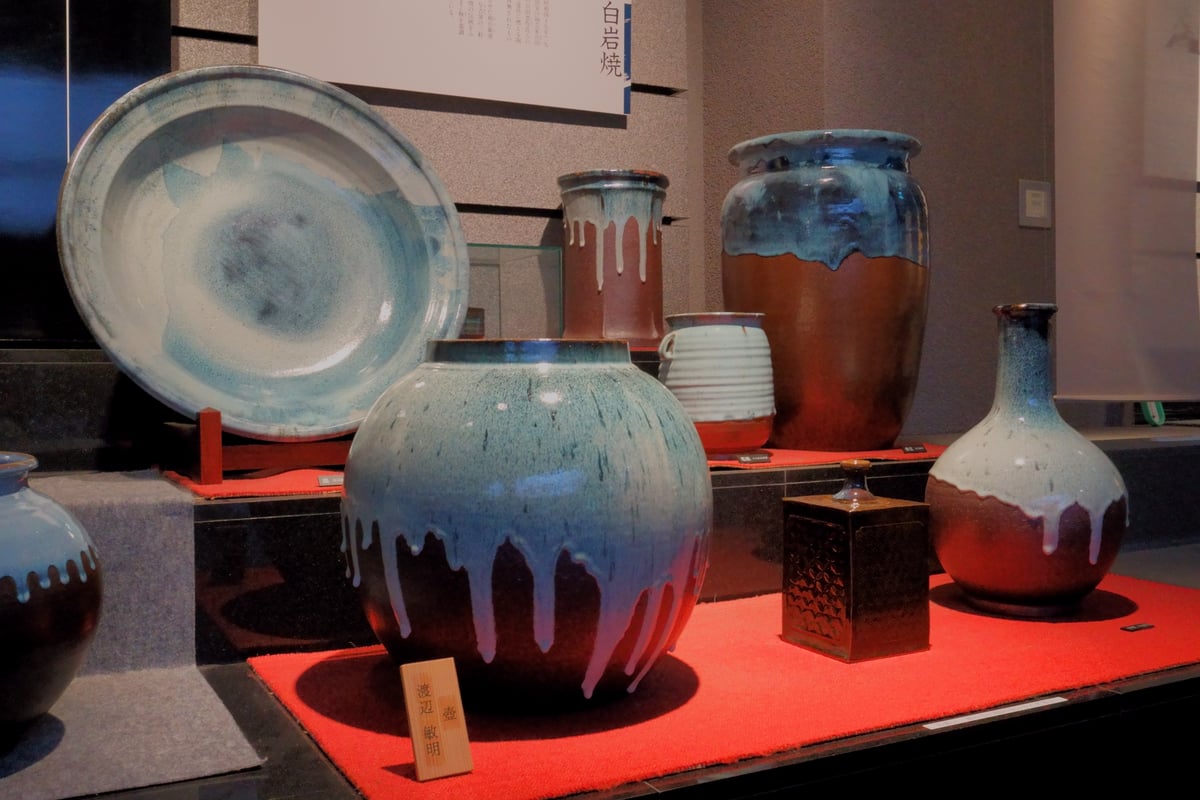
Shiraiwa ware is pottery fired in the Shiraiwa district of Kakunodate, Semboku City, and is said to have the oldest history of any pottery in Akita Prefecture. It began in 1771 (Meiwa 8), when Matsumoto Unshichi, a potter from Soma in Mutsu Province (present-day Fukushima Prefecture), opened a kiln with the support of samurai from Kakunodate; several kilns were subsequently opened, and at its peak more than 40,000 pieces of everyday earthenware were produced annually. However, after the Meiji Restoration the kilns lost the protection of the domain, and combined with the influx of porcelain and kiln damage from an earthquake, its 130-year history came to a temporary end in 1900 (Meiji 33). In 1974 (Showa 49), a meeting with the potter Shoji Hamada sparked momentum for revival, and the following year, in 1975 (Showa 50), local volunteers opened the 'Waheegama' kiln and revived the technique. Its defining feature is the contrast between the reddish local clay color and the bluish namako glaze, and today Waheegama continues to carry on the tradition.
Origin
Shiraiwa ware is said to have begun in 1771 (Meiwa 8), when Matsumoto Unshichi, a ronin and potter originally from the Soma-Nakamura domain of Mutsu Province (present-day Soma City, Fukushima Prefecture), discovered high-quality clay in the Shiraiwa area east of Kakunodate and fired up a kiln with the support of three or four samurai from Kakunodate. During the Anei era (1772-1781), his disciple Yamate Gizaburo took over as kiln master, and thereafter several kilns, including the Gizaburo kiln and the Kichigoro kiln, were opened one after another.
History
Shiraiwa ware reached its peak in the late Edo period, when about five kilns produced more than 40,000 pieces of everyday earthenware a year, such as jars and sake bottles, which circulated within and beyond the prefecture. However, the Meiji Restoration cost the kilns the domain's protection, and this, combined with the spread of porcelain, a ban on home-brewed unrefined sake, and kiln damage from a major earthquake in 1896 (Meiji 29), led all the kilns to close by 1900 (Meiji 33). In 1974 (Showa 49), momentum for revival grew after a local woman seeking to restore the craft met the potter Shoji Hamada, and the following year local volunteers opened the 'Waheegama' kiln, reviving the technique for the first time in 130 years.
Features
The defining feature of Shiraiwa ware is the contrast between the reddish color of the local clay and the bluish 'namako glaze.' The master craftsman Yamate Takiji is said to have used a wide range of glazes besides namako glaze, including amber glaze, black glaze, green glaze, and celadon, and these techniques have been carried on by the present-day Waheegama kiln. Since the revival, firing has also been carried out in a climbing kiln, and the kiln produces a wide range of work, from rustic, robust vessels to pieces suited to the modern table.
Materials Used
Production Process
- 1
Forming
The local reddish clay is shaped on a potter's wheel into forms such as jars and plates.
- 2
Bisque firing
The dried pieces are fired once at a low temperature to stabilize the clay body.
- 3
Glazing
Namako glaze and other glazes are applied to create the basis of the ware's distinctive bluish coloring.
- 4
Final firing
The ware is fired at high temperature in a climbing kiln, bringing out the contrast between the red clay and the glaze for the finished piece.
| Main Production Areas |
|
|---|
Artisans & Workshops
白岩焼 和兵衛窯
A kiln reopened by local volunteers in 1975 (Showa 50) after a 130-year gap. In 1993 (Heisei 5), it built a four-chamber climbing kiln, and it is the only kiln that carries on today the namako glaze technique dating back to the Edo period.
Official site →How to Buy
- Shiraiwa-yaki Waheegama
- The official website provides information on stockists as well as sales at Hakkeiso, the gallery attached to the kiln.Where to buy →PR
Hands-on Experiences
白岩焼陶芸塾
秋田県仙北市白岩地域(旧白岩駐在所)
A pottery-making experience facility run by the Shiraiwa-yaki Pottery Association. It opened in 2013 (Heisei 25) in a renovated former police substation; reservations required (contact the association for details).
FAQ
Q. Why is Shiraiwa ware called 'Akita Prefecture's oldest pottery'?
A. Because its kiln was opened in 1771 (Meiwa 8), giving it the oldest history of any kiln in Akita Prefecture. Production ceased once in 1900 (Meiji 33), but the kiln was revived in 1975 (Showa 50).
Q. What makes Shiraiwa ware distinctive?
A. Its defining feature is the contrast between the reddish color of the local clay and the bluish namako glaze, producing ware that combines rustic simplicity with a sense of weight and depth.