Karashi Renkon (Mustard-Stuffed Lotus Root)
Karashi Renkon (Mustard-Stuffed Fried Lotus Root)
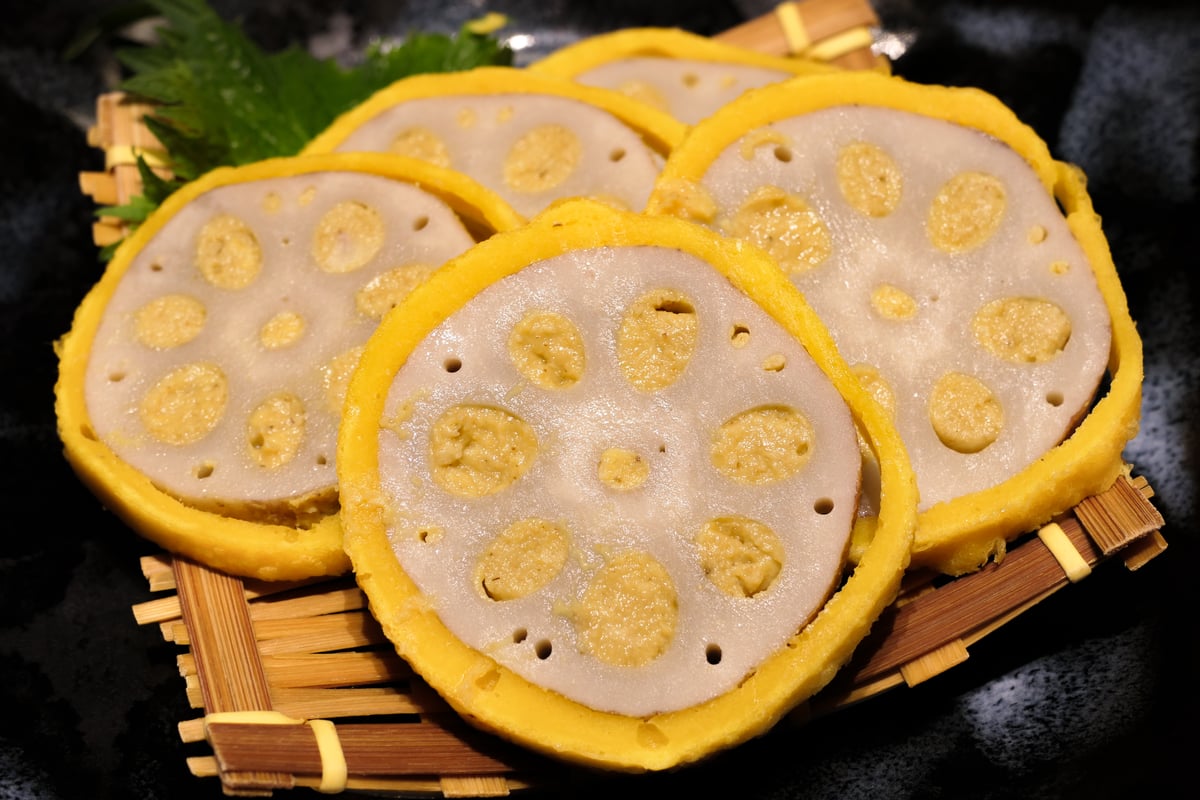
Image: Wikimedia Commons
Karashi renkon is a local dish of Kumamoto Prefecture in which the holes of boiled lotus root are filled with karashi miso, a mixture of barley miso and Japanese mustard, and the root is then coated in a yellow batter and deep-fried. It is said to have begun around 1632 (Kan'ei 9), when it was presented to Hosokawa Tadatoshi, the sickly first lord of the Higo domain from the Hosokawa clan. There is also a story that, because its sliced cross-section resembled the Hosokawa family crest, the 'kuyo-mon' (nine-star crest), the recipe was kept a closely guarded secret until the Meiji Restoration. It is sliced about 5 to 10 mm thick and arranged so that the pattern of the cross-section can be seen. It is eaten as an everyday side dish or as a snack with drinks, and at New Year it also appears as one of the dishes of osechi ryori (New Year's cuisine). In fiscal 2024 (Reiwa 6), it was certified as a '100-Year Food' by the Agency for Cultural Affairs. Besides specialty shops, it is also sold at local supermarkets and local product centers.
Origin
According to the Ministry of Agriculture, Forestry and Fisheries, Priest Gentaku of Rakanji Temple recommended lotus root, believed to be good for building up the blood, to the sickly Tadatoshi. However, Tadatoshi is said to have refused to eat it because it grows in mud. So the holes were filled with miso and Japanese mustard and the root was deep-fried, and it is said that he took a liking to it, ate it regularly, and regained his health. Ganso Mori Karashi Renkon (元祖 森からし蓮根) explains that it began when its ancestor Heigoro presented it to Tadatoshi. A travel information site states that, for this service, Heigoro was granted the privilege of bearing a surname and wearing a sword.
History
The Ministry of Agriculture, Forestry and Fisheries and the Agency for Cultural Affairs explain that, because its cross-section resembled the kuyo-mon crest, it was a flavor kept secret from outsiders until the Meiji Restoration. According to a travel information site, Mori Karashi Renkon began selling it in a shop after the Meiji Restoration. In 1984 (Showa 59), a mass food poisoning outbreak caused by type A Clostridium botulinum occurred, traced to vacuum-packed karashi renkon, with 36 patients and 11 deaths reported. According to Wikipedia, it is believed to have resulted from a combination of trace contamination of the mustard powder and long-term refrigeration after vacuum packing.
Features
In the recipe from the Ministry of Agriculture, Forestry and Fisheries, lotus root that has been boiled until still firm and then cooled is stood upright in the karashi miso and turned so that all the holes are filled. Excess miso is removed and the root is left for 6 to 7 hours, then coated in a batter of wheat flour and turmeric and slowly deep-fried in oil at around 180°C. The yellow color of the batter comes from the turmeric. It is basically eaten as is, though some households add soy sauce or mayonnaise to taste. Kumamoto Prefecture ranks among the top in the country for lotus root production, and the main production area is the Uki area, where new rice fields were developed during the era of the Hosokawa domain.
Main Ingredients
Food Culture
It is eaten as an everyday side dish or a snack with drinks, and is considered indispensable as one of the dishes of osechi ryori at New Year. It appears widely on the menus not only of local cuisine restaurants but also of Japanese restaurants and izakaya. The Ministry of Agriculture, Forestry and Fisheries notes that, recently, inventive uses such as making it into croquettes or putting it in bread sandwiches can also be seen.
How It Differs from Home Cooking
According to the Ministry of Agriculture, Forestry and Fisheries, most specialty shops use lotus root from contract farmers in the prefecture, and some shops grow their own. The home recipe introduced by the ministry is for 1 kg and uses 500 g of barley miso and 20 to 23 g of mustard powder. There is a step of leaving the root for 6 to 7 hours after stuffing it with miso, and when frying, care is taken not to let the oil temperature exceed 180°C.
Famous Shops
元祖 森からし蓮根 本店
熊本県熊本市中央区新町2丁目12-32
The official website states that it began when the founder's ancestor Heigoro presented it to Hosokawa Tadatoshi in 1632 (Kan'ei 9). There is also a shop on 'Sakura-no-Koji' at Josaien (城彩苑). The official online shop lists a single-root box (medium, around 300 g) at 1,620 yen including tax and a single-root box (large, around 550 g) at 2,376 yen including tax. Prices are subject to change.
View details →村上カラシレンコン店
熊本県熊本市中央区新町3丁目5-1
A travel information site describes it as a shop that has continued to make karashi renkon by hand for more than 50 years. According to the listing on the same site, business hours are 8:30 to 17:00, and it is closed on Saturdays.
View details →| Mori Karashi Renkon Single-Root Boxes and Sets | In addition to the medium-size single-root box, the official online shop also offers sets that combine items such as karashi renkon-flavored chips and Mori's soy sauce. There are also retailers inside and outside the prefecture, including Kumamoto Station, Aso Kumamoto Airport, and Tsuruya Department Store. Product selections vary by store.Where to buy →PR |
|---|
FAQ
Q. Do the holes in the lotus root really resemble the Hosokawa family crest?
A. The Ministry of Agriculture, Forestry and Fisheries explains that the arrangement of the holes in sliced lotus root resembles the kuyo-mon crest. Materials from the Kyushu Regional Agricultural Administration Office also explain that there are nine holes when it is sliced into rounds. However, even materials from Kumamoto City treat the story that it was kept secret for this reason as a legend.
Q. Is the name of the monk who recommended lotus root to Tadatoshi settled?
A. The name is given differently depending on the source. The Ministry of Agriculture, Forestry and Fisheries names Priest Gentaku of Rakanji Temple, while materials from Kumamoto City name Priest Gentaku of Suizenji Temple. The Agency for Cultural Affairs' '100-Year Food' introduction names the Zen monk 沢和尚. It is appropriate to read all of these as legends.