Ikinari Dango (Sweet Potato and Red Bean Bun)
Ikinari Dango (Steamed Sweet Potato and Red Bean Bun)
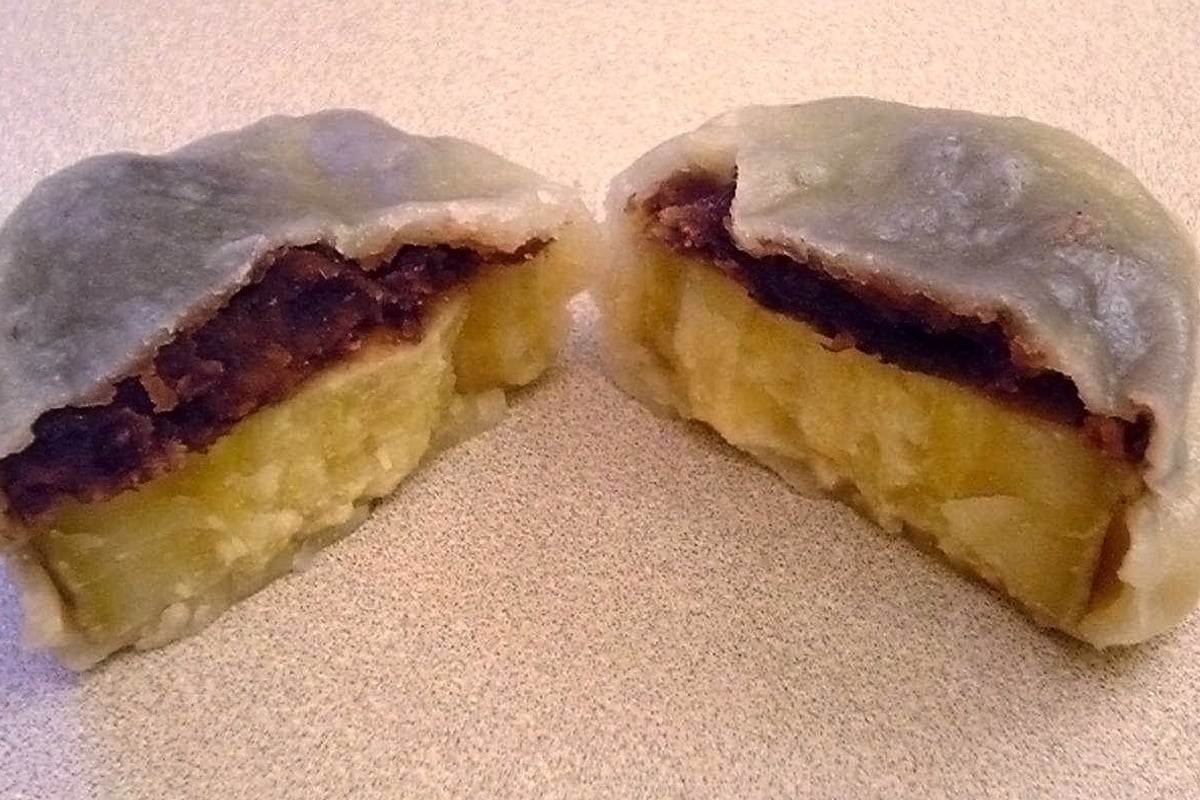
Image: Wikimedia Commons
Ikinari dango is a local confection of Kumamoto Prefecture made by wrapping a round slice of sweet potato and red bean paste in dough and steaming it. According to the Ministry of Agriculture, Forestry and Fisheries, against the backdrop of the thriving sweet potato cultivation around the foot of Mt. Aso, farmers on the Kikuchi Plain and the Kumamoto Plain made it as a snack to eat during breaks in the autumn harvest. Red bean paste began to be added several decades ago, and this is now the mainstream version. There are various theories about the origin of the name, but it is said that because 'ikinari' in the Kumamoto dialect means easy or quick, it was named as a confection that could be served right away even to unexpected guests. The multilingual commentary of the Ministry of Land, Infrastructure, Transport and Tourism describes it as one of Kumamoto's three great specialties, along with karashi renkon and basashi. It is basically eaten freshly made while still warm, and is sold every day at specialty shops, Japanese confectionery shops, street stalls, and elsewhere.
Origin
According to the Ministry of Agriculture, Forestry and Fisheries, sweet potato cultivation thrives around the foot of Mt. Aso due to the influence of volcanic ash. Farmers on the Kikuchi Plain and the Kumamoto Plain made it as a snack to eat during breaks in the autumn harvest. In times when rice was precious, it is said that only wheat flour was used for the dough. Materials from Kumamoto City also describe it as a simple confection in which sweet potato and bean paste are wrapped in a dough made by kneading and rolling out wheat flour.
History
According to the Ministry of Agriculture, Forestry and Fisheries, red bean paste began to be added as a filling several decades ago and has become the mainstream. The multilingual commentary of the Ministry of Land, Infrastructure, Transport and Tourism notes that red beans were expensive and were eaten only on special or auspicious days. In recent years, more and more varieties have appeared, such as dough mixed with mugwort or brown sugar, or versions using purple sweet potato, chestnuts, or walnuts. 'Hiyashi ikinari dango' (chilled ikinari dango), in which frozen dango are eaten half-thawed, has also appeared.
Features
The sweet potato is sliced 1 to 1.5 cm thick. In the Ministry of Agriculture, Forestry and Fisheries' recipe, all-purpose flour and dango flour are combined into a dough that is left to rest, and a ball of bean paste and the sweet potato are placed on it and wrapped. This is steamed in a steamer for about 20 minutes, and it is done when a bamboo skewer passes through easily. The flour used for the dough differs by source, and the Ministry of Land, Infrastructure, Transport and Tourism's commentary describes a rice flour dough. There are also examples that use different varieties of sweet potato or white bean paste.
Main Ingredients
Food Culture
Originally it was made and eaten at home during the sweet potato season. Today it can be bought at specialty shops, Japanese confectionery shops, and street stalls, and is eaten on a daily basis. The Ministry of Agriculture, Forestry and Fisheries notes that it is popular as a sweet to go with tea and as a snack for children, and that it is served as a dessert in school lunches.
How It Differs from Home Cooking
In the home recipe from the Ministry of Agriculture, Forestry and Fisheries, the dough is rested for at least one hour, because without resting it will not stretch. At shops, there are examples where freshly made dango can be bought at a counter next to the factory, and Chojuan (長寿庵) offers, in addition to the standard white type, a black type made with brown sugar and a purple type made with purple sweet potato powder.
Famous Shops
長寿庵 春日店
熊本県熊本市西区春日7-19-15
A tourism guide introduces it as a shop adjacent to the production factory where freshly made dango can be bought. According to the official website, business hours are 10:00 to 16:00, and it is closed on Sundays and over the year-end and New Year holidays. There is also a shop in Higo Yokamon Ichiba (肥後よかモン市場) at Kumamoto Station.
View details →大福堂
熊本県熊本市中央区上林町1-36
A travel guide notes that ikinari dango cost 100 yen each. They sometimes sell out by early afternoon, so visiting in the morning is recommended. They must be eaten on the day of purchase. Prices are subject to change.
View details →えびす屋餅本舗
熊本県熊本市東区広木町30-53
Introduced as an ikinari dango shop on an outdoor information site updated in October 2026. According to the listing on the same site, business hours are 8:30 to 18:00, and it is closed on Mondays.
View details →| Chojuan's Ikinari Dango | Chojuan makes and sells ikinari dango and also accepts mail orders. According to the Ministry of Agriculture, Forestry and Fisheries, souvenir products are frozen and are warmed in a microwave or steamer before eating. They can also be purchased at the shop in Higo Yokamon Ichiba at Kumamoto Station.Where to buy →PR |
|---|
FAQ
Q. Where does the name 'ikinari' come from?
A. There are various theories. The Ministry of Agriculture, Forestry and Fisheries explains that it means easy or quick in the Kumamoto dialect, citing the fact that it can be served right away even to unexpected guests. The Kumamoto City tourism guide says this overlaps with the ease of wrapping raw sweet potato as it is, and also introduces the theory that it means 'a confection that can be made quickly and roughly.' The Kumamoto Nichinichi Shimbun also reports the 'iki-nari' (生き成り) theory.