Image: Wikimedia Commons
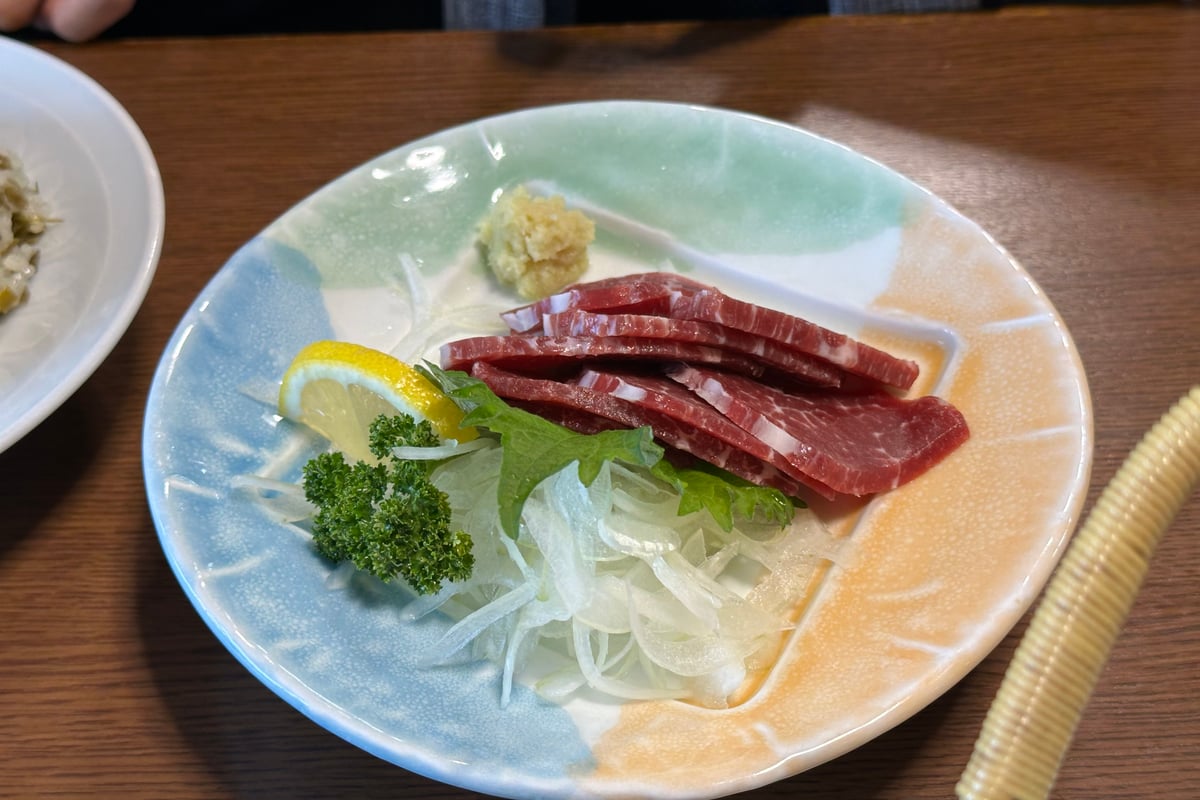
Basashi is a dish of raw horse meat sliced thinly and eaten with condiments and sweet soy sauce. Kumamoto Prefecture is a production area that the Ministry of Agriculture, Forestry and Fisheries describes as Japan's top producer of horse meat, and basashi is one of the prefecture's representative local dishes. As for its origin, a common theory holds that it began when Kato Kiyomasa ate army horses during the invasions of Korea and continued to enjoy horse meat after returning home, but there are various theories about its origins. In the Aso region, people began eating horse meat in the wake of the postwar food shortages, and it is said that by the Showa 30s (1955-1964) restaurants had also begun serving it. In addition to marbled and lean cuts, there are parts with names unique to horse meat, such as 'futaego' and 'kone.' It is also called 'sakura niku' (cherry blossom meat) because its cut surface is cherry-blossom pink. Today, horses are slaughtered at hygienically controlled meat processing plants, and the meat is always frozen before distribution as a measure against parasites.
Origin
According to the Ministry of Agriculture, Forestry and Fisheries, it is said to have begun when Kato Kiyomasa, having run out of food during the invasions of Korea, ate army horses, found them delicious, and continued to eat horse meat after returning home. However, the ministry also notes that there are various theories about its origin. It explains that during the Edo period there was almost no custom of eating meat, and that horse meat was eaten only to a limited extent by some farmers and others. Horse meat is also eaten in Nagano, Fukushima, and Iwate Prefectures, but the multilingual commentary of the Ministry of Land, Infrastructure, Transport and Tourism names Kumamoto Prefecture as Japan's largest production area.
History
From the Meiji era onward, eating horse meat gradually spread to Kumamoto and the Aso region. In the Aso region, which was a production area for army horses, people began eating horse meat in the wake of the postwar food shortages, and it is said to have spread widely among the general public. By the Showa 30s (1955-1964), restaurants had also begun serving it. Today there is 'Kumamoto-san Baniku' (Kumamoto-produced horse meat) from horses born and raised in Kumamoto, and 'Kumamoto Baniku' (Kumamoto horse meat) from foals imported from Canada and elsewhere and raised in Kumamoto for about one to one and a half years.
Features
In addition to marbled cuts such as loin and lean cuts such as thigh, there are also liver sashimi and tongue sashimi. There are distinctive names as well, such as 'futaego' for the belly, 'nekko' for the aorta, and 'kone' for the fat beneath the mane. Because the meat oxidizes easily and darkens, shops keep it chilled in blocks and slice it after an order is placed. It is served with sliced onion, grated ginger, grated garlic, and small green onions, and eaten with sweet soy sauce. The fat of marbled cuts and kone melts easily, so they should be eaten promptly.
Main Ingredients
Food Culture
According to the Ministry of Agriculture, Forestry and Fisheries, while it is often eaten at New Year and on celebratory occasions, it is also sold in supermarkets and eaten on a daily basis. 'Sakura natto,' in which finely chopped basashi is combined with natto and topped with a quail egg and small green onions, is popular as a snack to go with sake or shochu.
How It Differs from Home Cooking
Shops keep the meat chilled in blocks and serve it freshly sliced after receiving an order. In the home recipe from the Ministry of Agriculture, Forestry and Fisheries, the horse meat is sliced 2 to 3 mm thick perpendicular to the grain and arranged on top of onion and shiso. It is finished by adding grated garlic and ginger.
Famous Shops
菅乃屋 銀座通り店
熊本県熊本市中央区下通1丁目9-1 ダイワロイネットホテル熊本銀座通りPREMIER 2F
A horse meat specialty restaurant run by a group company of the horse meat producer Senko Farm (千興ファーム). It states that it uses horses from its own farm and serves almost all cuts, including rare ones. A tourism guide lists the budget as from 4,500 yen for lunch and from 8,800 yen for dinner. There is also a branch inside Higo Yokamon Ichiba (肥後よかモン市場) at Kumamoto Station. Prices are subject to change.
View details →馬料理専門 天國
熊本県熊本市西区二本木2丁目13-12 天國ビル
According to a travel information site, it carefully selects horse meat from contracted ranches and uses rare sanmai-bara (three-layer belly) for its signature nigiri and shabu-shabu. Another listing gives the price of its premium marbled basashi as 3,630 yen. Children younger than elementary school age are not admitted. Business hours differ between listings, so please check.
View details →郷土料理 五郎八
熊本県熊本市中央区花畑町12-8 銀杏会館 B1階
A local cuisine restaurant introduced on a travel information site. In addition to basashi, it serves karashi renkon and dago-jiru. According to the listing on the same site, its finest-grade basashi is 2,750 yen. The prices of course meals differ in another listing, so please check. Prices are subject to change.
View details →| Basashi from the Suganoya Official Online Shop | A mail-order service that delivers basashi made from Senko Farm horse meat nationwide. The operating company explains that it is processed at an SQF-certified factory and frozen at minus 20°C or below. Please follow the product instructions for thawing methods and expiration dates after delivery.Where to buy →PR |
|---|
FAQ
Q. Why can horse meat be eaten raw?
A. The Ministry of Agriculture, Forestry and Fisheries explains that this is because horses have a higher body temperature than cattle or pigs, which makes it harder for food poisoning bacteria to multiply. However, horse meat may contain a parasite called Sarcocystis fayeri. Aomori Prefecture states that food poisoning can be prevented by freezing treatment at a core temperature of minus 20°C for 48 hours or more.
Q. Is there anything to be careful about when eating it raw?
A. Aomori Prefecture advises people not to eat meat raw other than meat intended for raw consumption, such as basashi. The Ministry of Agriculture, Forestry and Fisheries also explains that even when standards are met it is difficult to eliminate bacteria completely, and advises people with weaker resistance, such as children and the elderly, to refrain from eating raw meat.
Q. Where does the name 'sakura niku' come from?
A. The Ministry of Agriculture, Forestry and Fisheries explains that it is also called sakura niku because its cut surface is cherry-blossom pink. However, horse meat oxidizes easily and darkens over time. For that reason, shops keep it chilled in blocks until an order comes in and serve it freshly sliced.