Hitomoji no Guruguru (Rolled Scallions with Vinegar Miso)
Hitomoji no Guruguru (Rolled Wakegi Scallions with Vinegar Miso)
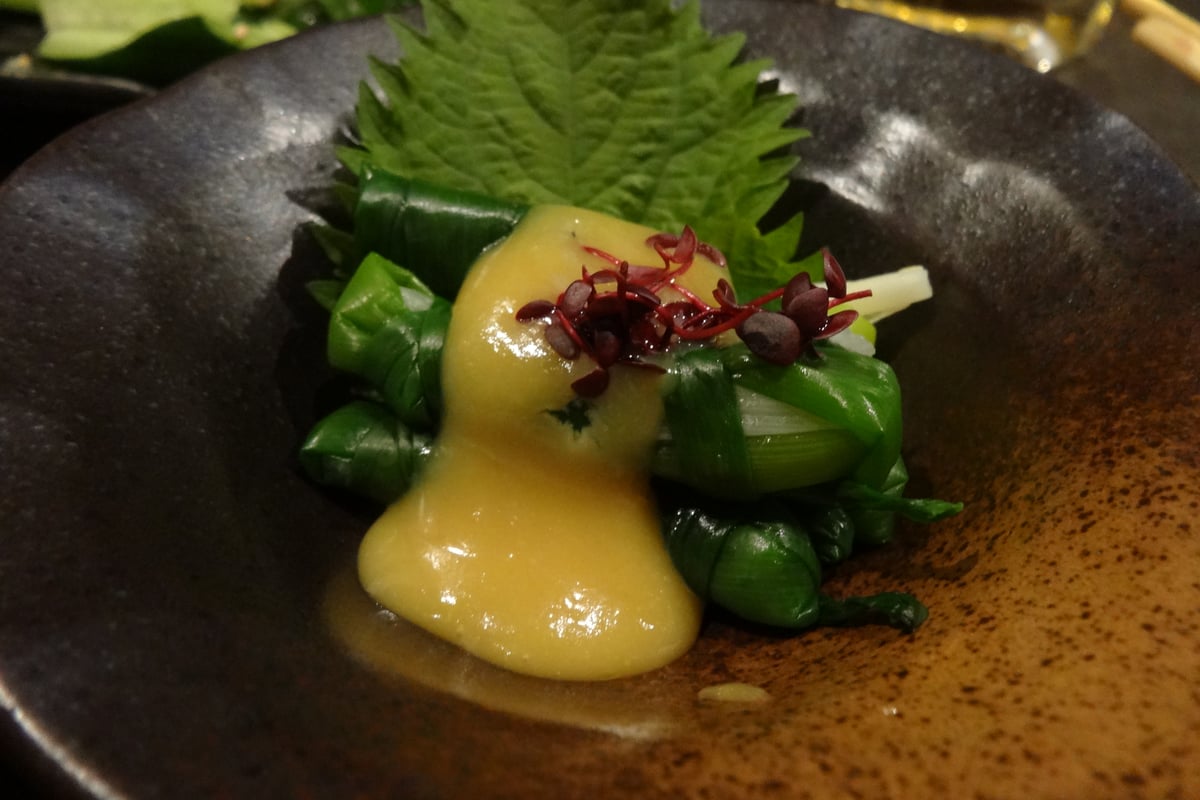
Image: Wikimedia Commons
Hitomoji no guruguru is a local dish of Kumamoto Prefecture in which hitomoji, another name for wakegi scallions, is briefly boiled, the green leaves are wrapped around the white base as a core, and it is eaten with vinegar miso. It is called 'guruguru' (round and round) because of its wrapped appearance. According to the Ministry of Agriculture, Forestry and Fisheries, during the time of the sixth lord, Hosokawa Shigekata, the finances of the Higo domain became strained and a frugality edict was issued. It is said that at that time it was devised as an inexpensive and tasty snack to go with sake. Its appeal lies in its crunchy texture and the distinctive aroma and sweetness of hitomoji. Today it is available year-round, but its peak season is said to be early spring, when the scallions have grown sweeter after enduring the winter. In the past it was an indispensable dish for Hinamatsuri (the Doll Festival). Today it is still made at home and is also served as an appetizer or a snack with drinks at Japanese restaurants and izakaya.
Origin
According to the Ministry of Agriculture, Forestry and Fisheries, during the time of the sixth lord, Hosokawa Shigekata, the finances of the Higo domain became strained and a frugality edict was issued. It is said to have begun at that time as an inexpensive and tasty snack devised to go with sake. Hitomoji, the main ingredient, has been cultivated since the Edo period. Although it is a simple dish made only with hitomoji, the ministry notes that adding miso makes it look impressive as a dish in its own right.
History
Hitomoji was originally a vegetable whose season was spring. According to the Ministry of Agriculture, Forestry and Fisheries, to meet demand for serving it year-round as a local dish, its growing season has been extended through breeding and other efforts. In the past it was an indispensable dish for Hinamatsuri, eaten together with konnyaku sashimi, razor clams, and uba-gai clams simmered as nishime. The main area where it has been passed down is said to be the whole of Kumamoto Prefecture. Even today, its peak season is said to be early spring, when it has grown sweeter through the winter cold.
Features
Hitomoji from Kumamoto Prefecture is characterized by its swollen white base. In the Ministry of Agriculture, Forestry and Fisheries' recipe, the hitomoji is placed in salted boiling water root end first, boiled until the core remains slightly firm, and cooled in cold water. It is folded 5 cm above the white base, and the green leaves are wrapped around the white base as a core. The end of the wrap is secured with the thick, slippery juice that comes out when the leaf tips are pinched off with the fingers. In addition to vinegar miso made with white miso, sugar, vinegar, and mirin, it is sometimes served with mustard vinegar miso or ume miso.
Main Ingredients
Food Culture
It is a dish that has long been eaten as a snack with sake, and today it is still made at home and served as an appetizer or a snack at Japanese restaurants and izakaya. According to the Ministry of Agriculture, Forestry and Fisheries, many people say that when this dish appears, they feel the arrival of spring.
Famous Shops
御縁 駕町店
熊本県熊本市中央区安政町5-16 カリーノ駕町ビル2F
An izakaya and local cuisine restaurant listed on Gurunavi, whose menu includes 'Hitomoji Guruguru' at 580 yen. It is also said to be included in the local cuisine course. It is open in the evening, and the information for Sundays varies between listings, so please check. Prices and menu items are subject to change.
View details →FAQ
Q. What kind of vegetable is 'hitomoji,' and why is it called that?
A. Hitomoji is another name for wakegi. The Ministry of Agriculture, Forestry and Fisheries introduces two theories: one that the planted scallions looked like the character 人 (hito), and one that the name derives from 'hitomoji-gusa' (一文字草), a nyobo kotoba (court ladies' language) term in which the scallion was called by the single character 'ki.' There are also examples in which it is written as 人文字, and sources that say it looked like the character 一.