Dango-jiru (Hand-Stretched Flour Noodle Soup)
Dango-jiru (Oita Hand-Stretched Flour Noodle Soup)
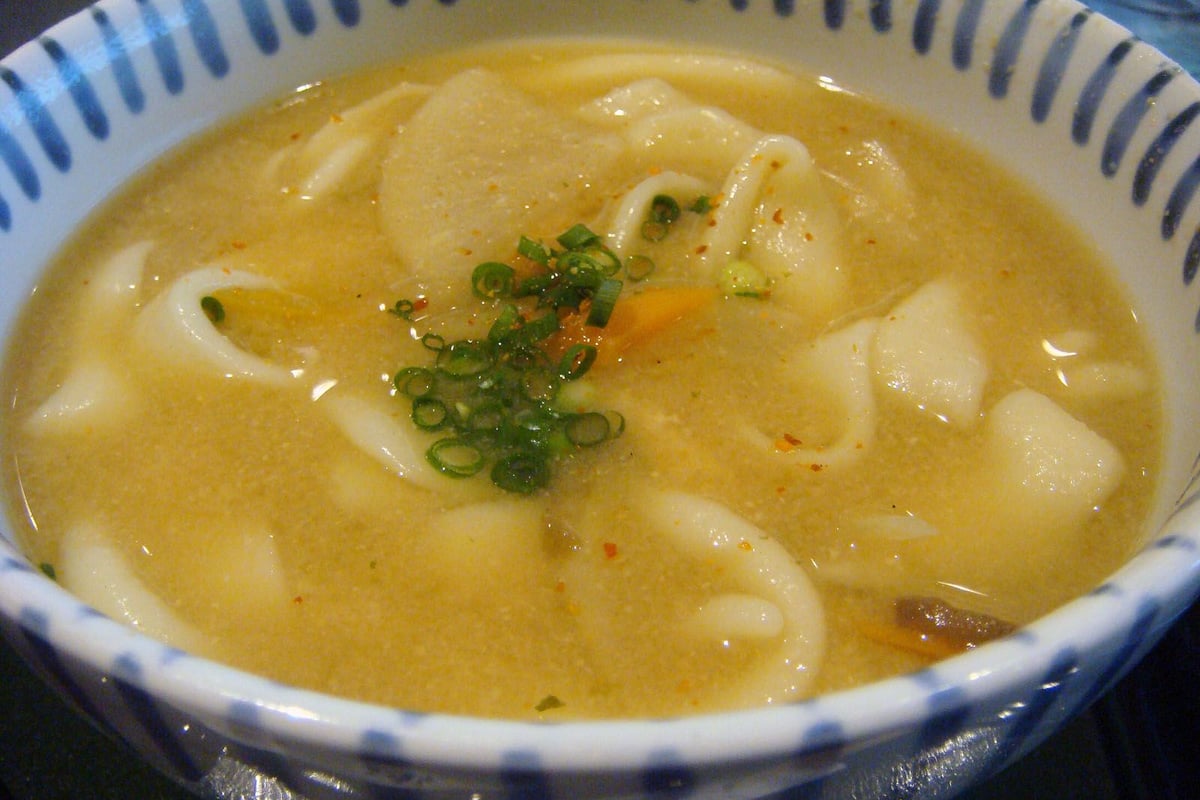
Image: Wikimedia Commons
Dango-jiru is a local specialty dish of Oita Prefecture in which 'dango,' made by kneading wheat flour and stretching it thinly by hand into strips, is simmered with vegetables in a miso-based soup. The Ministry of Agriculture, Forestry and Fisheries (MAFF) describes it as a representative local dish of Oita Prefecture that has long been an everyday food throughout the prefecture. The word 'dango' usually brings to mind something round, but Oita's dango are flat and look similar to kishimen (flat udon noodles). Much of the land in Oita Prefecture is unsuited to rice growing, so a funshoku culture of eating wheat and other grains ground into flour took root. Dango-jiru is a prime example, and in times when rice was scarce it was eaten in place of rice. The broth is often made with the local specialty of dried shiitake mushrooms or with iriko (dried sardines), and taro, burdock root, carrot, and other vegetables are added. Coating the same dough with kinako (roasted soybean flour) and sugar turns it into the snack 'Yaseuma.' Besides being eaten at home and in school lunches, it can also be enjoyed at local cuisine restaurants in Beppu City and Oita City.
Origin
According to MAFF, Oita Prefecture has well-developed plateaus, and much of its land was unsuited to rice growing. For this reason, wheat and other grains have long been cultivated in fields, and almost all of them were ground into flour. In this way, a funshoku (flour-based food) culture took root throughout the prefecture, and dango-jiru is regarded as its prime example. The ministry explains that in times when rice was scarce, it was eaten daily in place of rice. When it originated and who devised it are unknown.
History
It used to be made often at home, and the recipe has been passed down from grandmothers and mothers to children and grandchildren. MAFF notes that because it warms the body and is filling, it often appeared on the table from early autumn through winter. Today it is still eaten regularly at home and is sometimes served in school lunches. At local festivals and events, it is sometimes made in large pots and served to visitors. The ministry describes it as a dish that could be called Oita's soul food.
Features
In MAFF's recipe, salt and water are added to wheat flour, and the dough is kneaded, wrapped in a damp cloth, and left to rest for about an hour. It is shaped into a rod, torn into thumb-sized pieces, flattened with the palm, and left to rest again. Finally, it is stretched long by hand, boiled in hot water, and then added to the soup. It is said that the name 'dango' came from rolling the dough into balls and letting them rest. The dough is made into thin strips so that it absorbs the flavor more easily when simmered. It is said to be firmer and chewier than udon.
Main Ingredients
Food Culture
According to MAFF, it is an extremely familiar dish in Oita Prefecture, and many people are said to learn how to make it from their parents or grandparents. The Japan Tourism Agency's multilingual commentary also describes it as a local 'soul food' that embodies Oita's home cooking. The ingredients and the way it is served vary depending on who makes it.
How It Differs from Home Cooking
Each household has its own way of making the broth and stretching the dango. To save time, store-bought wide noodles are sometimes used instead. MAFF states that, unlike tonjiru (pork miso soup), it basically does not contain meat, yet the recipe published by the ministry also includes pork. Besides miso-based versions, some households season it with soy sauce.
Famous Shops
甘味茶屋
大分県別府市実相寺1-4
An eatery that makes dango-jiru, Yaseuma, zenzai (sweet red bean soup), and other dishes by hand. A gourmet information site introduces its dango-jiru in a white miso soup with napa cabbage, taro, and handmade dango. Sets that include tenmusubi (rice balls with tempura) cost 1,130 to 1,350 yen depending on the listing. Prices are subject to change.
View details →郷土料理処 こつこつ庵
大分県大分市府内町3-8-19
A restaurant serving local dishes such as Seki-aji and Seki-saba. According to a travel information site, its dango-jiru is made by stretching the flour dough after the order is placed, and it contains plenty of shiitake and burdock root. As listed on the same site, dango-jiru is 750 yen, and the restaurant is closed on Sundays.
View details →大納言
大分県大分市府内町2-2-1 名店ビル1階
An eatery within walking distance of JR Oita Station. A travel information site introduces its light-flavored dango-jiru, made with noodles hand-made by the owner and served with kabosu citrus. As listed on the same site, it is 600 yen on its own. Opening hours differ depending on the listing, so please check in advance.
FAQ
Q. Is it a different dish from Kumamoto Prefecture's 'Dago-jiru'?
A. MAFF notes that in Fukuoka and Kumamoto Prefectures it is called 'dago-jiru.' Oita's dango are characterized by being stretched thinly by hand into strips. In Kumamoto's Dago-jiru, the shape of the dago and the ingredients vary by region and household, and in Aso the flat, long 'nobe-dago' is said to be the mainstream.
Q. Are there other dishes in Oita made by stretching wheat flour dough?
A. There is the snack 'Yaseuma,' as well as 'hocho' (鮑腸), handed down mainly in the Hetsugi (戸次) area of Oita City. Hocho is a dish of noodles stretched to more than 2 m long and eaten with a dipping sauce. MAFF also introduces a theory that the name hocho is a corruption of 'hoto' from Yamanashi Prefecture.