Yaseuma (Flat Noodles with Sweet Kinako)
Yaseuma (Oita Flat Noodles with Sweet Kinako)
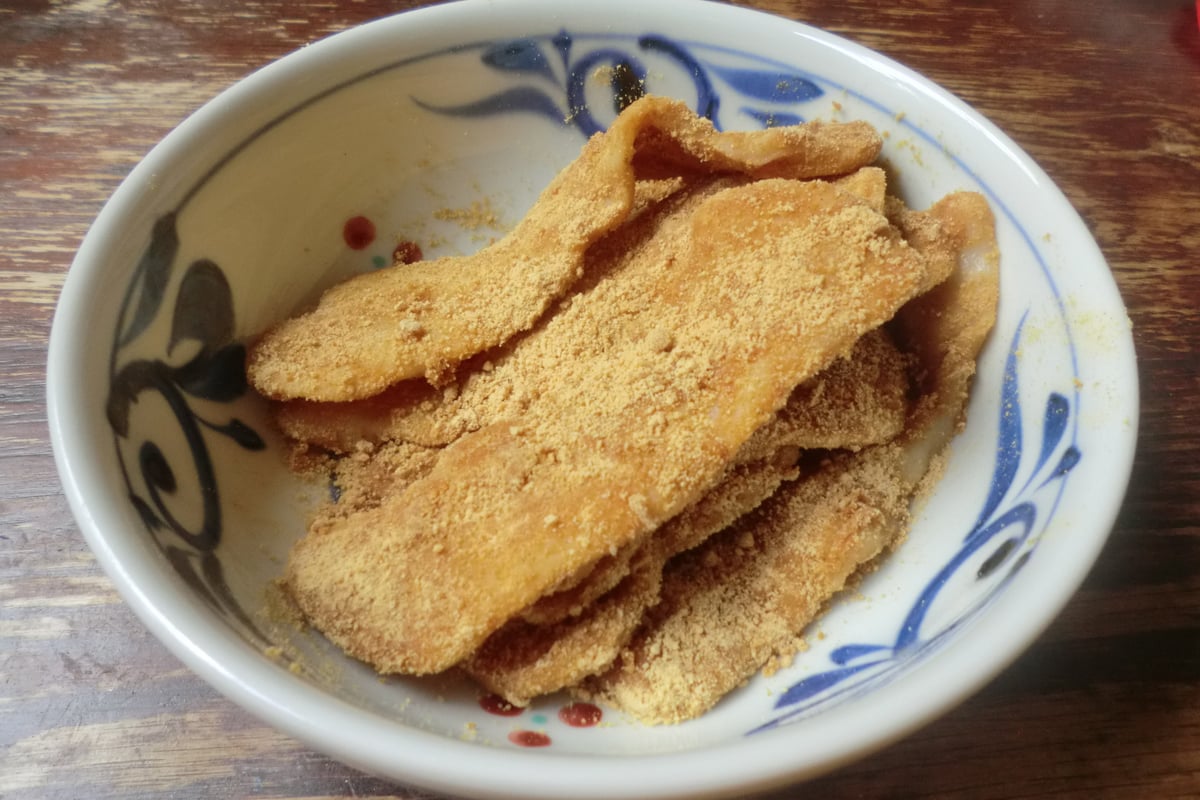
Image: Wikimedia Commons
Yaseuma is a traditional snack of Oita Prefecture made by kneading wheat flour, stretching it flat, boiling it, and coating it with kinako (roasted soybean flour) and sugar. The dough is the same as the 'dango' in Dango-jiru, and the Ministry of Agriculture, Forestry and Fisheries (MAFF) lists the entire prefecture as the area where it has been handed down. The name is said to come from a young lord in the Heian period who begged his wet nurse, Yase (八瀬), saying 'Yase, uma,' but there are other theories as well. Its birthplace is said to be the Furuno (古野) district of Hasama-machi (挾間町) in Yufu City. MAFF notes that Yaseuma is still made during Obon at Myorenji Temple (妙蓮寺) in that district. It is so rooted in everyday life that it is served in school lunches and at restaurants, while it is also used as an offering at Tanabata and Obon. Supermarkets and souvenir shops sell fresh and dried noodles for making Yaseuma. 'Bungo Meika Yaseuma,' a bite-sized wagashi version of the local dish made by a confectioner in Oita City, is also known as a souvenir.
Origin
According to MAFF, Furuno in Yufu City is said to be its birthplace. In the Heian period, Yase, a devout wet nurse, set out with the young son of a noble family to visit Myorenji Temple in Furuno. Along the way, the young lord became hungry and begged, 'Yase, uma,' so Yase stretched wheat flour dough thinly, coated it with kinako, and fed it to him. 'Uma' is a baby word meaning food. This is said to be the origin of the name, but it is only one of the traditions told about it.
History
In Oita Prefecture, grains have long been cultivated in fields, and a funshoku (flour-based food) culture using wheat flour developed. Wikipedia notes that Yaseuma was served on 'Odaishi-sama,' the memorial day of Kobo Daishi, and that at Obon it was made with kinako mixed with brown sugar and offered at the household Buddhist altar. MAFF notes that in the Furuno district, the 'Furuno Yaseuma Preservation Society' was formed and continues activities such as teaching local elementary school students. The official website of Myorenji Temple also includes a record of a year when the segaki memorial service (an offering for wandering spirits) could not be held because of the COVID-19 pandemic.
Features
In MAFF's recipe, salt and water are added to wheat flour, and the dough is kneaded and left to rest for about an hour. It is shaped into a rod, torn into thumb-sized pieces, flattened with the palm, and left to rest again. It is then stretched thin and long by hand, boiled in hot water, and coated with kinako and sugar while still warm. It is sometimes chilled before eating. It is said that the more skilled the maker, the thinner and longer the dough can be stretched. Sometimes anko (sweet bean paste) or hattaiko (roasted barley flour) is used instead of kinako, and brown sugar instead of white sugar.
Main Ingredients
Food Culture
According to MAFF, Yaseuma is also used as an offering at Tanabata and Obon. It is said that the spirits of ancestors returning to the Western Pure Land use Yaseuma as strings to tie up the offerings. It is an everyday snack and, at the same time, a food connected with seasonal events.
How It Differs from Home Cooking
At home, besides stretching the dough by hand from scratch, people sometimes use store-bought noodles made for Yaseuma. According to Wikipedia, store-bought noodles are made with noodle-making machines, and many are said to be shaped similarly to hoto. MAFF notes that sweets shops in the prefecture each serve their own creative versions of Yaseuma.
Famous Shops
甘味茶屋
大分県別府市実相寺1-4
An eatery that makes dango-jiru, Yaseuma, zenzai (sweet red bean soup), and other dishes by hand. As listed on a travel information site, Yaseuma is 330 yen including tax. Another gourmet information site lists it at 440 yen, and prices are subject to change. Please check before visiting.
View details →| 豊後銘菓やせうま(やせうま本舗 田口菓子舗) (Bungo Meika Yaseuma) | A semi-moist confection that a confectionery shop in Mitsuyoshi, Oita City, began making and selling in 1958. A filling made from kinako that the shop roasts and grinds itself is wrapped in gyuhi (soft rice-cake dough). On the official online shop, a box of 5 is 756 yen including tax. Its shape differs from that of the local dish Yaseuma. Prices are subject to change.Where to buy →PR |
|---|
FAQ
Q. Where does the name 'Yaseuma' come from?
A. The story of a young lord begging his wet nurse Yase, saying 'Yase, uma,' is widely known. Wikipedia also introduces a theory that a horse-shaped snack made from rice flour became long and thin. There is also a theory that the horses grew thin because people ate the wheat meant as horse feed (in Japanese, yase means 'thin' and uma means 'horse'), so the origin has not been settled.
Q. Is Yaseuma a horse meat dish?
A. It does not use horse meat. It is a sweet snack of flat noodles made from wheat flour and water, coated with kinako and sugar. Adding the same dough to a miso-based soup makes Oita's local dish 'Dango-jiru.'