Image: Wikimedia Commons
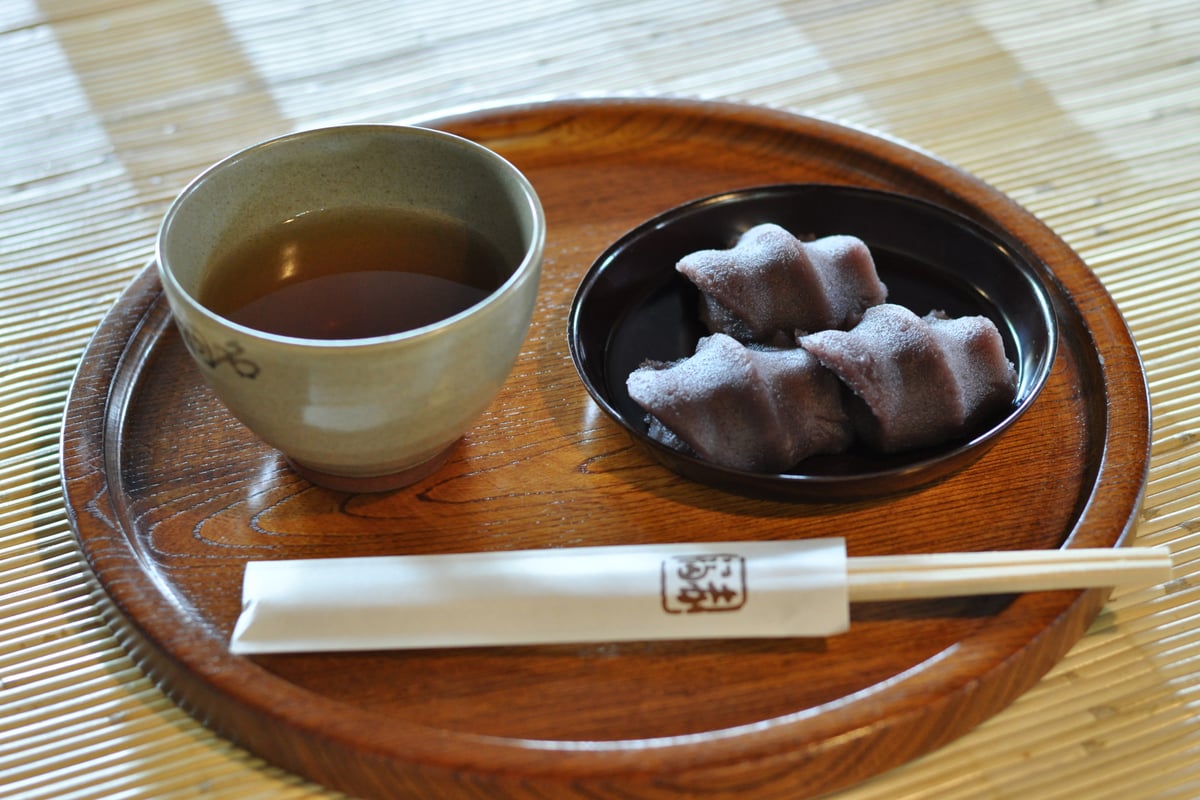
Akafuku mochi is a famous confection of Ise City, Mie Prefecture, made of soft mochi topped with smooth red bean paste (koshi-an). It is made by Akafuku, whose main store stands in Oharai-machi in front of the Naiku (Inner Shrine) of Ise Grand Shrine, and the company is said to have been founded in 1707 (Hoei 4). The three ridges pressed into the bean paste represent the clear stream of the Isuzu River, which flows through the shrine grounds. The white mochi is said to represent the pebbles lying on the riverbed. The shop name comes from the phrase 'sekishin keifuku' (赤心慶福), meaning to rejoice in the happiness of oneself and others with a sincere heart, free of falsehood like that of a newborn baby. In the Edo period, the Ise Kaido (pilgrimage road to Ise) running from Kuwana to Ise was also called the 'Mochi Road' (Mochi Kaido), and many famous mochi treats for welcoming pilgrims were born along the road. Akafuku mochi is the leading example. At the main store, you can enjoy freshly made Akafuku mochi with hojicha (roasted green tea) made with water boiled on a vermilion-lacquered kamado (hearth). 'Tsuitachi-mochi' (朔日餅), sold only on the first day of each month, is also popular.
Origin
Akafuku is said to have been founded in 1707 (Hoei 4), and it has served mochi to people on the Ise pilgrimage (Oise-mairi) since the Edo period. At the time, mochi that could be eaten quickly and kept travelers full is said to have been popular at the teahouses along the Ise Kaido. The shape of Akafuku mochi expresses the nature of Ise. The three ridges pressed into the bean paste are said to represent the flow of the Isuzu River, and the white mochi the pebbles on the riverbed.
History
In 1877 (Meiji 10), after the main store was damaged by the Isuzu River during a typhoon, it was rebuilt at its current location. In 1900 (Meiji 33), Masaoka Shiki is said to have left a haiku about Akafuku mochi. In 1911 (Meiji 44), bean paste made with white sugar was created, replacing the brown sugar (kurozato) bean paste used until then. In 1944 (Showa 19), the business closed because of controls on raw materials, and it reopened in 1949 (Showa 24). In 2007 (Heisei 19), the company was ordered to suspend business over false labeling of manufacturing dates and other information, and it resumed business the following year, 2008.
Features
Akafuku mochi is made by placing smooth red bean paste on glutinous rice mochi and finishing it with three ridges. At some stores, you can watch the artisans making it up close. As a fresh confection (namagashi) made without preservatives, it has a relatively short use-by period. Souvenir boxes include 8 pieces for about 900 yen and 12 pieces for about 1,300 yen, and there are also individual boxes for one person. Seasonal items such as Akafuku Kori (shaved ice) in summer and Akafuku Zenzai (sweet red bean soup) in winter can be enjoyed at the main store and elsewhere.
Main Ingredients
Food Culture
In Ise, there is a custom called 'tsuitachi-mairi' (朔日参り), in which people visit the shrine early in the morning on the first day of each month. In 1978 (Showa 53), Akafuku began selling 'tsuitachi-mochi' to welcome these worshippers. On the first day of every month except New Year's Day, a different mochi confection is sold each month, and many people come from early in the morning.
Famous Shops
赤福 本店
三重県伊勢市宇治中之切町26
Located in Oharai-machi in front of the Naiku of Ise Grand Shrine, in a gable-roofed (kirizuma-zukuri) building that has been in use for more than 140 years since the Meiji era. Because the shrine can be visited early in the morning, the store opens at 5 a.m. every day. On the veranda facing the Isuzu River, you can enjoy the 'Bon' set of two pieces of Akafuku mochi with hojicha for about 400 yen.
View details →| Akafuku Mochi (Gift Box) | A classic Ise souvenir; gift boxes cost about 900 yen for 8 pieces and about 1,300 yen for 12 pieces. There are also individual boxes for one person (about 400 yen). As a fresh confection made without preservatives, it has a short use-by period, so it is best eaten soon after purchase. Besides being sold within Mie Prefecture, it is also available at some stores in Nagoya and the Kansai region.Where to buy →PR |
|---|---|
| Tsuitachi-mochi | A mochi confection that changes monthly and is sold only on the first day of each month (except New Year's Day). Its contents reflect the season, and it is sold at the main store and some other stores. It is so popular that lines form from early in the morning, and some stores accept reservations.Where to buy →PR |
FAQ
Q. Do the three ridges on Akafuku mochi have a meaning?
A. Yes. The three ridges pressed into the bean paste are said to represent the clear flow of the Isuzu River, which runs through the grounds of Ise Grand Shrine. The white mochi represents the pebbles on the riverbed. As befits a confection born near the shrine, it gives shape to the scenery of Ise.
Q. Where does the name 'Akafuku' come from?
A. It is said to come from the phrase 'sekishin keifuku' (赤心慶福), meaning to rejoice in the happiness of oneself and others with a sincere heart, free of falsehood like that of a newborn baby. It is not called Akafuku because the mochi is red.
Q. What is the 'Mochi Road' of the Ise Kaido?
A. It is a name for the Ise Kaido (pilgrimage road to Ise) from Kuwana to Ise, traveled by people on the Ise pilgrimage in the Edo period. Many famous mochi were born at the teahouses along the road, and 安永餅 of Kuwana, naga-mochi (なが餅) of Yokkaichi, 関の戸 of Kameyama, henba-mochi (へんば餅) of Ise, and others are still made today.