Image: Wikimedia Commons
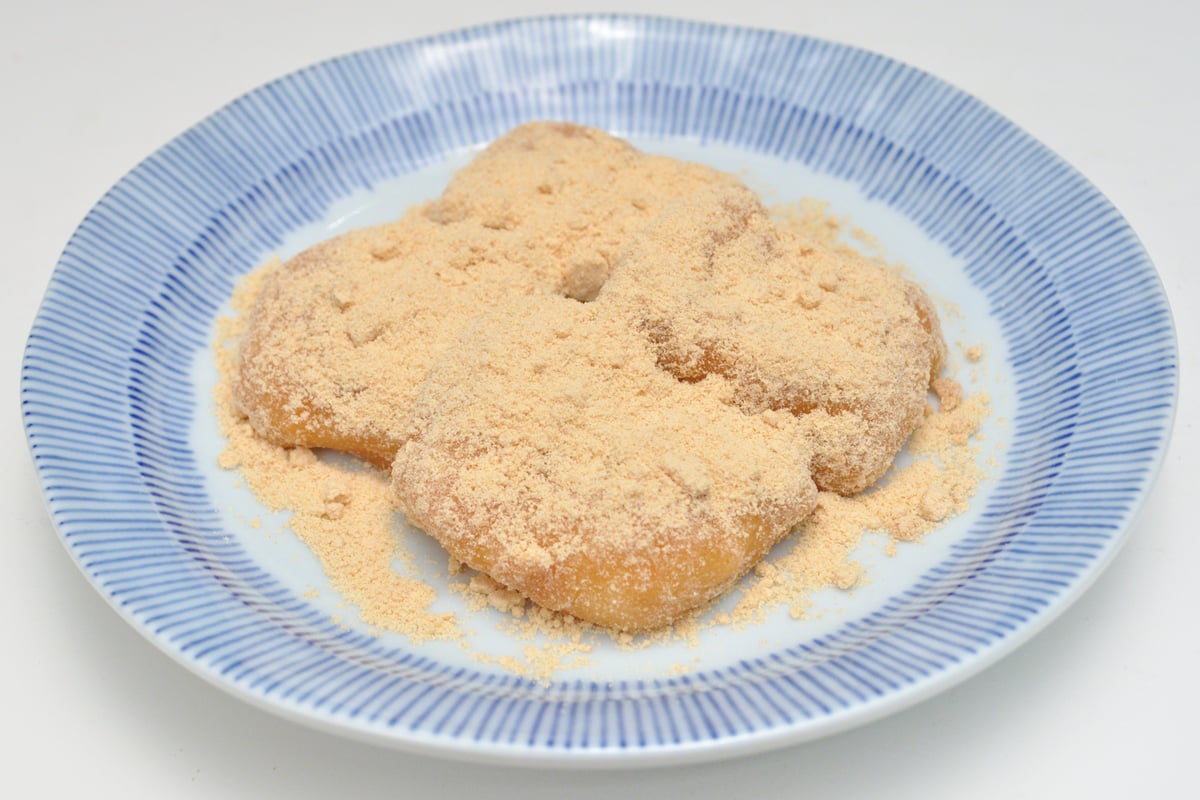
Abekawa mochi is a famous sweet of Shizuoka City made by coating freshly pounded mochi in kinako (roasted soybean flour) and sprinkling it with white sugar. It is often served together with mochi wrapped in smooth red bean paste (koshian), and since the Edo period it has been loved by travelers as a specialty of the Tokaido. The name is said to come from the fact that it became famous when sold at teahouses on the banks of the Abe River, which flows through Shizuoka City. There is also a legend that Tokugawa Ieyasu named it, and an anecdote remains that Ieyasu likened the kinako to the gold dust of the Abe River and called it 'kinako mochi' written with the character for gold (金な粉餅). In the Edo period, white sugar was very rare, so mochi topped with sugar delighted travelers. It also appears as a specialty of the Abe River in Jippensha Ikku's 'Tokaidochu Hizakurige.' During the war it disappeared because sugar became hard to obtain, but it was revived after the war. Today it can be enjoyed at long-established shops at the foot of Abekawa Bridge, and it is also loved as a classic Shizuoka souvenir.
Origin
Abekawa mochi is said to have begun in the Edo period, when it was served at teahouses by the Abe River ferry crossing. There are two theories about the origin of the name: one that Tokugawa Ieyasu named it, and one that it was named because it was a specialty of the Abe River teahouses. According to the Ieyasu anecdote, during the Keicho era (1596–1615), freshly pounded mochi coated in kinako was served to Ieyasu on the banks of the Abe River. It is said that because the kinako was called 'golden flour' (金な粉) after the gold dust from the gold mines upstream on the Abe River, Ieyasu liked it and named it 'Abekawa mochi.'
History
In the Edo period, teahouses lined Miroku, at the foot of Abekawa Bridge, and Abekawa mochi was known as a specialty of the Tokaido. Jippensha Ikku's 'Tokaidochu Hizakurige' also notes that Abekawa mochi was a specialty of Miroku. There were still many teahouses in the early Meiji period, but their number fell sharply with the opening of the Tokaido Line. During the war, it temporarily disappeared due to a shortage of white sugar, but it was revived after the war, and in 1950 (Showa 25) Abekawa mochi for souvenirs began to be sold at Shizuoka Station.
Features
The original way of making it is to coat soft, freshly pounded mochi with kinako and then sprinkle white sugar over it. Today, kinako mixed with sugar is sometimes used instead. It is common to serve kinako mochi together with mochi wrapped in koshian. In older times, it is also recorded that grilled mochi was dipped in hot water, soaked in kuromitsu (brown sugar syrup), and then coated in kinako. Long-established shops also serve 'karami mochi,' eaten with wasabi soy sauce.
Main Ingredients
Food Culture
Abekawa mochi has been loved since the Edo period as a specialty for travelers coming and going on the Tokaido. Today it is known as a souvenir sweet representing Shizuoka, and one product even ranked first in a citizens' vote under a Shizuoka City certification program. Many people enjoy it as a teatime sweet with Shizuoka green tea.
How It Differs from Home Cooking
At home, it can be made easily by softening store-bought mochi and coating it with kinako and sugar. Some long-established shops shape the mochi only after receiving an order and serve it with kinako or bean paste. Freshly pounded mochi is appealing for being soft and stretchy, but it does not keep long, so it is best eaten as soon as possible.
Famous Shops
石部屋(せきべや)
静岡県静岡市葵区弥勒2-5-24
An Abekawa mochi specialty shop at the foot of Abekawa Bridge, founded in 1804 (Bunka 1). It is said to be the only shop continuing from the teahouses of old, and it keeps to handmade production, shaping the mochi only after seeing the customer. Abekawa mochi with kinako and koshian costs about 800 yen for a set of four of each, and karami mochi with wasabi soy sauce is also available.
かごや
静岡県静岡市葵区弥勒2-4-12
An Abekawa mochi shop in Miroku near Abekawa Bridge, said to have been in business for more than 100 years. Its popular 'nama Abekawa mochi' is mochi pounded in the morning and coated with kinako or bean paste after an order is received. It is open only on Sundays, during the New Year holidays, major holiday periods, and the Obon season, and takeout starts from about 1,000 yen for 16 pieces.
| やまだいち 'Abekawa Mochi' | A classic souvenir from Shizuoka Station that combines bite-sized kinako mochi and bean-paste mochi. It went on sale at Shizuoka Station in 1950 (Showa 25). In Shizuoka City's 'Shizuoka Aoi Premium AWARD 2017,' it ranked first in the citizens' vote and was chosen for the Grand Prix. Four servings cost about 1,590 yen.Where to buy →PR |
|---|
FAQ
Q. Was Abekawa mochi named by Tokugawa Ieyasu?
A. There is one theory that Ieyasu named it and another that it got its name because it was sold at the Abe River teahouses and became a specialty. According to the Ieyasu anecdote, the kinako was likened to the gold dust of the gold mines on the Abe River, and the sweet was called 'kinako mochi' written with the character for gold (金な粉餅). The theory that Ieyasu named it has been handed down as a legend.